Virginia’s tax code includes all major tax types. The state’s individual income tax has remained stable over the past three decades. However, this stability is not necessarily a positive factor, as many states have implemented significant income tax reforms in recent years, leaving Virginia behind. With four tax brackets that are not adjusted for inflation, the state’s progressive income tax has a top marginal rate higher than several of its neighbors, including Kentucky, North Carolina, Tennessee, and West Virginia. Additionally, Virginia requires individual income tax filing and withholding for nonresidents working even a single day in the state.
While Virginia’s flat corporate income tax rate of 6 percent is around the national average, it is lower than most of Virginia’s neighbors (except North Carolina). The state conforms to the federal treatment of net operating losses, does not have a throwback rule, and does not impose statewide gross receipts or capital stock taxes. However, Virginia allows municipalities to establish local gross receipts taxes and does not permit businesses to claim bonus depreciation, which negatively impacts the state’s tax competitiveness. Implementing permanent full expensing could improve Virginia’s business tax climate.
Virginia’s sales tax rate is relatively competitive, though the state could improve by broadening its base to include more consumer services (but not business inputs). In recent years, local and regional sales tax authority has been expanded.
Virginia does not impose estate or inheritance taxes, making it more appealing to wealthy households and retirees. Most of Virginia’s shortcomings are at the local level, with a trio of taxes on business personal property (with no de minimis exemption), business inventory, and business gross receipts. Counties and independent cities are entitled to impose their choice of two of these three taxes.
Privacy concerns are a primary driver of opposition to vehicle miles traveled (VMT) tax systems, but VMT taxes do not need to invade drivers’ privacy to efficiently fund the roads.
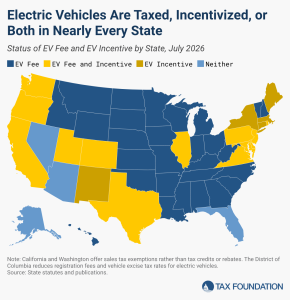
As the market share of electric vehicles (EVs) on the road grows, the gas tax’s ability to fund road projects and decrease traffic congestion erodes. Both federal and state real tax revenue per vehicle mile traveled has been on a steady decline for decades, creating a fiscal gap for road expenditures even as the demand for road infrastructure improvements has grown.
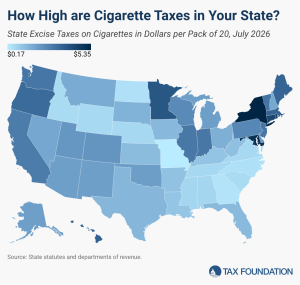
The highest state tax on cigarettes is levied by New York at $5.35 per pack of 20. The next highest tax jurisdiction is the District of Columbia at $5.07 per pack of cigarettes, followed closely by Maryland at $5.00 per pack, Rhode Island at $4.50 per pack, and Connecticut at $4.35 per pack.