Vehicle miles traveled (VMT) taxes have become a prominent consideration for governments at all levels struggling to fund their roads, but privacy fears have blocked much implementation. Americans are not unreasonable to worry about an unconstitutional surveillance program under the guise of a VMT taxA tax is a mandatory payment or charge collected by local, state, and national governments from individuals or businesses to cover the costs of general government services, goods, and activities., but a properly designed VMT tax need not invade drivers’ privacy.
With both the federal Highway Trust Fund and state road programs failing to provide enough road funding with existing road user fees, policymakers need a better option. A VMT tax is a more efficient user fee for the roads than the gas taxA gas tax is commonly used to describe the variety of taxes levied on gasoline at both the federal and state levels, to provide funds for highway repair and maintenance, as well as for other government infrastructure projects. These taxes are levied in a few ways, including per-gallon excise taxes, excise taxes imposed on wholesalers, and general sales taxes that apply to the purchase of gasoline. and various other additional taxes and fees.
A VMT tax charges drivers per mile they drive on government roads to cover the costs of building and maintaining those roads. Adjusting this charge according to the weight of the vehicle, which affects the amount of damage that driving does, establishes a neutral and direct user feeA user fee is a charge imposed by the government for the primary purpose of covering the cost of providing a service, directly raising funds from the people who benefit from the particular public good or service being provided. A user fee is not a tax, though some taxes may be labeled as user fees or closely resemble them. for the roads.
A VMT tax would be simpler than the myriad taxes and fees currently levied—one tax to replace many. It’s also more neutral: it doesn’t unduly favor one type of engine, like electric vehicles over gas-powered, nor does it unduly burden one type of driving, like a retail delivery fee or rental car tax would.
A VMT tax is more transparent as well. Indeed, what could be more transparent than establishing the price of a mile? The current system obfuscates the true cost of the roads by spreading that burden across many taxes. Sometimes, it even hides the burden of environmental programs by lumping them into what users think is the price they pay for roads.
A VMT tax is also more stable. No updates would be needed to accommodate more prevalent electric vehicles. No additional tax per gram of thorium in a nuclear fuel cell would be needed to make sure the drivers of the future are paying their fair share. The VMT tax is largely future-proof.
If a VMT tax is more principled, has modeling to show its capacity to fund the roads, and has existing programs to demonstrate its administrative feasibility, why does it face so much opposition?
Privacy. The strongest opposition to a VMT tax is out of concern for drivers’ privacy.
This concern was well-expressed by Governor Ron DeSantis (R-Florida), who posted on X in response to Tax Foundation’s analysis of the viability of VMT taxes to solve ongoing funding issues with state transportation systems:
Vehicle Miles Driven (VMT) taxes require the government to surveil movements and violates individual privacy.
This may be implemented in states like California, and some have argued that other states should follow.
No dice. https://t.co/LTOef4dZ3v
— Ron DeSantis (@RonDeSantis) November 18, 2025
While the public and policymakers should be wary of privacy violations, a properly implemented VMT tax can avoid them.
Ongoing Transgressions Against Drivers’ Privacy
The public cannot be faulted for worrying about the privacy of drivers under a VMT tax, given the present landscape of ongoing and escalating transgressions against that privacy.
Most notable is the rise in automated license plate reader (ALPR) cameras. These ALPR cameras scan every license plate that passes within their field of view, store the record of who was driving where and when, and create a searchable database of that information.
Nearly 100,000 of these cameras have been documented by the open-source mapping project DeFlock, and the US Border Patrol is already using them for AI-powered “predictive policing.” The mass network of warrantless domestic surveillance this has created has sparked much backlash, including the Plate Privacy Project by the Institute for Justice to challenge these violations in court.
Governor DeSantis was quick to oppose surveillance from VMT taxes; however, license plate cameras are widely used by Florida’s Toll-By-Plate system to supplement its SunPass (EZ-pass) program for Florida’s many toll roads. DeFlock identified more than 5,000 ALPR cameras in the state of Florida—the 5th most per road mile.
Further privacy concerns arise from the 2021 Infrastructure Investment and Jobs Act, which included a vehicle “kill switch” provision. The law mandates new vehicles to have a surveillance system that can “passively monitor the performance of a driver” and prevent operation if impairment is perceived.
It is not yet clear how that provision is to be implemented, or when—as it has already been delayed once. If it is implemented, the mandate will add to the long list of ways that vehicles track their drivers.
Amid a field of vehicle-centered privacy violations, it is perfectly reasonable to be skeptical of another monitoring program. But a VMT tax is not and could not legally be a monitoring program.
Privacy-Conscious VMT Tax Design
Policymakers should do more for privacy than grandstand on social media. They should design their policies with respect for privacy, even if only to get public support for and avoid legal challenges to the optimal way to fund government roads.
A VMT tax does not require invading drivers’ privacy. There is no need to track drivers’ locations or driving patterns. It does not need to know where, when, how, or why driving occurs. It requires exactly one piece of information: the total miles driven on government roads. That information can be supplied to the government in multiple ways
- Annual odometer readings can identify miles driven.
The Washington state pilot program showed that reporting odometer readings, especially with an accompanying photograph, is a perfectly viable way of facilitating a VMT tax. To accommodate for miles driven on private roads or otherwise outside of the applicable jurisdiction, a standard exemption for non-chargeable miles can be given, and drivers would have the opportunity to provide documentation of any non-taxable driving in excess of that standard exemption.
- Location-specific data can be collected by a third party and only total mileage shared with government.
Privacy concerns don’t mean that governments can’t offer location-based reporting options, only that they cannot require them. Location-based reporting options, especially with strong data anonymization and security policies, may be the optimal choice for many drivers.
Millions of Americans currently opt in to voluntary driving monitoring programs from their insurance companies. These systems use in-vehicle devices, paired with phone apps, to track not only miles driven but also driving behaviors like speed, acceleration, deceleration, and adherence to local roadway rules.
With the use of a third-party commercial account manager (CAM), the granular data on driving activity can be collected, secured, and aggregated, with only the aggregated mileage total shared with the taxing body.
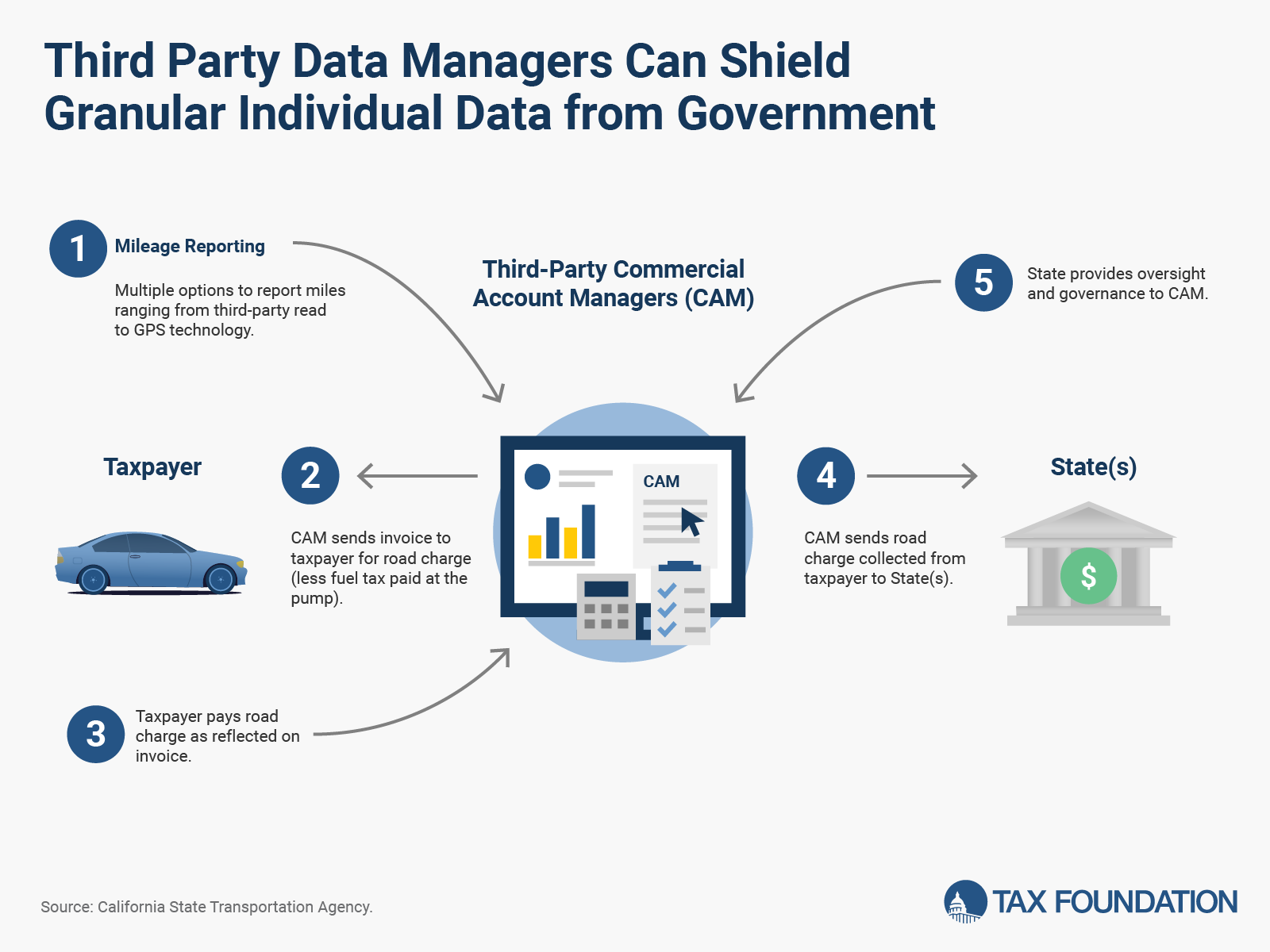
California has piloted programs with multiple CAMs and multiple location-tracking tools. They have also tested odometer readings to measure road use. All methods suggest VMT viability.
The public is wary of government surveillance programs—and for good reason. Fortunately, VMT taxes do not require government surveillance.
Policymakers that do not attach a surveillance program to their VMT tax regime are much more likely to garner both public consent and the constitutional go-ahead. Both are likely to be necessary to ensure that transportation systems receive sufficient, reliable, and principled funding in the future.
Stay informed on the tax policies impacting you.
Subscribe to our free newsletter to get the latest tax data, news and analysis.
Subscribe