Real Property Taxes in Europe, 2026
High property taxes levied not only on land but also on buildings and structures can discourage investment in infrastructure, which businesses would have to pay additional tax on.
3 min read
Massachusetts ranks among the bottom 10 states on the Index due to its overly burdensome individual income taxes, property taxes, and UI taxes. In 2022, Massachusetts voters amended the state constitution to impose an additional 4 percent surtax on income greater than $1 million, dismantling the state’s formerly competitive flat income tax and making Massachusetts less attractive for productive households and businesses. The Commonwealth is also an outlier in imposing a separate payroll tax for non-UI purposes.
Additionally, Massachusetts’ so-called corporate excise tax, which has a capital stock base component, imposes high burdens on businesses with large amounts of capital in Massachusetts and includes a throwback rule that exposes Massachusetts’ businesses to high tax burdens when they sell tangible property into states with which they do not have nexus. Furthermore, the state does not offer first-year expensing, discouraging in-state investment. Massachusetts also has an overly burdensome UI tax, with high rates, a solvency tax and surtax, and a lengthy experience rating qualifying period.
In addition to its hefty income tax burdens, especially for businesses, Massachusetts’ property taxes are among the highest in the nation, and the base includes some business inventory, though a levy limit, conventionally called Proposition 2 ½, does help reduce the further growth of property taxes. The state taxes commercial property more heavily than residential property, adding to businesses’ tax burdens. Additionally, Massachusetts levies both an estate tax and a real estate transfer tax.
| Category | Rank | Rank Change | Score |
|---|---|---|---|
| Overall | 43 | 0 | 4.45 |
| Corporate Taxes | 33 | 0 | 4.94 |
| Individual Income Taxes | 42 | -1 | 4.58 |
| Sales Taxes | 22 | -1 | 4.85 |
| Property Taxes | 48 | -2 | 3.35 |
| Unemployment Insurance Taxes | 45 | 1 | 3.86 |


Get facts about taxes in your state and around the US
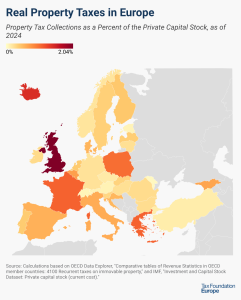
High property taxes levied not only on land but also on buildings and structures can discourage investment in infrastructure, which businesses would have to pay additional tax on.
3 min read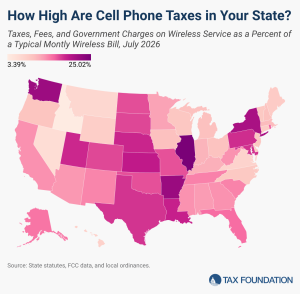
Applying the sales tax, a traditional broad-based consumption tax, is perfectly appropriate, but excessive targeted taxation of wireless services lacks the traditional justifications—a user-pays system or the internalization of social costs—for excise taxation, raising consumer costs and discouraging investment.
5 min read
California levies the highest tax on gasoline at 73.6 cents per gallon (cpg), followed by Illinois at 70.4 cpg and Indiana at 63.1 cpg.
10 min read