TaxA tax is a mandatory payment or charge collected by local, state, and national governments from individuals or businesses to cover the costs of general government services, goods, and activities. treatment of electric vehicles (EVs) can be contradictory. On one hand, EVs generate lower emissions than internal combustion engine vehicles and can run on sustainably generated, renewable electricity. This suggests EVs receive tax-preferred status from an environmental perspective. However, EV users don’t pay the gas taxA gas tax is commonly used to describe the variety of taxes levied on gasoline at both the federal and state levels, to provide funds for highway repair and maintenance, as well as for other government infrastructure projects. These taxes are levied in a few ways, including per-gallon excise taxes, excise taxes imposed on wholesalers, and general sales taxes that apply to the purchase of gasoline.. By not paying gasoline taxes, states need to find ways to charge EV drivers for their road usage, suggesting higher taxes and fees.
States fund most of their transportation infrastructure with revenues from gasoline taxes. The rationale is intuitive: the more people use public roads, the more gasoline they consume, making the gas tax a well-designed user feeA user fee is a charge imposed by the government for the primary purpose of covering the cost of providing a service, directly raising funds from the people who benefit from the particular public good or service being provided. A user fee is not a tax, though some taxes may be labeled as user fees or closely resemble them..
In recent years, technology has complicated the equation. Real tax revenue per vehicle mile traveled (VMT) have fallen steadily for decades due to the combination of stagnant gas tax rates, the development of increasingly fuel-efficient automobiles, and the steady erosion of inflationInflation is when the general price of goods and services increases across the economy, reducing the purchasing power of a currency and the value of certain assets. The same paycheck covers less goods, services, and bills. It is sometimes referred to as a “hidden tax,” as it leaves taxpayers less well-off due to higher costs and “bracket creep,” while increasing the government’s spendin. With the prevalence of EVs rising, the fiscal gap for transportation grows and states are seeking alternate ways to raise revenue.
Most states impose additional fees on EVs. These fees range from $50 in Hawaii up to $270 in New Jersey. These fees are trending upwards—fourteen states increased their EV fees recently, from small inflation adjustments up to major changes (e.g., an additional $100 in Michigan).
Contrary to fees, 15 states offer tax credits or rebates, ranging from $500 dollars in New York to $8,000 in Maine. Federal income tax credits for EV purchases, however, ended in 2025. Many states have similarly phased out their tax incentives over the last couple years; Rhode Island increased their standard rebate recently, bucking the general trend.

States Apply a Variety of Tax Treatments to Electric Vehicles
Electric Vehicle Annual Fees and Purchase Incentives by State, July 2026
| State | Electric Vehicle Fee | Plug-In Hybrid Electric Vehicle Fee | Purchase Incentives |
|---|---|---|---|
| Alabama | $203 | $103 | None |
| Alaska | $0 | $0 | None |
| Arizona | $0 | $0 | None |
| Arkansas | $200 | $100 | None |
| California | $121 | $0 | Sales Tax Exemption (a) |
| Colorado | $89.05 | $76.05 | $750-$3,250 Credit (b) |
| Connecticut | $0 | $0 | $500-$5,000 Rebate (c) |
| Delaware | $110 (n) | $85 (n) | $1,000-$2,500 Rebate (d) |
| Florida | $0 | $0 | None |
| Georgia | $273.59 (e) (f) | $273.59 (e) (f) | None |
| Hawaii | $50 (g) | $0 | None |
| Idaho | $140 | $75 | None |
| Illinois | $100 | $0 | $2,000-$4,000 Rebate (h) |
| Indiana | $242 | $81 | None |
| Iowa | $130 (i) | $65 (i) | None |
| Kansas | $135 (j) | $70 (j) | None |
| Kentucky | $126 (i) | $126 (i) | None |
| Louisiana | $110 | $60 | None |
| Maine | $0 | $0 | $3,000-$8,000 Rebate (k) |
| Maryland | $125 | $100 | $3,000 Credit (l) (m) |
| Massachusetts | $0 | $0 | $3,500-$6,000 Rebate (n) |
| Michigan | $267 (o) | $113 (o) | None |
| Minnesota | $150 (o) | $75 (o) | None |
| Mississippi | $150 | $75 | None |
| Missouri | $150 | $75 | None |
| Montana | $130 (o) | $70 (o) | None |
| Nebraska | $150 | $75 | None |
| Nevada | $0 | $0 | None |
| New Hampshire | $100 | $50 | None |
| New Jersey | $270 | $270 | $1,500-$4,000 Rebate (p) |
| New Mexico | $0 | $0 | $2,000-$3,000 Credit (q) |
| New York | $0 | $0 | $500-$2,000 Rebate (r) |
| North Carolina | $214.50 | $107.25 | None |
| North Dakota | $120 | $50 | None |
| Ohio | $200 | $150 | None |
| Oklahoma | $110 (i) (o) | $82 (i) (o) | None |
| Oregon | $115 (g) | $35 | $1,500-$7,500 Rebate (m) (s) |
| Pennsylvania | $250 | $63 | $1,500-$4,000 Rebate (t) |
| Rhode Island | $200 | $100 | $1,750-$4,500 Rebate (u) |
| South Carolina | $60 | $30 | None |
| South Dakota | $100 | $0 | None |
| Tennessee | $200 | $100 | None |
| Texas | $200 (e) | $0 | $2,500 Rebate (m) (v) |
| Utah | $187.50 (g) (o) | $71.50 | $4,000-$10,000 Grant (w) |
| Vermont | $89 | $44.50 | None |
| Virginia | $135.63 (g) | $7.05-$103.48 (g) (o) | $2,500-$4,500 Rebate (m) (x) |
| Washington | $225 | $225 | Sales Tax Exemption (a) |
| West Virginia | $200 | $100 | None |
| Wisconsin | $175 (i) | $75 (i) | None |
| Wyoming | $100 (i) | $50 (i) | None |
| District of Columbia | $0 | $0 | None (y) |
(a) Purchases of EVs may qualify for an exemption from the state sales tax.
(b) Purchases or leases of EVs or PHEVs with an MSRP of $80,000 or less qualify for a $750 income tax credit. Vehicles with an MSRP of $35,000 or less qualify for $3,250. Rideshare drivers also receive a reduced rideshare fee when driving a zero-emission vehicle.
(c) Purchases of leases of EVs or PHEVs with an MSRP of $50,000 qualify for a $1,000 or $500 rebate, respectively. Low-income applicants qualify for an additional $1,500 for new PHEVs, $2,500 for used PHEVs, $3,000 for new EVs, and $4,000 for used EVs, totaling a maximum rebate of $5,000 for low-income applicants purchasing or leasing a used EV. Electric vehicle drivers in Connecticut also avoid the state's $15 Clean Air Act fee and $40 Emissions Exemption fee on a biennial basis.
(d) EVs purchased new or used for less than $40,000 may qualify for a $2,500 rebate. EVs purchased new for $50,000 or less may qualify for a $1,500 rebate. PHEVs purchased new with an MSRP not more than $50,000 or purchased used with a fair price less than $40,000 may qualify for a $1,000 rebate.
(e) Does not include an additional one-time fee. Georgia charges a $25 AFV license plate manufacturing fee. Texas levies an initial registration fee of $400 rather than the $200 renewal fee.
(f) Includes both the annual Alternative Fuel Vehicle license fee and Alternative Fuel Vehicle license plate fee.
(g) Drivers may choose to enroll in the state's VMT tax program to pay a per-mile rate rather than an annual flat fee.
(h) Qualifying purchasers of a new or used EV with a selling price of $80,000 or less may qualify for a $2,000 rebate. Low-income applicants may qualify for an additional $2,000 rebate, totaling $4,000.
(i) Some electricity for EV charging also subject to excise tax.
(j) Kansas levies an increased registration fee on EVs and PHEVs, rather than a separate surcharge. The fee shown represents the additional amount EVs and PHEVs must pay to register compared to internal combustion engine cars whose registration costs $30.
(k) Qualifying purchasers of a new EV with a price of $55,000 or less may qualify for a $6,000 rebate, or a $3,000 rebate for a used EV with a price of $40,000 or less. Low-income applicants may qualify for an additional rebate, totaling $8,000 for a new EV or $4,000 for a used EV. These figures include a $1,000 bonus rebate that is set to expire September 30, 2026.
(l) Qualifying purchases of EVs or PHEVs may qualify for a $3,000 credit against the 6.5% tax Maryland levies on the fair market value of vehicles.
(m) Incentive program still exists and is operational, but has no funds remaining and thus is not accepting new applicants.
(n) Qualifying purchases or leases of new or user Zero Emission Vehicles with an MSRP of $55,000 or less may qualify for a $3,500 rebate. Low-income applicants may qualify for an additional $1,500 rebate. An additional $1,000 rebate is available when trading in a qualified vehicle, totaling a maximum rebate of $6,000 for most drivers. An additional rebate of $6,500 to $17,500 is available to qualifying taxi, livery, or rideshare drivers switching to an electric vehicle.
(o) Fee shown represents the standard or minimum rate. Actual rate may vary by vehicle weight, MPG, age, MSRP, or other factor.
(p) Qualifying purchases or leases of EVs with an MSRP of $55,000 or less may qualify for a $1,500 rebate. Applicants with a modified adjusted gross income of $75,000 or less or who are enrolled in certain public assistance programs may qualify for an additional rebate, totaling $4,000.
(q) Qualifying purchases of new EVs with an MSRP of $55,000 or less may qualify for a $3,000 income tax credit. New PHEVs or used EVs may qualify for a $2,500 credit, and used PHEVs may qualify for a $2,000 credit.
(r) Qualifying purchases or leases of EVs or PHEVs with more than 200 miles of range and an MSRP of $42,000 or less may qualify for a $2,000 rebate. Vehicles with more than 40, but less than 200, may qualify for a $1,000 rebate. Vehicles with less than 40 miles of range or whose MSRP is greater than $42,000 may qualify for a $500 rebate.
(s) Qualifying purchases or leases of new EVs or PHEVs with an MSRP less than $50,000 may qualify for a $1,500 rebate for vehicles with a battery capacity less than 10 kWh or $2,500 for vehicles with a battery capacity 10 kWh or greater. Low-income applicants may qualify for an increased rebate of $5,000 for a used vehicle or $7,500 for a new vehicle.
(t) Qualifying purchasers of new or used EVs with a price of $45,000 or less may qualify for a $3,000 rebate, or a $1,500 rebate for PHEVs. Low-income applicants may qualify for an additional $1,000 rebate, totaling a maximum of $4,000.
(u) Qualifying purchases or leases of new EVs with a price of $75,000 or less may qualify for a $3,000 rebate, or a $2,500 rebate for used EVs with a price of $55,000 or less. New PHEVs may qualify for a $2,000 rebate or used PHEVs may qualify for a $1,750 rebate. An additional $1,500 rebate is available for low-income applicants, totaling a maximum of $4,500.
(v) Qualifying purchases or leases of new EVs or PHEVs may qualify for a $2,500 rebate.
(w) Utah's Electric Vehicle Replacement Assistance Program provides grants for low-income applicants to replace a gas or diesel powered vehicle that is eight years old or older or failed an emissions test within 30 days with a new or used EV with a price of $48,125 or less. Grants are up to $4,000 for applicants whose income is 401% to 500% of the federal poverty level, up to $7,000 for applicants whose income is 301% to 400% of the federal poverty level, or up to $10,000 for applicants whose income is 300% or less of the federal poverty level.
(x) Qualifying purchases of new or used EVs with a price of $25,000 or less may qualify for a $2,500 rebate. An additional $2,000 rebate is available for low-income applicants, totaling a maximum of $4,500.
(y) EVs qualify for a reduced registration fee, avoiding $30 or $135 per year depending on weight, as well as a reduced vehicle excise tax rate which scales based on weight and fuel efficiency. Electric vehicles are taxed at 1% to 3% while combustion vehicles are taxed at 1.5% to 11%.
Data compiled by Jacob Macumber-Rosin, Cole Kellison, Violet Lamptey, Adam Hoffer
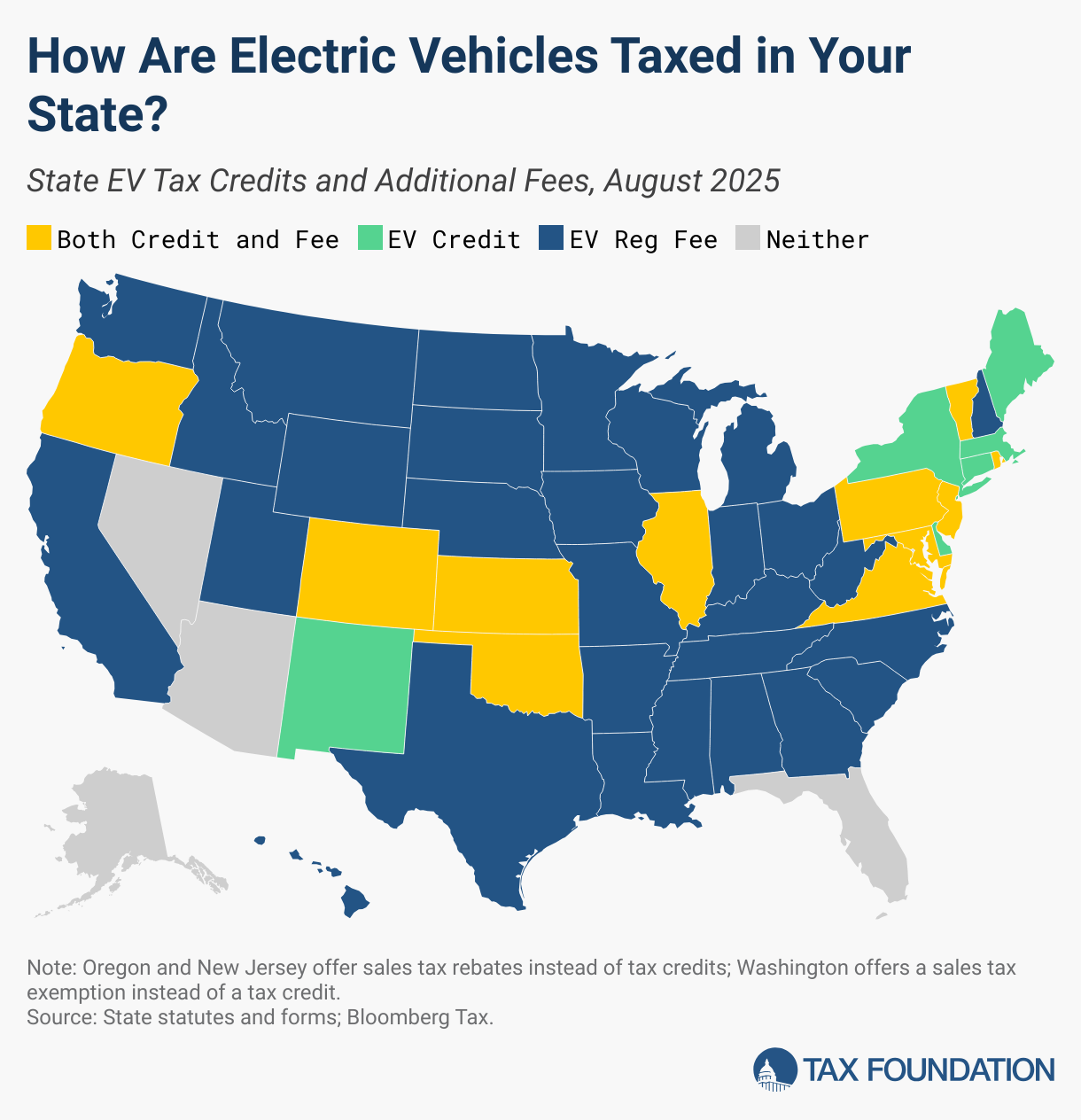
States Apply a Variety of Tax Treatments to Electric Vehicles
US State EV Purchase Tax Credits and Annual Registration Fees, 2025
| State | EV Purchase Tax Credit | EV Annual Registration Fee | Hybrid Annual Registration Fee |
|---|---|---|---|
| Alabama | 0 | 203 | 103 |
| Alaska | 0 | 0 | 0 |
| Arizona | 0 | 0 | 0 |
| Arkansas | 0 | 200 | 100 (a) |
| California | 0 (b) | 118 | 0 |
| Colorado | 3500 | 60.05 | 0 |
| Connecticut | 750-5,000 | 0 | 0 |
| Delaware | 1,000-2,500 (c) | 0 | 0 |
| Florida | 0 (d) | 0 | 0 |
| Georgia | 0 | 234.97 | 0 |
| Hawaii | 0 | 50 | 0 |
| Idaho | 0 | 140 | 75 |
| Illinois | 4,000 (e) | 100 | 0 |
| Indiana | 0 | 230 | 77 |
| Iowa | 0 | 130 | 65 (a) |
| Kansas | Up to 4000 | 165 | 70 |
| Kentucky | 0 | 120 | 60 |
| Louisiana | 0 | 110 | 60 (a) |
| Maine | Up to 7,500 (f) | 0 | 0 |
| Maryland | 3,000 (g) | 125 | 100 (a) |
| Massachusetts | Up to 3,500 | 0 | 0 |
| Michigan | 0 | 160 | 60 (a) |
| Minnesota | 0 | 75 | 0 |
| Mississippi | 0 (d) | 150 | 75 |
| Missouri | 0 | 135 | 67.5 |
| Montana | 0 | 130-190 | 70-100 |
| Nebraska | 0 | 150 | 75 |
| Nevada | 0 (d) | 0 | 0 |
| New Hampshire | 0 (d) | 100 | 50 |
| New Jersey | Up to 4,000 (b)(h) | 260 | 0 |
| New Mexico | Up to 3000 | 0 | 0 |
| New York | Up to 2,000 | 0 | 0 |
| North Carolina | 0 | 214.5 | 107.25 |
| North Dakota | 0 | 120 | 50 |
| Ohio | 0 | 200 | 150 (a) |
| Oklahoma | Up to 5,500 | 110 | 82 (a) |
| Oregon | Up to 7,500 (f) (h) | 115 (i) | 35 (i) (j) |
| Pennsylvania | Up to 3,000 (f) (k) | 200 | 50 |
| Rhode Island | Up to 1,500 | 200 | 100 (a) |
| South Carolina | 0 | 60 (m) | 30 (m) |
| South Dakota | 0 | 50 | 0 |
| Tennessee | 0 | 200 | 100 |
| Texas | 0 | 200 (n) | 0 |
| Utah | 0 | 130.25 (o) | 56.5 (a)(o) |
| Vermont | Up to 5,000 (c) | 89 | 44.5 |
| Virginia | 2,500 | 131.88 (l) | 0 (l) |
| Washington | 0 (e) | 150 | 75 (a) |
| West Virginia | 0 | 200 | 100 |
| Wisconsin | 0 | 175 | 75 (a) |
| Wyoming | 0 | 200 | 0 |
(a) Value listed is for plug in hybrids only.
(b) Partial sales and use tax exemption.
(c) Funding currently exhausted; expected to resume mid-2026.
(d) Rebates available through municipalities.
(e) EV purchase is exempt from sales tax.
(f) Credit amount depends on income level.
(g) Credit applies only to vehicles priced below $50,000.
(h) Available as a rebate, not a tax credit.
(i) Drivers may opt into a $0.02/mile pay-as-you-go system with an $86 annual registration fee.
(j) Hybrid registration fee applies to high-MPG vehicles generally, not just hybrids.
(k) Limited to 500 rebates for July 2025 – July 2026.
(l) Calculated as a function of vehicle miles driven; set at $131.88 for EVs.
(m) Fee levied biennially.
(n) $400 for new EV registrations, $200 for renewals.
(o) Users may elect to pay $0.0111 per mile driven instead.
Source: State departments of transportation; state statutes; author calculations
Data compiled by Brayden Myers , Jacob Macumber-Rosin, Adam Hoffer

Major Changes as of July 2026:
- Oklahoma and Vermont ended their electric vehicle tax creditA tax credit is a provision that reduces a taxpayer’s final tax bill, dollar-for-dollar. A tax credit differs from deductions and exemptions, which reduce taxable income rather than the taxpayer’s tax bill directly. programs.
- Rhode Island increased their standard EV rebate from $1,500 to $3,000.
- Delaware introduced a new registration fee at $110 for EVs and $85 for hybrids.
- Colorado, Michigan, Minnesota, Missouri, New Jersey, Pennsylvania, and Utah raised their registration fees substantially.
- California, Georgia, Indiana, Kansas, and Kentucky raised their registration fees to adjust for inflation.
- Wyoming reduced their EV fee as part of a broader reform to equalize the tax treatment of electric and combustion vehicles.
- Many state incentive programs have exhausted the funds they were allocated and have closed to new applicants, though may be reopened with new funding.
Of the 41 states that levy a fee, 40 of them earmark the revenues mostly for transportation. Six states divert some of the revenues to unrelated transportation programs like mass transit, two states divert small portions of the revenue to unrelated spending like tourist promotion, and three states dedicate some portion of the fees to the general fund. In Rhode Island, fee revenues are entirely sent to the state’s general fund.
Thirteen states both offer an incentive for the purchase of an EV and impose an additional fee for them compared to combustion engine vehicles. This disjointed circumstance arises as states try to further two goals with one taxed product.
States have also tried to innovate with other policies aimed at backfilling reductions in gas tax revenue. Iowa, Kentucky, Oklahoma, Wisconsin, and Wyoming have imposed a tax per kilowatt-hour distributed by charging stations. Other states like Georgia and Minnesota have legislated one to go into effect next year. This is aimed to further equalize the treatment of internal combustion engine vehicles and electric vehicles, but can create behavioral distortions. Firstly, it effectively disincentivizes charging stations. Additionally, it encourages charging electric vehicles at home to avoid the tax, thus undermining its effectiveness at coupling taxes paid to road use.
It can also lead to EV drivers being effectively double taxed. If annual fees are calibrated to recoup lost gas taxes and an excise taxAn excise tax is a tax imposed on a specific good or activity. Excise taxes are commonly levied on cigarettes, alcoholic beverages, soda, gasoline, insurance premiums, amusement activities, and betting, and typically make up a relatively small and volatile portion of state and local and, to a lesser extent, federal tax collections. per gasoline gallon equivalent is levied on charging, EVs would have twice the effective tax burden as a gas-powered car. Such a discrepancy, along with sales of electricity for EV charging being subject to sales taxA sales tax is levied on retail sales of goods and services and, ideally, should apply to all final consumption with few exemptions. Many governments exempt goods like groceries; base broadening, such as including groceries, could keep rates lower. A sales tax should exempt business-to-business transactions which, when taxed, cause tax pyramiding. while gasoline sales were not, was addressed by the Wyoming legislature earlier this year.
Both additional fees and charging station taxes are attempts to approximate a user fee for EVs, but both fall short. A simpler solution would be to implement a VMT tax.
A VMT tax is levied on the number of miles traveled by an individual vehicle. This is usually done by odometer reading or through a GPS device. While there are privacy concerns with the use of GPS devices to track VMT, relying purely on odometer readings can result in drivers being charged for miles driven outside of the taxing jurisdiction. A pilot program in Washington found that a standard exemption for non-taxable miles solves that problem for most drivers.
Moreover, as devices and apps used by insurance providers to track safe driving become commonplace, similar tools could be used to directly link the miles traveled to public road and infrastructure spending in the proper jurisdiction.
A VMT tax essentially prices a mile of driving on government roads, a much better proxy user fee for road use than either the gas tax or EV fees. States need not add a fee for EVs, tax charging per kilowatt-hour, tax by the gasoline gallon equivalent of propane or natural gas, or levy a per-gram of thorium tax for nuclear powered cars of the theoretical future. Instead, they can simply tax per mile driven—regardless of how, where, when, or why.
Currently, four states have active VMT tax programs:
- Oregon drivers with vehicles rated above 20 MPG are allowed to opt to pay $0.02 per mile driven instead of the state’s $115 electric vehicle registration fee. Miles traveled are tracked by either an odometer plugin or a telematic device. This was enacted in 2013.
- Utah electric vehicle drivers may opt to pay $0.0125 per mile driven, up to the value of the state’s electric vehicle registration fee. This is tracked via an app. The program was enacted in 2020.
- Virginia allows drivers with vehicles rated above 25 MPG to opt into a per mile payment based on the vehicle’s fuel efficiency. For electric vehicle drivers, this value is set to $0.0117 per mile. Mileage is tracked via an OBD plugin. This was enacted in 2022.
- Hawaii began the HiRUC program on July 1, 2025, allowing electric vehicle drivers to pay either $0.008 per mile or a $50 flat fee. The mileage is measured by odometer reading. Because of the state’s unique geographic situation, odometer-only reporting will likely avoid the issue of taxing out-of-state travel. This was enacted in 2025.
Vermont was expected to begin a similar program in 2025, but implementation has been postponed to 2027. Additionally, California and Washington have run significant VMT pilot programs.
The current trends in EV taxation reflect the once novel technology becoming increasingly mainstream. Now that states are increasingly thinking about EV policy in terms of making up revenue rather than incentivizing their adoption at cost, the EV market will adjust. In turn, as EV technology and adoption continues, it’s likely that tax policies will also adapt.
Stay informed on the tax policies impacting you.
Subscribe to our free newsletter to get the latest tax data, news and analysis.
Subscribe