In recent years, Oklahoma lawmakers have adopted several structural reforms, including eliminating the income tax’s marriage penalty and repealing a capital stock tax. In 2025, lawmakers again reformed the individual income tax by reducing the top marginal rate to 4.5 percent, consolidating six brackets into three, and providing fiscal safeguards for future triggered rate reductions. These changes take effect in 2026. However, lawmakers have yet to index the code for inflation. This leaves taxpayers vulnerable to bracket creep, which occurs when inflation pushes a taxpayer from a lower bracket to a higher one when nominal income rises, but due to inflation, real income does not, or may even decline.
Oklahoma’s property taxes are relatively low, and the state has benefited from the repeal of the capital stock tax. Capital stock taxes are imposed on a business’s net worth (or accumulated wealth) and tend to penalize investment. Moreover, businesses are required to pay the capital stock tax regardless of profitability. However, the state continues to tax business inventory, which is also levied regardless of profitability. Such taxes are nonneutral and disproportionately affect those businesses with larger inventories, causing taxpayers to make inefficient timing and location decisions with their inventory.
Oklahoma was the first state to adopt permanent first-year full expensing for qualifying investments in machinery and equipment. This boosted the state’s competitiveness, particularly as the federal provision began to phase out. Those states that continue to conform to the federal provision are less competitive in this regard.
Oklahoma has a single corporate tax rate at 4 percent; however, the state does not conform to federal depletion rules, which is like depreciation but applies to natural resources. The corporate code also features some nonneutral incentive credits for jobs and investment. The state’s throwback rule is inefficient and taxes “nowhere income” in the state from which sales are made because the seller lacks sufficient nexus to be taxed in the destination state, leading to taxation in the wrong state at the wrong rate.
Imposing sales taxes on rental car companies’ fleet purchases, in addition to the sales and rental car excise taxes levied when those cars are rented, yields double taxation and causes harmful tax pyramiding.
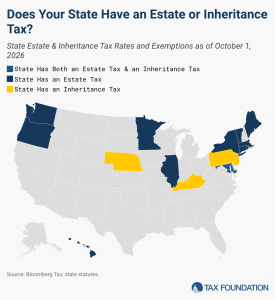
In addition to the federal estate tax, which has a top marginal rate of 40 percent, 12 states and the District of Columbia impose estate taxes, while five states levy inheritance taxes.
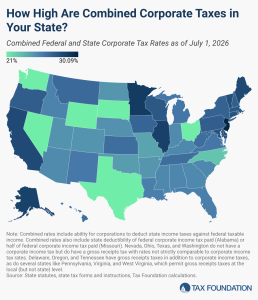
Corporations in the United States pay federal corporate income taxes levied at a 21 percent rate. Forty-four states and DC also levy taxes on corporate income, with top marginal rates ranging from 2.5 percent in North Carolina to 11.5 percent in New Jersey.