Florida boasts no individual income tax and a competitive 5.5 percent corporate income tax. Unlike many of its regional competitors, Florida does not tax capital stock, and its corporate income tax largely adheres to national norms, yielding a highly competitive overall tax code. However, the state falls short on its treatment of capital investment, only allowing corporate taxpayers to claim 15 percent of the first-year expensing of machinery and equipment offered under the federal tax code. With full expensing now permanent at the federal level, Florida should consider conforming to this provision of the federal tax code.
Florida’s sales tax rate—despite the lack of an individual income tax—is lower than those levied in many other southern states. Florida’s sales tax base contains a fair amount of exemptions, and in 2025, Florida narrowed its sales tax base even further with new exemptions as well as additional sales tax holidays.
Florida offers a de minimis exemption for tangible personal property, but at $25,000, it is relatively low and offers a possible avenue for improvement. As of the July 1, 2025, snapshot date of this Index, Florida was also the only state to impose a separate commercial lease tax, though the tax was repealed as of October 1. Despite a few outlier provisions, in most regards, the state is among the more competitive in the country.
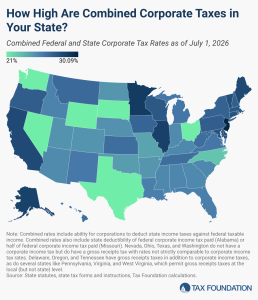
Corporations in the United States pay federal corporate income taxes levied at a 21 percent rate. Forty-four states and D.C. also levy taxes on corporate income, with top marginal rates ranging from 2.5 percent in North Carolina to 11.5 percent in New Jersey.
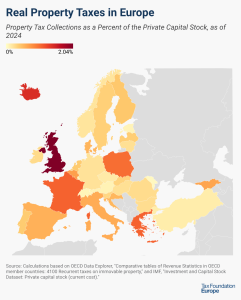
High property taxes levied not only on land but also on buildings and structures can discourage investment in infrastructure, which businesses would have to pay additional tax on.
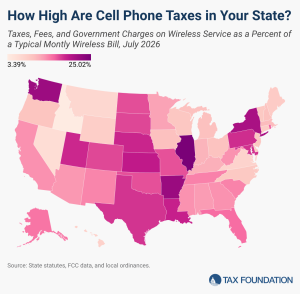
Applying the sales tax, a traditional broad-based consumption tax, is perfectly appropriate, but excessive targeted taxation of wireless services lacks the traditional justifications—a user-pays system or the internalization of social costs—for excise taxation, raising consumer costs and discouraging investment.