Real Property Taxes in Europe, 2026
High property taxes levied not only on land but also on buildings and structures can discourage investment in infrastructure, which businesses would have to pay additional tax on.
3 min read
Delaware, despite maintaining several distinctly uncompetitive provisions, ranks slightly above average on the Index due to its lack of a sales tax. Delaware has a graduated individual income tax with a top rate of 6.6 percent kicking in at $60,000. In addition, the city of Wilmington collects its own individual income tax of 1.25 percent, the only jurisdiction to do so. Taxpayers in the state also face a marriage penalty, where a household’s overall tax bill increases due to a couple marrying and filing taxes jointly.
Delaware has an 8.7 percent corporate income tax rate and is one of only two states with both a corporate income tax and a gross receipts tax (GRT), which applies to gross sales, without deductions for a firm’s business expenses, like costs of goods sold and compensation, and without regard for ability to pay. This leads to tax pyramiding, favors high-profit-margin companies, and can cause low-profit-margin firms to cease operations. Most states have abandoned GRTs due to the economic harm and inefficiencies they cause. Delaware also imposes a capital stock tax. The state does benefit, however, from its lack of a state sales tax, as well as its reasonable 0.48 percent effective property tax rate on owner-occupied housing value.
Delaware does not levy an estate tax or inheritance tax, a notable competitive advantage compared to most of its regional competitors. However, the state does impose an uncompetitive convenience rule and requires nonresident individual income tax filing and withholding for nonresidents who work for even a single day in the state. Delaware is perhaps most notable for policies that make it more attractive as a place in which to incorporate than a state in which to actually conduct significant business operations. Its Court of Chancery, which wins many plaudits, is well outside the scope of the Index, while its uniquely favorable treatment of royalty income does not benefit the state on the Index.
| Category | Rank | Rank Change | Score |
|---|---|---|---|
| Overall | 24 | -4 | 5.22 |
| Corporate Taxes | 50 | 0 | 1.41 |
| Individual Income Taxes | 43 | -1 | 4.51 |
| Sales Taxes | 2 | 0 | 8.65 |
| Property Taxes | 2 | -1 | 6.54 |
| Unemployment Insurance Taxes | 2 | -1 | 6.16 |


Get facts about taxes in your state and around the US
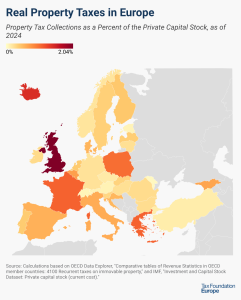
High property taxes levied not only on land but also on buildings and structures can discourage investment in infrastructure, which businesses would have to pay additional tax on.
3 min read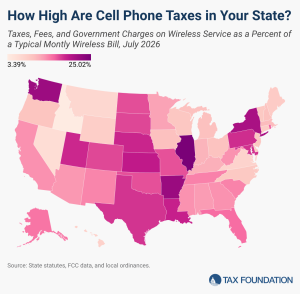
Applying the sales tax, a traditional broad-based consumption tax, is perfectly appropriate, but excessive targeted taxation of wireless services lacks the traditional justifications—a user-pays system or the internalization of social costs—for excise taxation, raising consumer costs and discouraging investment.
5 min read
California levies the highest tax on gasoline at 73.6 cents per gallon (cpg), followed by Illinois at 70.4 cpg and Indiana at 63.1 cpg.
10 min read