Alaska, which forgoes an individual income tax and a state-level sales tax, ranks well on the Index due to the absence of major taxes, but has room to reform the taxes it does impose. Cities and boroughs can impose their own sales taxes, resulting in a lack of base uniformity, though local governments have agreed to adopt a uniform code with central administration for remote sellers, lessening compliance burdens.
The state’s corporate income tax has a 20 percent net CFC-tested income (NCTI) inclusion, making it a national outlier. Alaska also imposes a throwback rule, exposing some out-of-state activity of Alaska-based corporations to the state’s corporate taxes, and it only partially conforms to federal depletion allowances. Property taxes are somewhat high, and the state taxes some inventory, but with no individual income tax, state sales tax, capital stock tax, or inheritance or estate tax, Alaska keeps taxes low for most residents and for some businesses, particularly those not subject to production taxes (e.g., oil and natural gas).
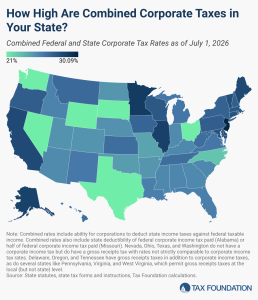
Corporations in the United States pay federal corporate income taxes levied at a 21 percent rate. Forty-four states and D.C. also levy taxes on corporate income, with top marginal rates ranging from 2.5 percent in North Carolina to 11.5 percent in New Jersey.
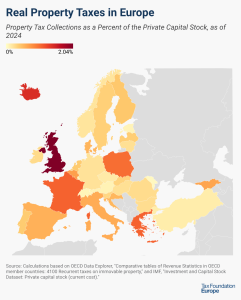
High property taxes levied not only on land but also on buildings and structures can discourage investment in infrastructure, which businesses would have to pay additional tax on.
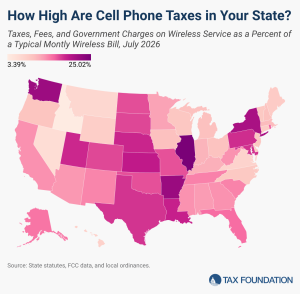
Applying the sales tax, a traditional broad-based consumption tax, is perfectly appropriate, but excessive targeted taxation of wireless services lacks the traditional justifications—a user-pays system or the internalization of social costs—for excise taxation, raising consumer costs and discouraging investment.