Iowa’s Index ranking has improved substantially in recent years as the result of several rounds of pro-growth and structurally sound tax reform that have greatly improved the state’s competitive standing. Under recent reforms, Iowa has lowered income tax rates, eliminated an unusual and counterproductive policy of federal deductibility, repealed the alternative minimum tax, and, as of 2025, has now phased out the inheritance tax.
In 2025, Iowa moved to a flat 3.8 percent income tax, with proposals for further reduction, which has improved the state’s overall score. Unusually, Iowa has a graduated-rate corporate income tax structure but has enacted tax triggers to reduce and flatten the rate over time as revenue becomes available. Iowa is also among the states that allow local income taxes.
While Iowa’s combined state and average local sales tax rate is slightly below average, the state’s property tax burden is somewhat high, and unlike many of its regional competitors, Iowa not only taxes tangible personal property (machinery and equipment) but does so without providing a de minimis exemption for small businesses. The state also has split roll property taxes, with higher ratios applied to businesses and renters than to homeowners.
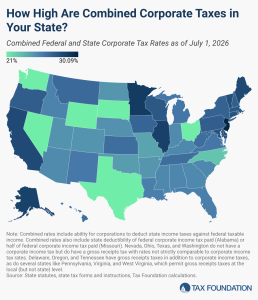
Corporations in the United States pay federal corporate income taxes levied at a 21 percent rate. Forty-four states and D.C. also levy taxes on corporate income, with top marginal rates ranging from 2.5 percent in North Carolina to 11.5 percent in New Jersey.
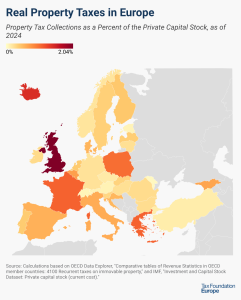
High property taxes levied not only on land but also on buildings and structures can discourage investment in infrastructure, which businesses would have to pay additional tax on.
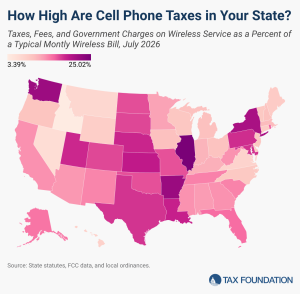
Applying the sales tax, a traditional broad-based consumption tax, is perfectly appropriate, but excessive targeted taxation of wireless services lacks the traditional justifications—a user-pays system or the internalization of social costs—for excise taxation, raising consumer costs and discouraging investment.