Gas Taxes by State, 2026
California levies the highest tax on gasoline at 73.6 cents per gallon (cpg), followed by Illinois at 70.4 cpg and Indiana at 63.1 cpg.
10 min read
Florida boasts no individual income tax and a competitive 5.5 percent corporate income tax. Unlike many of its regional competitors, Florida does not tax capital stock, and its corporate income tax largely adheres to national norms, yielding a highly competitive overall tax code. However, the state falls short on its treatment of capital investment, only allowing corporate taxpayers to claim 15 percent of the first-year expensing of machinery and equipment offered under the federal tax code. With full expensing now permanent at the federal level, Florida should consider conforming to this provision of the federal tax code.
Florida’s sales tax rate—despite the lack of an individual income tax—is lower than those levied in many other southern states. Florida’s sales tax base contains a fair amount of exemptions, and in 2025, Florida narrowed its sales tax base even further with new exemptions as well as additional sales tax holidays.
Florida offers a de minimis exemption for tangible personal property, but at $25,000, it is relatively low and offers a possible avenue for improvement. As of the July 1, 2025, snapshot date of this Index, Florida was also the only state to impose a separate commercial lease tax, though the tax was repealed as of October 1. Despite a few outlier provisions, in most regards, the state is among the more competitive in the country.
| Category | Rank | Rank Change | Score |
|---|---|---|---|
| Overall | 5 | -1 | 6.84 |
| Corporate Taxes | 17 | -1 | 5.47 |
| Individual Income Taxes | 1 | 0 | 10.00 |
| Sales Taxes | 16 | 0 | 5.19 |
| Property Taxes | 20 | -5 | 5.22 |
| Unemployment Insurance Taxes | 8 | 2 | 5.72 |


Get facts about taxes in your state and around the US

California levies the highest tax on gasoline at 73.6 cents per gallon (cpg), followed by Illinois at 70.4 cpg and Indiana at 63.1 cpg.
10 min read
Privacy concerns are a primary driver of opposition to vehicle miles traveled (VMT) tax systems, but VMT taxes do not need to invade drivers’ privacy to efficiently fund the roads.
6 min read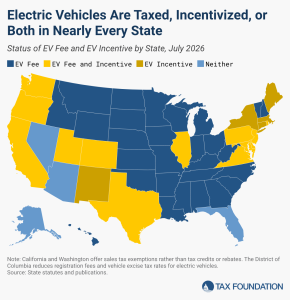
As the market share of electric vehicles (EVs) on the road grows, the gas tax’s ability to fund road projects and decrease traffic congestion erodes. Both federal and state real tax revenue per vehicle mile traveled has been on a steady decline for decades, creating a fiscal gap for road expenditures even as the demand for road infrastructure improvements has grown.
6 min read