Louisiana‘s tax system ranks 40th overall on the 2025 State Tax Competitiveness Index. Louisiana’s tax code is a national outlier, with one of the most complicated sales tax regimes and a long list of unusual and uncompetitive taxes and tax provisions, like inventory taxes and a capital stock (franchise) tax. Individual taxpayers are subject to three tax brackets and a competitive top marginal rate of 4.25 percent. However, the individual income tax code is not indexed for inflation, which means Louisiana taxpayers are subject to bracket creep (i.e., when inflation pushes a taxpayer from a lower bracket to a higher one when nominal income rises, but due to inflation, real income does not, or may even decline). Moreover, unlike other states with an individual income tax, Louisiana does not currently recognize S corporation status, requiring these entities to file taxes as C corporations rather than enjoying the pass-through status accorded to them in other states.
Businesses are subject to a franchise tax on their net worth (or accumulated wealth), which penalizes investment and is imposed regardless of profitability. Louisiana does not cap maximum payments for these taxes, making an already uncompetitive tax even more detrimental. Louisiana also taxes business inventory, which, like the capital stock tax, is imposed regardless of business profitability. These taxes are nonneutral, disproportionately affecting those businesses with larger inventories and causing taxpayers to make inefficient timing and location decisions with their inventory.
Like the state’s individual tax code, the corporate tax rates are not indexed for inflation.
Perhaps most notably, Louisiana is highly unusual in lacking central collections and administration of its sales tax. The state has made progress with an alternative remote sellers regime, but parishes’ and other jurisdictions’ ability to define their own tax bases and to administer the taxes separately from the state imposes high compliance costs.
Summer has arrived, and states are beginning to implement policy changes that were enacted during this year’s legislative session (or that have delayed effective dates or are being phased in over time).
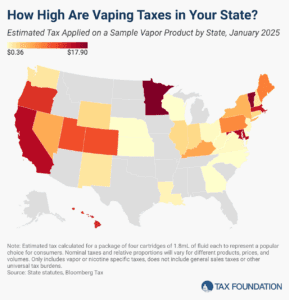
The vaping industry has grown rapidly in recent decades, becoming a well-established product category and a viable alternative to cigarettes for those trying to quit smoking. US states levy a variety of tax structures on vaping products.
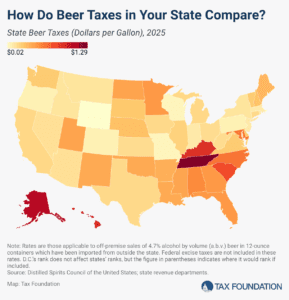
In the United States, taxes are the single most expensive ingredient in beer. The tax burden accounts for more of the final price of beer than labor and materials combined—the many different layers of applicable taxes combining to total as much as 40.8 percent of the retail price.