Georgia’s tax code includes all major tax types. The state has recently transitioned to a flat individual income tax and is gradually reducing the tax rate (currently 5.19 percent, scheduled to reach 4.99 percent by 2028), two positive developments in terms of tax competitiveness. However, the state still faces strong regional competition, as both Florida and Tennessee do not impose individual income taxes, while Alabama and North Carolina have lower rates.
Since 2024, Georgia’s corporate income tax rate has been aligned with the individual income tax rate and is set to decrease from the current 5.19 percent to 4.99 percent by 2028. However, the state does not allow first-year expensing of capital investment and imposes a nuisance capital stock tax of up to $5,000 per year. Like many states, Georgia also taxes tangible personal property. The state offers a de minimis exemption, but it is quite low.
Georgia’s state sales tax rate is relatively low at 4 percent, but localities are authorized to impose local sales taxes, with an average rate of 3.44 percent, bringing the combined rate to 7.44 percent, which is above the national average. Georgia does not impose inheritance, estate, or gift taxes.
Privacy concerns are a primary driver of opposition to vehicle miles traveled (VMT) tax systems, but VMT taxes do not need to invade drivers’ privacy to efficiently fund the roads.
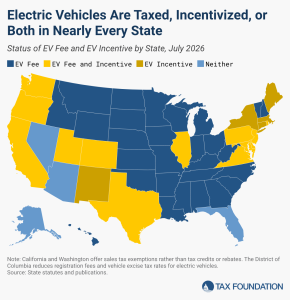
As the market share of electric vehicles (EVs) on the road grows, the gas tax’s ability to fund road projects and decrease traffic congestion erodes. Both federal and state real tax revenue per vehicle mile traveled has been on a steady decline for decades, creating a fiscal gap for road expenditures even as the demand for road infrastructure improvements has grown.
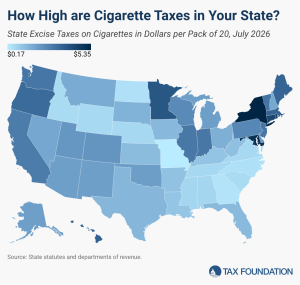
The highest state tax on cigarettes is levied by New York at $5.35 per pack of 20. The next highest tax jurisdiction is the District of Columbia at $5.07 per pack of cigarettes, followed closely by Maryland at $5.00 per pack, Rhode Island at $4.50 per pack, and Connecticut at $4.35 per pack.