Sales Tax Holidays by State, 2026
However well-intended they may be, sales tax holidays remain the same as they always have been—ineffective and inefficient.
12 min read
Iowa’s Index ranking has improved substantially in recent years as the result of several rounds of pro-growth and structurally sound tax reform that have greatly improved the state’s competitive standing. Under recent reforms, Iowa has lowered income tax rates, eliminated an unusual and counterproductive policy of federal deductibility, repealed the alternative minimum tax, and, as of 2025, has now phased out the inheritance tax.
In 2025, Iowa moved to a flat 3.8 percent income tax, with proposals for further reduction, which has improved the state’s overall score. Unusually, Iowa has a graduated-rate corporate income tax structure but has enacted tax triggers to reduce and flatten the rate over time as revenue becomes available. Iowa is also among the states that allow local income taxes.
While Iowa’s combined state and average local sales tax rate is slightly below average, the state’s property tax burden is somewhat high, and unlike many of its regional competitors, Iowa not only taxes tangible personal property (machinery and equipment) but does so without providing a de minimis exemption for small businesses. The state also has split roll property taxes, with higher ratios applied to businesses and renters than to homeowners.
| Category | Rank | Rank Change | Score |
|---|---|---|---|
| Overall | 17 | 2 | 5.40 |
| Corporate Taxes | 25 | -4 | 5.32 |
| Individual Income Taxes | 11 | 7 | 5.95 |
| Sales Taxes | 11 | 0 | 5.49 |
| Property Taxes | 33 | -6 | 4.81 |
| Unemployment Insurance Taxes | 35 | -1 | 4.60 |


Get facts about taxes in your state and around the US
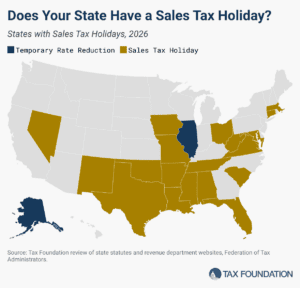
However well-intended they may be, sales tax holidays remain the same as they always have been—ineffective and inefficient.
12 min read
Policymakers are increasingly considering taxes on data processing and other businesses’ digital services, but these taxes increase costs at many stages of the production process for virtually all businesses, not just tech-oriented businesses.
7 min read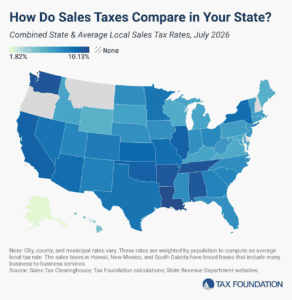
The five states with the highest average combined state and local sales tax rates are Louisiana (10.13 percent), Tennessee (9.61 percent), Washington (9.57 percent), Arkansas (9.48 percent), and Alabama (9.46 percent).
8 min read