Federal, state, and local governments raise revenues for road infrastructure and maintenance through a combination of taxes on motor fuel, fees on vehicles (like registration and licensure), and direct levies on drivers (like tolls). This system constitutes a relatively well-designed user feeA user fee is a charge imposed by the government for the primary purpose of covering the cost of providing a service, directly raising funds from the people who benefit from the particular public good or service being provided. A user fee is not a tax, though some taxes may be labeled as user fees or closely resemble them. system, where roadway expenditures are largely funded by the people who use the roads, generally in proportion to the extent of their use.
However, these road taxes and fees are far from a perfect user fee, especially as inflationInflation is when the general price of goods and services increases across the economy, reducing the purchasing power of a currency and the value of certain assets. The same paycheck covers less goods, services, and bills. It is sometimes referred to as a “hidden tax,” as it leaves taxpayers less well-off due to higher costs and “bracket creep,” while increasing the government’s spendin, electric vehicles (EVs), and fuel efficiency gains erode gas taxA gas tax is commonly used to describe the variety of taxes levied on gasoline at both the federal and state levels, to provide funds for highway repair and maintenance, as well as for other government infrastructure projects. These taxes are levied in a few ways, including per-gallon excise taxes, excise taxes imposed on wholesalers, and general sales taxes that apply to the purchase of gasoline. revenues per mile of road driven. Most states fail to collect enough in user fees to fully provide for roadway spending. This necessitates transfers from general funds or other revenue sources that are unrelated to road use to pay for road construction and maintenance.
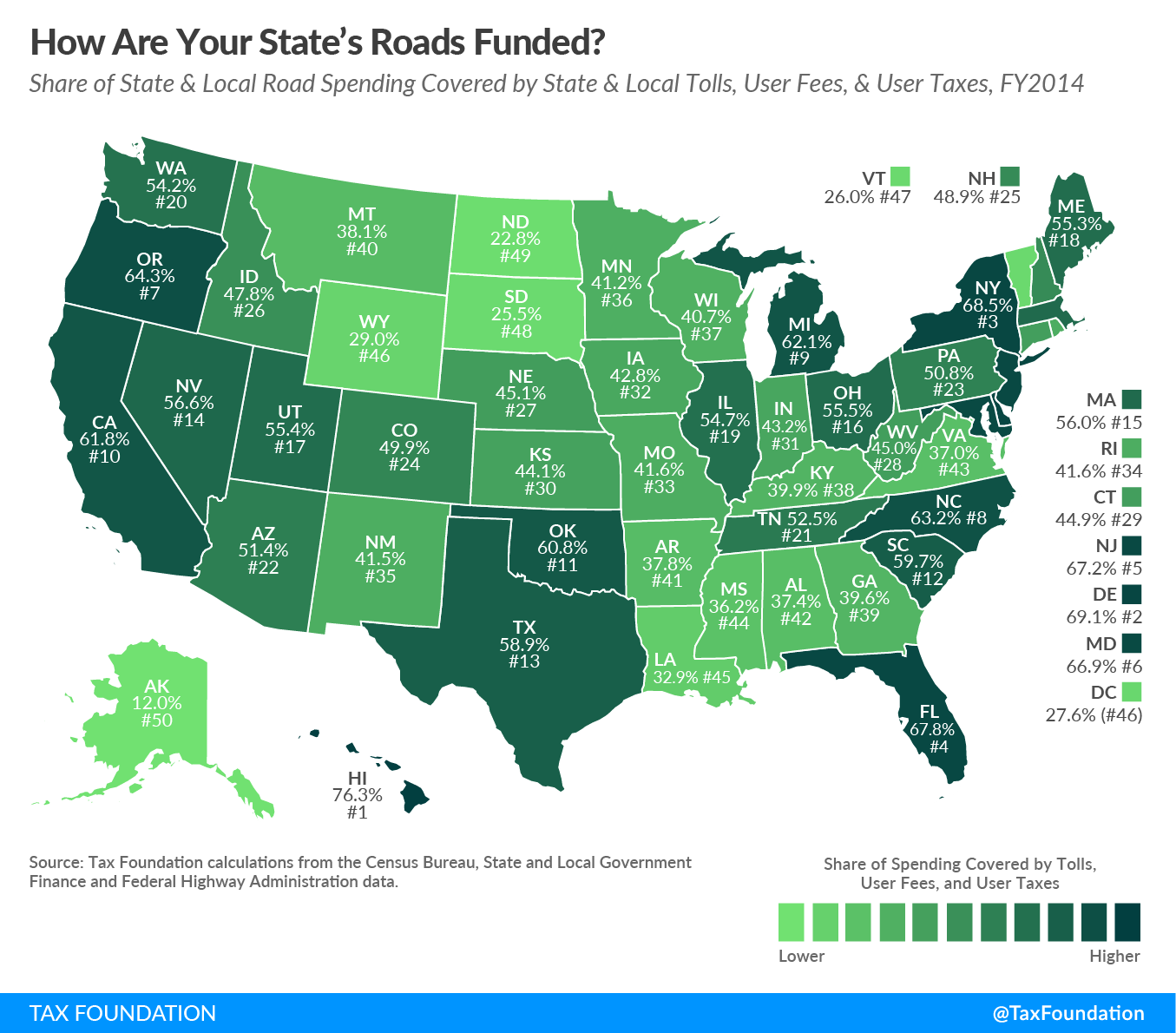
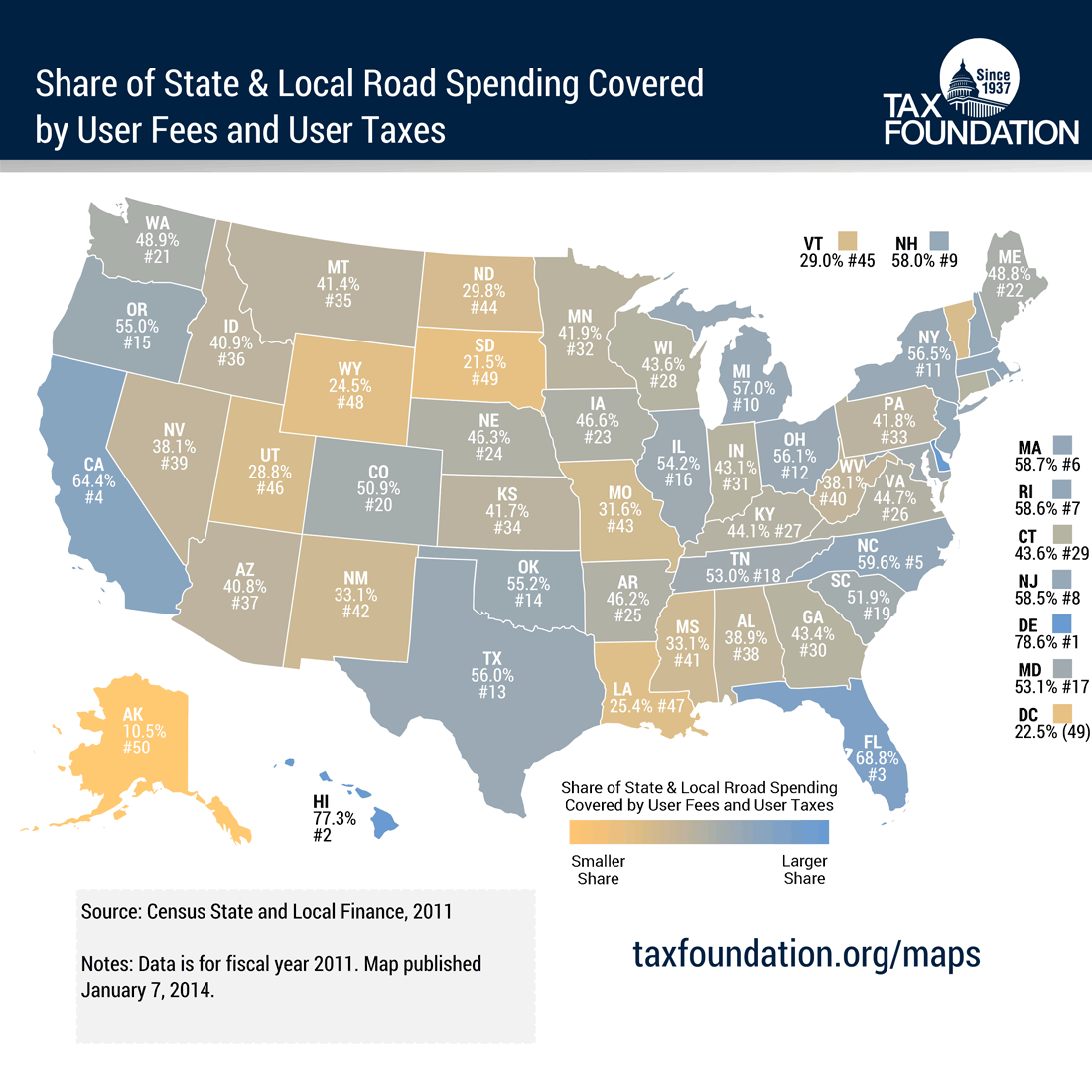
The amount of revenue states raise through roadway-related revenues varies significantly across the US. Only two states—Maryland and New Jersey—raise enough revenue to fully cover their highway spending. The remaining 48 states and the District of Columbia must make up the difference with taxA tax is a mandatory payment or charge collected by local, state, and national governments from individuals or businesses to cover the costs of general government services, goods, and activities. revenues from other sources. The states that raise the lowest proportion of their highway funds from transportation-related sources are Alaska (17.4 percent) and North Dakota (26.8 percent), both states that rely heavily on revenue from severance taxes.
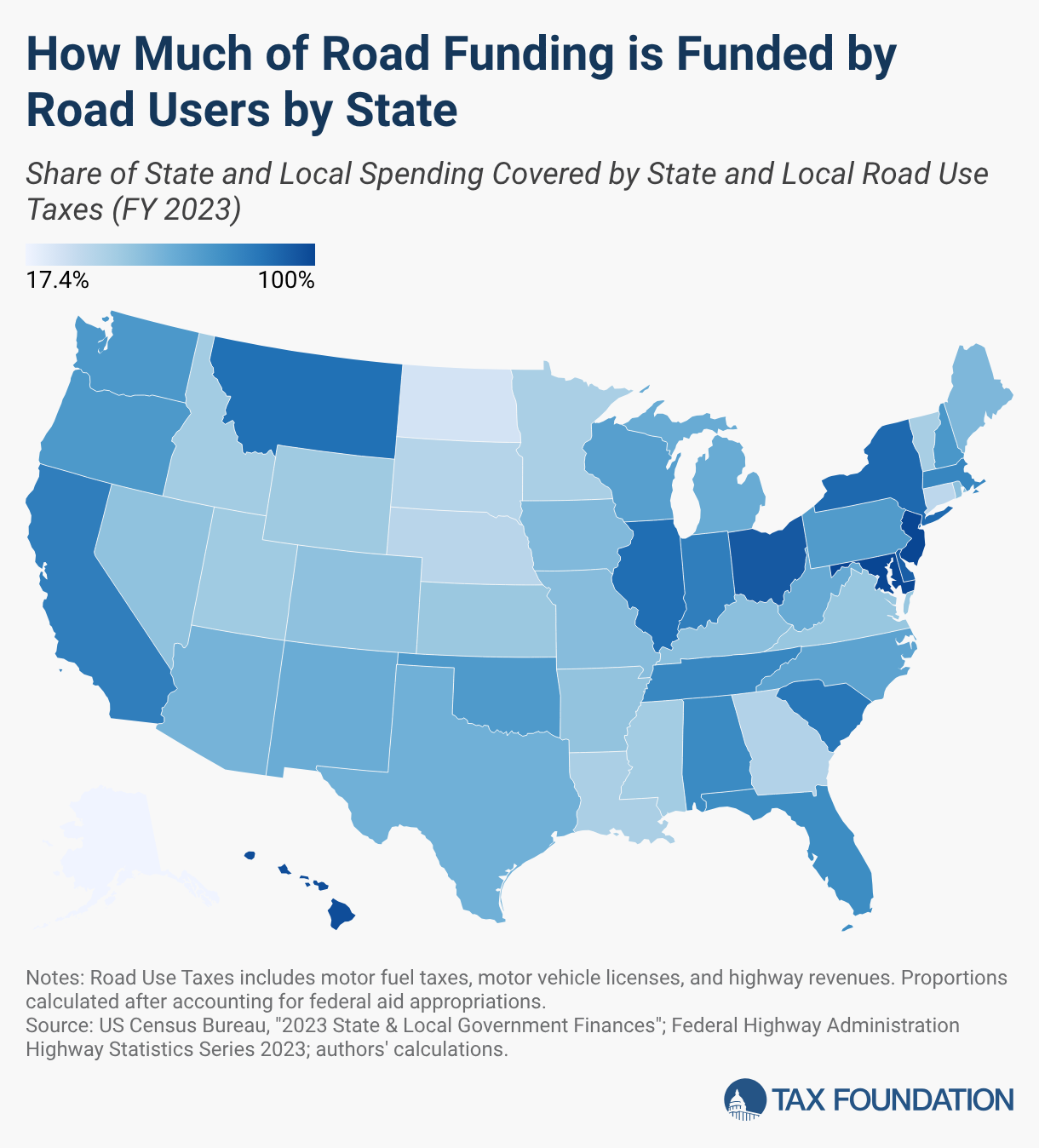
Road Taxes and Funding by State
Share of State and Local Spending Covered by State and Local Road Use Taxes (FY 2023)
| State | Share of State & Local Expenditures Covered by State & Local Roadway Revenues | Rank |
|---|---|---|
| Alabama | 75.3% | 14 |
| Alaska | 17.4% | 50 |
| Arizona | 56.2% | 27 |
| Arkansas | 48.1% | 35 |
| California | 80.7% | 11 |
| Colorado | 49.3% | 33 |
| Connecticut | 34.2% | 48 |
| Delaware | 92.2% | 5 |
| Florida | 74.5% | 15 |
| Georgia | 38.3% | 45 |
| Hawaii | 97.6% | 3 |
| Idaho | 43.1% | 41 |
| Illinois | 87.1% | 7 |
| Indiana | 80.7% | 10 |
| Iowa | 53.1% | 29 |
| Kansas | 45.8% | 37 |
| Kentucky | 50.5% | 31 |
| Louisiana | 40.6% | 44 |
| Maine | 54.0% | 28 |
| Maryland | 100.0% | 1 |
| Massachusetts | 77.2% | 12 |
| Michigan | 60.1% | 24 |
| Minnesota | 41.0% | 43 |
| Mississippi | 43.1% | 40 |
| Missouri | 51.6% | 30 |
| Montana | 86.2% | 8 |
| Nebraska | 35.7% | 47 |
| Nevada | 48.9% | 34 |
| New Hampshire | 69.8% | 16 |
| New Jersey | 100.0% | 1 |
| New Mexico | 59.5% | 25 |
| New York | 88.7% | 6 |
| North Carolina | 64.0% | 22 |
| North Dakota | 26.8% | 49 |
| Ohio | 93.7% | 4 |
| Oklahoma | 68.5% | 19 |
| Oregon | 69.1% | 18 |
| Pennsylvania | 67.9% | 20 |
| Rhode Island | 49.9% | 32 |
| South Carolina | 83.7% | 9 |
| South Dakota | 37.0% | 46 |
| Tennessee | 76.8% | 13 |
| Texas | 57.7% | 26 |
| Utah | 44.1% | 39 |
| Vermont | 41.7% | 42 |
| Virginia | 46.6% | 36 |
| Washington | 69.4% | 17 |
| West Virginia | 60.6% | 23 |
| Wisconsin | 65.8% | 21 |
| Wyoming | 44.7% | 38 |
| District of Columbia | 27.9% | 49 |
| United States | 66.5% |
Source: US Census Bureau, "2023 State & Local Government Finances"; Federal Highway Administration Highway Statistics Series 2023; authors' calculations.
Data compiled by Jacob Macumber-Rosin , Adam Hoffer
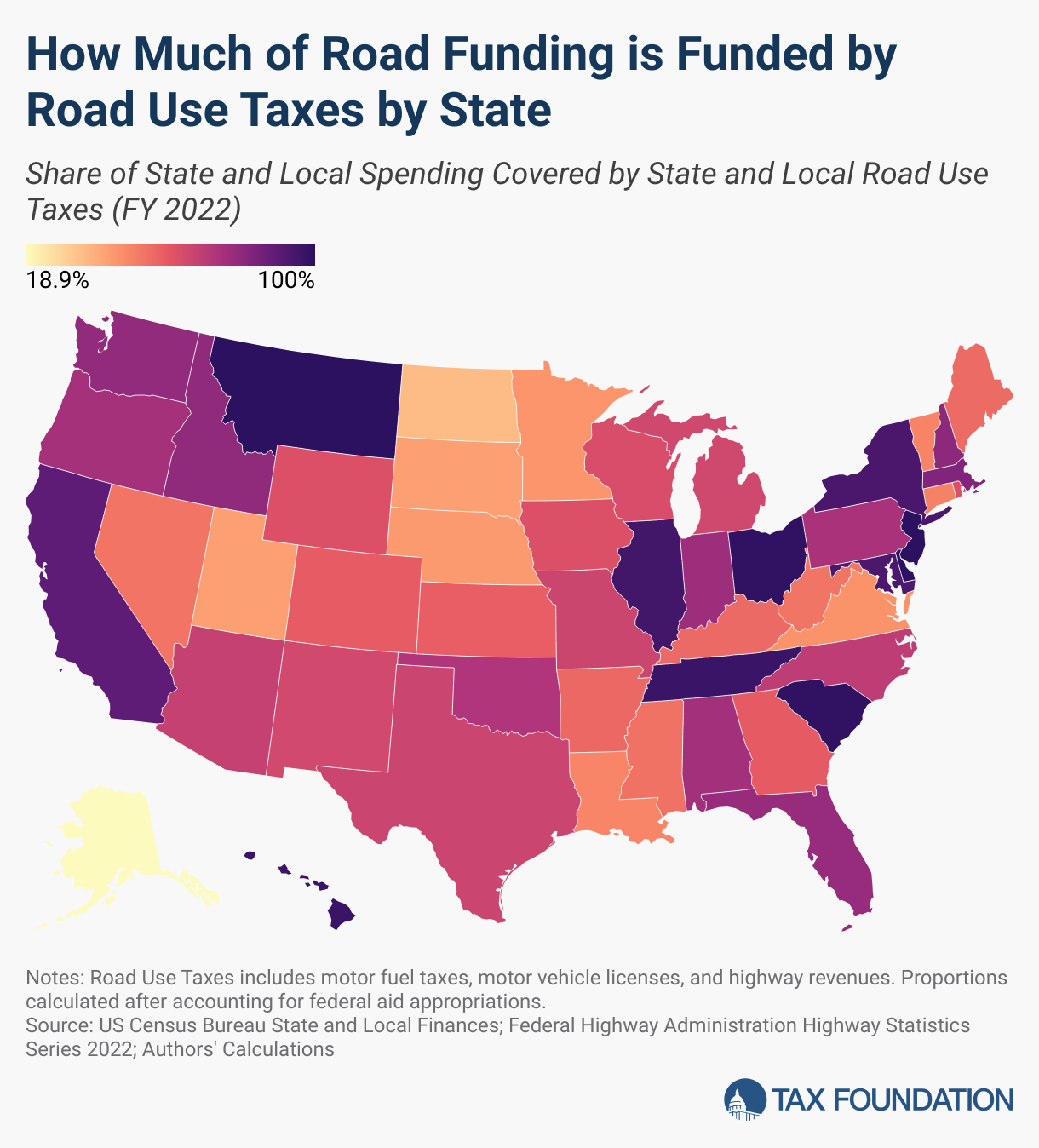
Road Taxes and Funding by State
Share of State and Local Spending Covered by State and Local Road Use Taxes (FY 2022)
| State | Share of State and Local Spending Covered by State and Local Road Use Taxes, FY 2022 | Rank |
|---|---|---|
| Alabama | 74.9% | 18 |
| Alaska | 19.4% | 50 |
| Arizona | 67.3% | 23 |
| Arkansas | 55.1% | 35 |
| California | 89.2% | 11 |
| Colorado | 58.0% | 33 |
| Connecticut | 48.7% | 41 |
| Delaware | 100.0% | 1 |
| Florida | 77.7% | 16 |
| Georgia | 58.4% | 32 |
| Hawaii | 97.2% | 7 |
| Idaho | 78.9% | 14 |
| Illinois | 95.4% | 8 |
| Indiana | 76.2% | 17 |
| Iowa | 61.6% | 31 |
| Kansas | 57.4% | 34 |
| Kentucky | 54.7% | 36 |
| Louisiana | 47.9% | 43 |
| Maine | 54.4% | 37 |
| Massachusetts | 82.2% | 12 |
| Maryland | 93.2% | 10 |
| Michigan | 64.5% | 26 |
| Minnesota | 44.1% | 45 |
| Mississippi | 52.7% | 38 |
| Missouri | 65.5% | 25 |
| Montana | 100.0% | 1 |
| Nebraska | 43.0% | 46 |
| Nevada | 52.2% | 39 |
| New Hampshire | 79.7% | 13 |
| New Jersey | 100.0% | 1 |
| New Mexico | 64.1% | 27 |
| New York | 93.8% | 9 |
| North Carolina | 68.8% | 22 |
| North Dakota | 35.1% | 49 |
| Ohio | 99.0% | 5 |
| Oklahoma | 72.1% | 21 |
| Oregon | 74.4% | 19 |
| Pennsylvania | 73.4% | 20 |
| Rhode Island | 61.6% | 30 |
| South Carolina | 99.1% | 4 |
| South Dakota | 41.6% | 47 |
| Tennessee | 97.2% | 6 |
| Texas | 65.9% | 24 |
| Utah | 41.6% | 48 |
| Virginia | 44.7% | 44 |
| Vermont | 48.3% | 42 |
| West Virginia | 52.1% | 40 |
| Washington | 78.4% | 15 |
| Wisconsin | 62.4% | 28 |
| Wyoming | 61.7% | 29 |
| District of Columbia | 18.9% | (51) |
| US | 73.0% | - |
Source: US Census Bureau State and Local Finances; Federal Highway Administration Highway Statistics Series 2022; Authors' Calculations
Data compiled by Jacob Macumber-Rosin , Adam Hoffer
Changes from 2025
- Idaho’s roadway user revenues covered only 43.1 percent of roadway spending, down significantly from 78.9 percent following drastic increases in roadway expenditures, met with only slight increases in roadway revenues.
- Tennessee’s share of roadway spending covered by roadway user revenues fell from 97.2 percent to 76.8 percent following a significant increase in roadway expenditures and a slight reduction in roadway revenues.
- Georgia’s roadway user revenues covered only 38.3 percent of roadway spending, down from 58.4 percent, after significant increases in roadway expenditures and a decrease in roadway revenues.
- Wyoming increased roadway expenditures with little change in roadway revenues, decreasing the share of roadway spending that roadway user revenues covered from 61.7 percent to 44.7 percent.
- South Carolina’s share of roadway spending covered by roadway user revenues fell from 99.1 percent to 83.7 percent following an increase in roadway expenditures that was not compensated by an increase in roadway revenues.
- Other states had their share of roadway spending covered by roadway revenues that changed by less than 15 percent. Overall, 41 states had their share decrease, and the national average fell from 73.0 percent to 66.5 percent.
Roadway spending continues to rapidly outpace roadway revenues. Because road use fees fall short of fully funding roadway systems in most states, governments must transfer revenues from other sources to road expenditures. By diverting general funds to roadway spending, the burden of paying for the roads falls on all taxpayers, including people who drive very little or may not drive at all. By relying on other revenue sources to fund roads, states effectively underprice road use. This can manifest in several forms, most notably traffic congestion, but can also distort the transportation market by subsidizing road use relative to alternatives, particularly freight rail.
Gas tax revenues have become increasingly decoupled from road funding needs. Tax rates are often not indexed to inflation, which causes the real value of the revenues to deteriorate even without other changes.
Beyond the effects of inflation, gas taxes are losing ground as an effective proxy for road use. Motor vehicle fuel efficiency increased substantially over the past several decades, meaning vehicles can drive more miles per gallon of gas consumed. This means the gas tax generates declining revenue per mile driven on roads. And EVs don’t pay the gas tax at all. Whatever the benefits of EVs, they still put wear and tear on roads.
These proportions are calculated after considering federal apportionmentApportionment is the determination of the percentage of a business’s profits subject to a given jurisdiction’s corporate income tax or other business tax. US states apportion business profits based on some combination of the percentage of company property, payroll, and sales located within their borders. of the federal roadway user fees. Those roadway revenues at the federal level are also struggling. Recent discussions in Congress surrounded one-time fees on EVs to partially offset their lack of exposure to the gas tax, but there are better options to refuel the Highway Trust Fund. At both the federal and state levels, crude patches in roadway funding holes can at best delay fiscal problems with the road funding system, as the same underlying trends would still affect road revenues despite the new influx of EV fees.
A better long-term fix would be to shift funding from increasingly inappropriate proxies for road use to a direct user fee on each mile driven, a vehicle miles traveled (VMT) tax. Most states and the federal Department of Transportation have begun exploring replacing the existing funding structure with a simpler VMT tax that better aligns use with costs and better approximates the real price of roads. While states may find it difficult to shift to such a system without the federal government as the first mover, state policymakers might nonetheless want to push—and prepare—for such a system. With all but two states unable to fund their roadways using existing user fees, road funding is in dire need of a better system.
Stay informed on the tax policies impacting you.
Subscribe to our free newsletter to get the latest tax data, news and analysis.
Subscribe