Skip to content
Policymakers Must Weigh the Revenue, Distributional, and Economic Trade-Offs of SALT Deduction Cap Design Options

Economic Data Dashboard: US Tax and Trade Policy

Two major fiscal policy changes occurred in 2025: the One Big Beautiful Bill Act (OBBBA) and a new tariff regime.  While the effects of the policy changes will take years to fully materialize and years more to study, we can now consider how relevant variables have moved to date in response.

The OBBBA made expiring individual income tax changes permanent, introduced new temporary tax breaks for specific types of income, and provided full deductibility of domestic research and development (R&D) and equipment investment on a permanent basis. Tax Foundation estimates the new law will reduce federal tax revenue by $5.2 trillion over the coming decade before accounting for changes in federal spending and economic growth.

Tariffs increased significantly in 2025, with great variability in introduction, effective dates, applied rates, exempted and included goods, and repeal. Broadly, Section 232 tariffs were imposed on approximately $600 billion of specific imported products (steel, aluminum, cars, trucks, and furniture). Tariffs introduced under the International Emergency Economic Powers Act (IEEPA) applied to nearly all US trade partners; rates varied by country and were often raised, reduced, or delayed. In February 2026, the Supreme Court ruled the IEEPA tariffs unconstitutional, and the Trump administration responded by introducing new tariffs under Section 122 authority, affecting $1.2 trillion of imports.

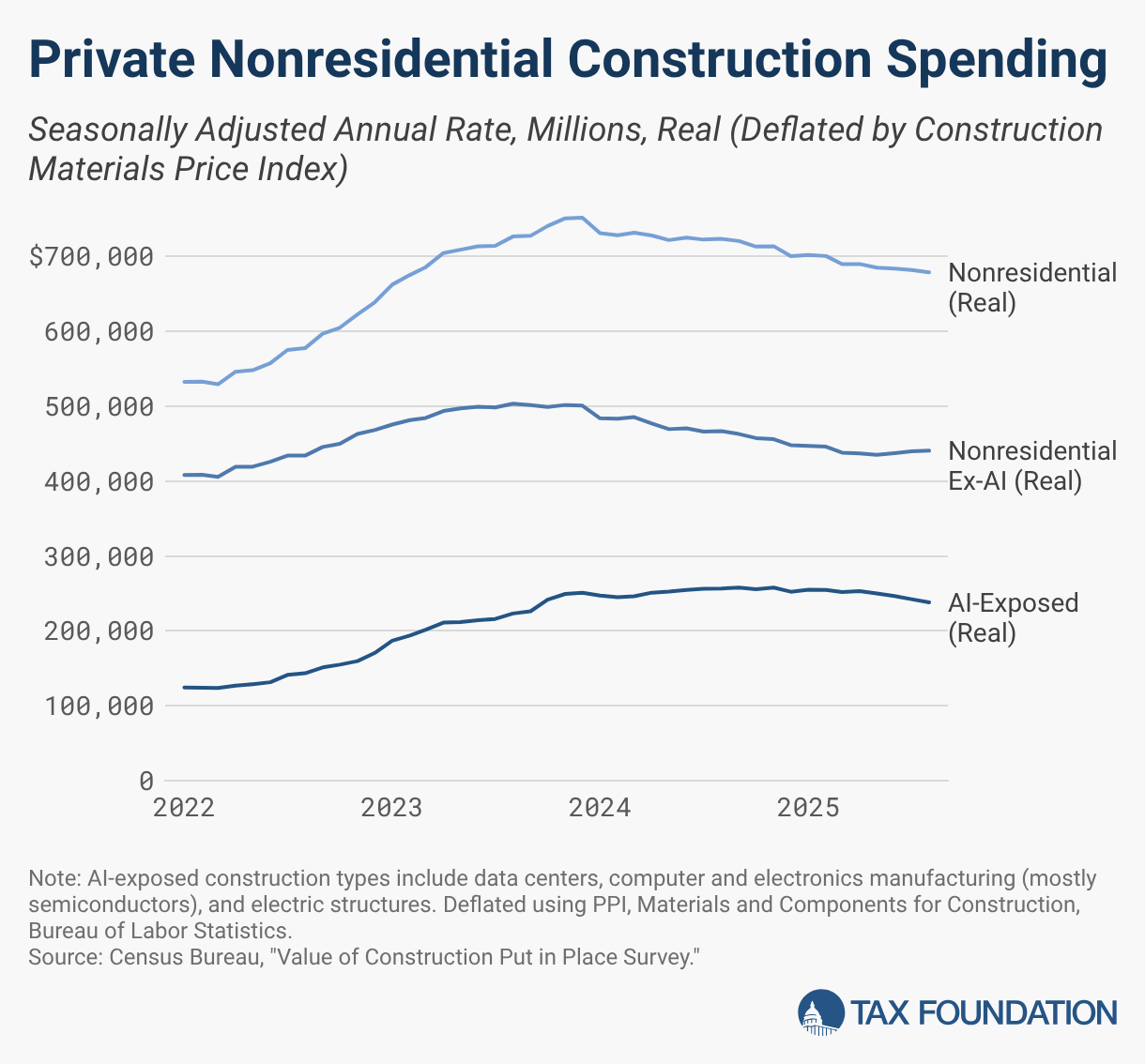
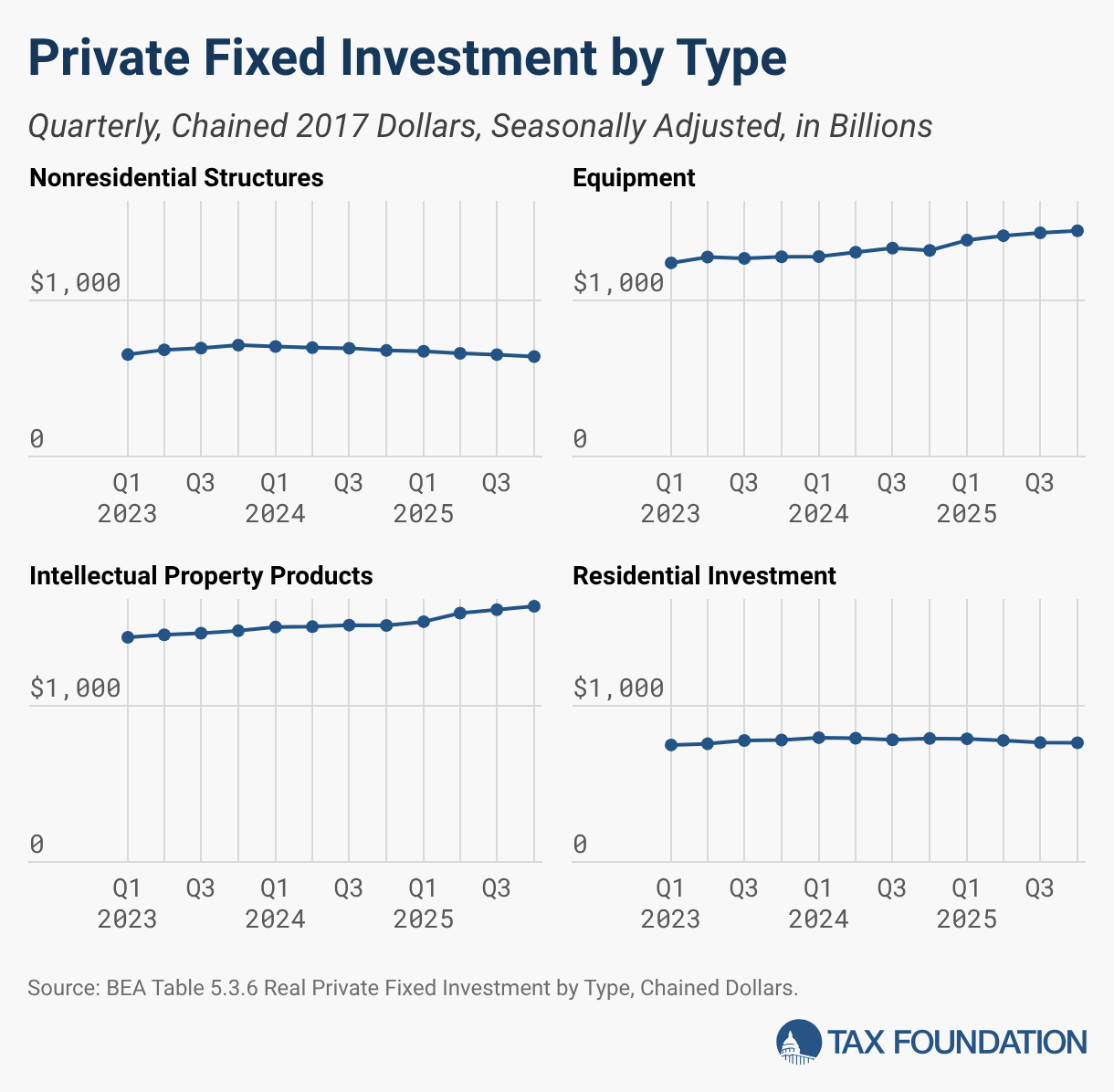
Both fiscal policy changes have myriad goals. Before looking at the data, it is important to note: establishing causation is hard. Even when a counterfactual is available, such as a forecast of GDP or business investment made before a policy change took effect, it is not possible to attribute the gap between the forecast and actual events to any specific policy change. The forecast could be mistaken, for one, but more importantly, multiple factors have changed in the meantime. This applies to fiscal policy in 2025: for example, we expect the OBBBA’s permanent expensing provisions for R&D and equipment investment to have a positive effect on business investment, while we expect tariffs to have a negative overall effect on business investment. Limits to tax credits for green energy would also be expected to affect investment. Additionally, factors outside of fiscal policy have changed, including the rapid advance of artificial intelligence as well as geopolitical tensions and conflicts that were not anticipated or incorporated into previous forecasts.

Last Updated: April 1, 2026

The United States consistently consumes more goods than it produces, resulting in a trade deficit. A trade deficit is driven by macroeconomic forces: the balance between national saving and national investment. When investment in the US outpaces saving, foreign capital flows into the US to make up the difference, leading to a capital account surplus and a current account (or trade) deficit as current spending exceeds current saving.

One of the stated purposes of the Trump tariffs is to reduce the trade deficit. A trade deficit is not necessarily a problem to solve. A trade deficit may reflect capital inflows that support productivity-enhancing investment or that support government expenditures that only create future liabilities for repayment. Tariffs will not be effective in fundamentally changing the balance of trade because they do not fundamentally change the saving-investment balance.

The goods trade deficit in 2025 was little changed from 2024 overall, though import patterns were significantly disrupted.

Featured Experts

Have a question about this data? Contact us to connect with a federal tax policy expert or click on the experts below to request them as a speaker at your upcoming event.


Related Resources

Big Beautiful Bill Tax Plan and Senate GOP Tax Plan: Details & Analysis of 2025 Trump Tax Cuts

One Big Beautiful Bill Act Tax Policies: Details and Analysis

Our analysis of the major tax provisions included in the OBBBA finds it will increase long-run GDP by 0.7 percent. The major tax provisions will reduce federal tax revenue by nearly $5.2 trillion between 2025 and 2034, on a conventional basis.

12 min read
Inflation Reduction Act IRA repeal and reforms

Will the OBBBA Tax Cuts Grow the US Economy?

Over the long run, OBBBA’s permanent extension of lower marginal tax rates on work, saving, and investment lays a solid foundation for stronger economic growth.

6 min read

Timeline of Activity

  1. Data Dashboard Launched
Back to Top