2026 Tax Brackets
Explore the IRS inflation-adjusted 2026 tax brackets, for which taxpayers will file tax returns in early 2027.
5 min read
Providing journalists, taxpayers, and policymakers with the latest data on taxes and spending is a cornerstone of the Tax Foundation’s educational mission.
As a nonpartisan, educational organization, the Tax Foundation has earned a reputation for independence and credibility. Our federal tax policy team regularly provides accessible, data-driven insights from sources such as the Internal Revenue Service (IRS), the Organisation for Economic Co-Operation and Development (OECD), Congressional Budget Office (CBO), the Joint Committee on Taxation (JCT), and others. For more insights on the latest federal tax policies, explore the Tax Foundation’s general equilibrium Taxes & Growth (TAG) Model
Explore the IRS inflation-adjusted 2026 tax brackets, for which taxpayers will file tax returns in early 2027.
5 min read
Explore the IRS inflation-adjusted 2027 tax brackets, for which taxpayers will file tax returns in early 2028.
5 min read
New IRS data shows the US federal income tax system continues to be progressive as high-income taxpayers pay the highest average income tax rates. Average tax rates for all income groups remain lower after the Tax Cuts and Jobs Act (TCJA).
6 min read
How will recent federal tax changes affect you?
4 min read
Notably, the OBBBA makes permanent the individual tax changes first put in place by the TCJA, which avoids a tax hike on an estimated 62 percent of tax filers in 2026.
4 min read
Two major fiscal policy changes occurred in 2025: the One Big Beautiful Bill Act (OBBBA) and a new tariff regime. While the effects of the policy changes will take years to fully materialize and years more to study, we can now consider how relevant variables have moved to date in response.

How do current federal individual income tax rates and brackets compare historically?
1 min read
Different taxes have different economic effects, so policymakers should always consider how tax revenue is raised and not just how much is raised.
4 min read
How do current federal corporate tax rates and brackets compare historically?
1 min read
Explore the IRS inflation-adjusted 2027 tax brackets, for which taxpayers will file tax returns in early 2028.
5 min read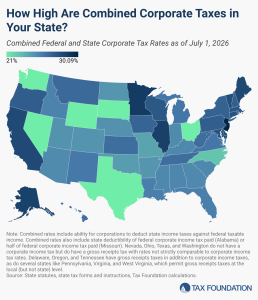
Corporations in the United States pay federal corporate income taxes levied at a 21 percent rate. Forty-four states and DC also levy taxes on corporate income, with top marginal rates ranging from 2.5 percent in North Carolina to 11.5 percent in New Jersey.
2 min read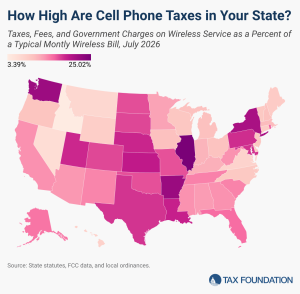
Applying the sales tax, a traditional broad-based consumption tax, is perfectly appropriate, but excessive targeted taxation of wireless services lacks the traditional justifications—a user-pays system or the internalization of social costs—for excise taxation, raising consumer costs and discouraging investment.
5 min read
Americans will spend 6.9 billion hours complying with IRS tax filing and reporting requirements in 2026, costing about $387 billion in lost productivity. Including an additional $157 billion in out-of-pocket costs, complying with the federal tax code will cost Americans more than $544 billion this year, over 1.7 percent of GDP.
10 min read
In 2022, incomes for the bottom 80 percent of earners were slightly lower after taxes and transfers compared to 2020 and 2021, driven by expiring pandemic-era policies.
6 min read
New IRS data shows the US federal income tax system continues to be progressive as high-income taxpayers pay the highest average income tax rates. Average tax rates for all income groups remain lower after the Tax Cuts and Jobs Act (TCJA).
6 min read