How to Refuel the Highway Trust Fund
Examples from other countries and US states show that well-designed user fees can fund transportation infrastructure effectively.
19 min read
Examples from other countries and US states show that well-designed user fees can fund transportation infrastructure effectively.
19 min read
Creative destruction—coined by famed economist Joseph Schumpeter—is the idea that new innovations disrupt and “destroy” existing economic structures as they create better and more efficient products and processes.
4 min read
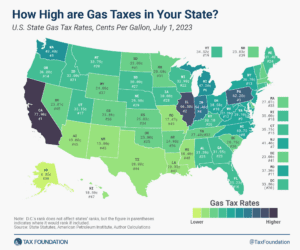
California levies the highest tax on gasoline at 70.9 cents per gallon (cpg), followed by Illinois at 66.4 cpg and Washington at 59.0 cpg.
8 min read
As the market share of electric vehicles (EVs) on the road grows, the gas tax’s ability to fund road projects and decrease traffic congestion erodes. Both federal and state real tax revenue per vehicle mile traveled has been on a steady decline for decades, creating a fiscal gap for road expenditures even as the demand for road infrastructure improvements has grown.
5 min read
The EV fee in the reconciliation package would help the fiscal situation but would overcorrect the hole in the gas tax base EVs create. There are intermediate options, such as VMT taxes for EVs and commercial traffic or pairing flat EV fees with gas and diesel tax increases, that would be incrementally better than the reconciliation package’s approach.
7 min read
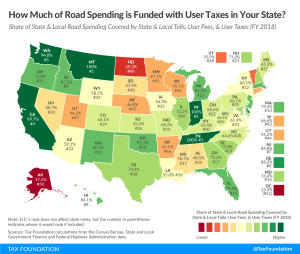
The amount of revenue states raise through roadway-related revenues varies significantly across the US. Only three states raise enough revenue to fully cover their highway spending.
5 min read
While fixing infrastructure funding has not been a focus of the tax expiration debate, it would be a smart way to pay for at least a small portion of the expiring tax cuts. In recent years, highway funding has exceeded highway revenues, and the introduction of electric vehicles has made the gas tax increasingly obsolete.
7 min read
By 2034, the gas tax and other car-related excise taxes are projected to raise less than half of the Highway Trust Fund’s outlays. While broader tax and spending reforms are necessary for overall deficit reduction, improving transportation funding would be a crucial step forward.
34 min read
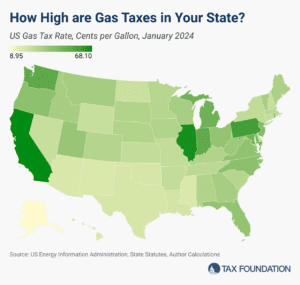
Though gas taxes are intended to serve as user fees and pollution deterrents, they vary widely across states. How does your state’s burden compare?
4 min read
Gas tax revenues have decoupled from road expenses and have been unable to support road funding in recent years. As such, states nationwide are exploring ways to supplement or replace gas tax revenues.
8 min read
Buckle up as we navigate the twists and turns of infrastructure and road funding. As electric vehicles gain traction, traditional gas taxes are running out of fuel to support our infrastructure budget.
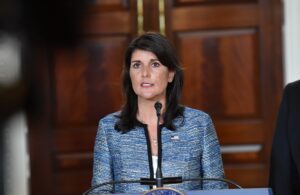
At the most recent Republican primary debate, former governor and United Nations ambassador Nikki Haley (R-SC) proposed eliminating the federal gas tax to lower fuel prices for consumers.
3 min read
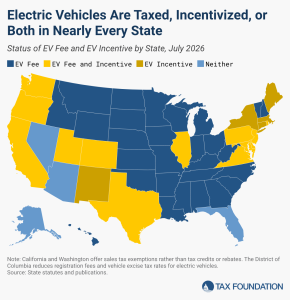
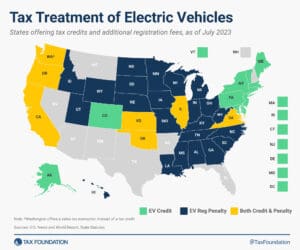
The state EV taxation landscape reflects the evolving transportation sector and the pressing need to address both fiscal gaps in road funding and environmental concerns.
4 min read
California pumps out the highest state gas tax rate of 77.9 cents per gallon (cpg), followed by Illinois (66.5 cpg) and Pennsylvania (62.2 cpg).
2 min read
As lawmakers explore funding mechanisms for additional federal infrastructure investment, they should focus on permanent, sustainable, and transparent revenue options that conform to the benefit principle. Permanent user fees, appropriately adjusted to restore and maintain their purchasing power, would serve as ideal revenue sources for federal infrastructure investments.
5 min read
As spending priorities are dividing lawmakers trying to negotiate among the various federal infrastructure plans, less time is being spent on the funding of one of the key components—our highways, both current and future taxes and fees. One of the current taxes, a federal excise tax on heavy commercial vehicles and trailers, is an important revenue generator, but its flawed tax design has a negative impact on investment and leads to unstable revenue.
4 min read
Traditionally, revenue dedicated to infrastructure spending has been raised through taxes on motor fuel, license fees, and tolls, but revenue from motor fuel has proven less effective over the last few decades.
6 min read
In Pennsylvania, Gov. Tom Wolf (D) has proposed phasing out the gas tax as the main funding mechanism for the state’s highway fund, and he has established a commission to recommend options for replacing it with alternative revenue sources. In a statement, the governor called the current motor fuel tax burdensome, outdated, and unreliable.
5 min read
What can the U.S. do to raise the revenue needed for infrastructure upkeep and accurately internalize the costs associated with road usage?