In May, the US government refunded just slightly more in customs duties than it collected. In June, it refunded more than twice what it collected. While small on their own, the net outflows illustrate a broader problem with President Trump’s tariffTariffs are taxes imposed by one country on goods imported from another country. Tariffs are trade barriers that raise prices, reduce available quantities of goods and services for US businesses and consumers, and create an economic burden on foreign exporters. regime: legally uncertain and chaotic policy creates instability for government revenues and for the people and businesses trying to plan investment and hiring decisions.
Customs duties had been the federal government’s fastest-growing source of revenue through 2025, driven by a rash of new tariffs imposed by President Trump, including IEEPA (International Emergency Economic Powers Act) tariffs that accounted for roughly half of collections. But in February 2026, the Supreme Court struck down the IEEPA tariffs, and subsequent court orders instructed the federal government to refund the illegal duties. May’s Monthly Treasury Statement shows $21.97 billion refunded that month, completely wiping out the $21.93 billion collected. June shows $49.18 billion refunded, compared to $23.63 billion collected, taking net customs revenue to a negative $25.56 billion.
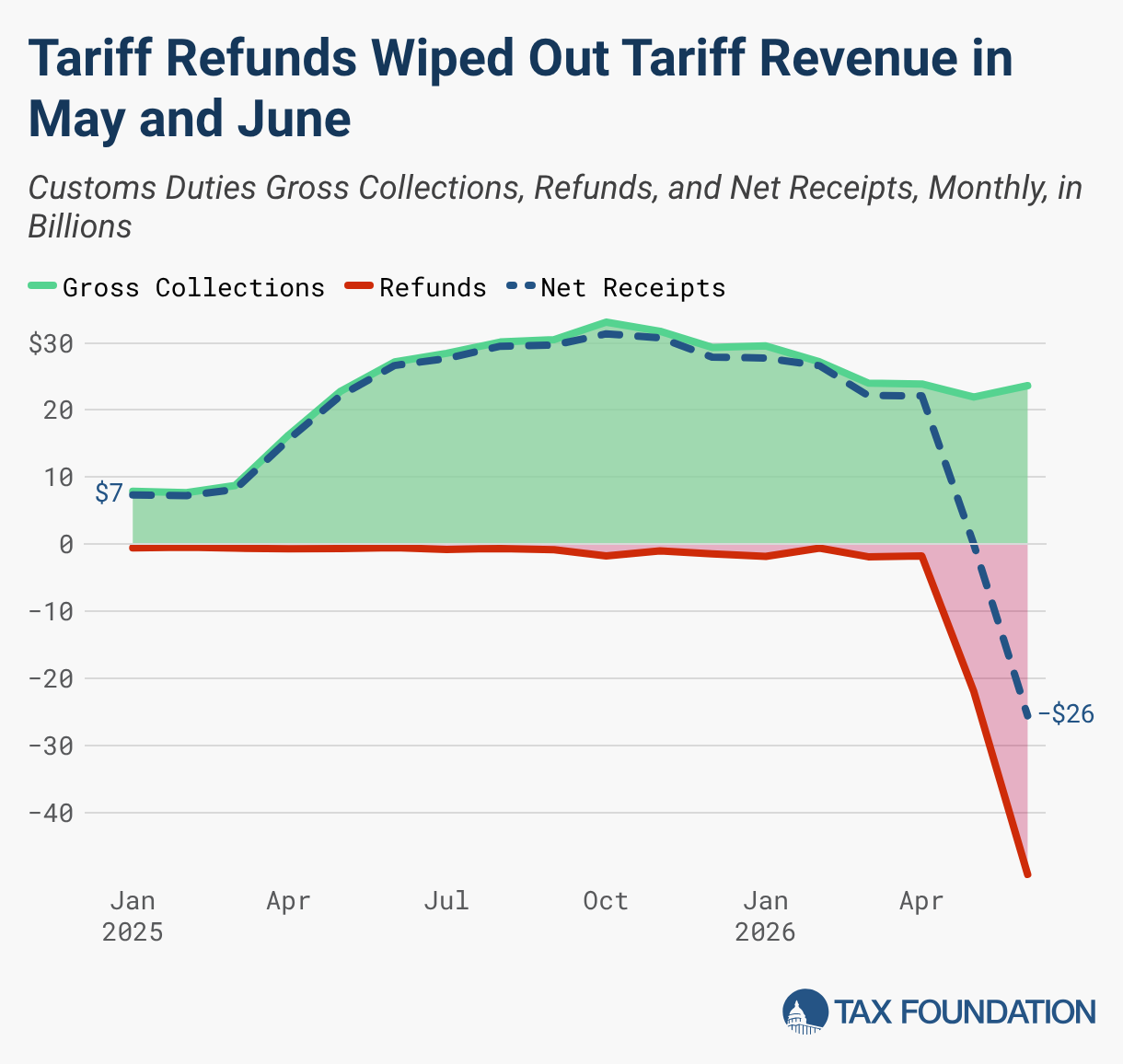
Throughout 2025, refunds of monthly customs duties never exceeded $2 billion. In May 2026, after the Court of International Trade ordered Customs and Border Protection to refund the illegally collected IEEPA duties, refunds spiked to nearly $22 billion, then to nearly $50 billion in June.
Approximately $165 billion of IEEPA tariffs were collected before the Court’s ruling, making May and June only the start of a large refund process. Customs refunds totaled roughly $71 billion across May and June—the bulk of it coming from IEEPA. Well over half of the illegally collected duties remain unreturned. The federal government should make that process simple and transparent for all importers, quickly refunding all the illegally collected taxes. However, the first phase of refunds only covers simpler claims, leaving more complex claims (related to finally liquidated entries) subject to remaining procedural uncertainty. Meanwhile, interest is piling up on what’s still owed (calculated as 4.5 percent for overpayments exceeding $10,000 or 6 percent below), and the administration has appealed the order requiring refunds to importers that never sued.
While the refund process plays out for the tariffs that were struck down, other tariffs are still being collected. Gross collections peaked at $33.09 billion in October 2025 and have declined sharply to $23.63 billion in June. Immediately after the Supreme Court ruling, the Trump administration invoked Section 122 of the Trade Act of 1974 to impose a temporary 10 percent tariff on most imports through July 24. The Court of International Trade ruled against the Section 122 tariffs in May, though that ruling is stalled pending the government’s appeal. On July 23, USTR took final action in its Section 301 forced labor investigations, imposing duties of 10 to 12.5 percent on 86 countries, subject to broad exemptions, including for USMCA-qualifying and Section 232 goods. The administration also invoked Section 338 of the Tariff Act of 1930, never before used to impose duties, for a 50 percent tariff on selected Canadian goods beginning August 19. Both are likely to be litigated.
Unfortunately, refunds will do little to reverse the damage imposed by the Trump administration’s tariffs.
While it is appropriate to refund the tariffs to the legal entity that made the tariff payment, that may not always align with who ultimately bore the tariff burden. The Harvard Pricing Lab, for example, estimates the tariffs were partly passed through to higher prices, meaning consumers and downstream businesses bore much of the economic cost. Refunds to importers will not make consumers or downstream businesses whole. Arguing they are entitled to the refunds, some shoppers have filed long-shot class-action suits.
And one of the largest costs of tariffs is unaccounted for. Tariffs were imposed under IEEPA, struck down, replaced under Section 122, ruled illegal again but left in place, expired, and replaced a second time under Sections 301 and 338, all within 18 months. In all, we estimate US tariff policy has changed more than 50 times since the start of Trump’s second term. For businesses making decisions on a long time horizon, that uncertainty suppresses investment and hiring and distorts pricing decisions. The economic damage from a chaotic tariff regime can outweigh the revenue itself, and unlike the tariffs, it cannot be refunded.
Stay informed on the tax policies impacting you.
Subscribe to our free newsletter to get the latest tax data, news and analysis.
Subscribe