What the 1990s-Era “Bit Tax” Can Teach Us About AI Tax Proposals
Policymakers considering AI-specific token or compute taxes can learn from the “bit tax” proposals of the 1990s during the rise of the internet.
6 min read

Policymakers considering AI-specific token or compute taxes can learn from the “bit tax” proposals of the 1990s during the rise of the internet.
6 min read
At the Republican National Convention in Dallas, President Trump promised payments of $5,000 to every adult citizen in the US if the Republicans maintain control of the House and the Senate in the upcoming midterm elections. Vice President JD Vance later supported the idea, saying that the president’s new tariffs are generating a lot of revenue that can be shared with Americans.
3 min read
Most Americans don’t understand how the tax code works. According to a poll conducted by TaxEDU, a majority of respondents do not have a basic understanding of common tax concepts.

There is a real danger that the well-founded admiration of expensing can slip into the belief that rates will not matter if the business tax base is correctly designed. Avi-Yonah’s article is a recent and well-articulated version of this intellectual undercurrent.
7 min read
A Destination-Based Cash Flow Tax (DBCFT) reduces the tax code’s penalty on investment, narrows its bias toward debt over equity, and removes much of the incentive to shift profits abroad.
7 min read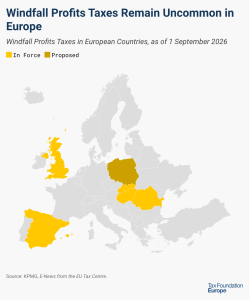
As energy prices have declined, European countries have switched the focus of their windfall profits taxes—a one-time tax levied on a company or industry when economic conditions result in large, unexpected profits—from energy providers to the banking and financial sector.
7 min read
Investment in digital assets, long thought of as a niche interest reserved for enthusiasts, has broken into the mainstream. In 2026, about one in five US adults report being invested in or using cryptocurrency.
5 min read
Economists and journalists have been pointing to a labor share of income series from the Bureau of Labor Statistics (BLS) as evidence that capital is taking an ever-increasing slice of the economic pie. But a closer look at the national income accounts shows a different story.
7 min read
Utah’s targeted advertising tax is not identical to Maryland’s, but it shares key characteristics that make it vulnerable to the same challenges that sank Maryland’s tax, starting with a clash with the Internet Tax Freedom Act (ITFA).
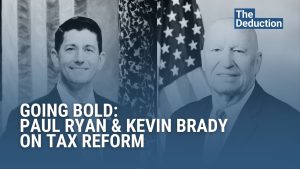
Ten years ago, then-Speaker Paul Ryan and Ways and Means Chairman Kevin Brady released the “Better Way” Tax Plan, the blueprint that would eventually become the Tax Cuts and Jobs Act of 2017—the largest overhaul of the US tax code in over 30 years.

Tax Foundation’s new resource, Options for Reforming America’s Tax Code 3.0, demonstrates that not all revenue-raising options are created equal—some do more harm to the economy than others for the same amount of revenue.
7 min read
A new paper finds that foreign exporters absorbed 47 percent of the tariff burden, passing on a smaller share to US importers than estimated by other studies.
6 min read
If America’s leaders today want to learn how to build a lasting system on the foundation of simplicity and neutrality, they should follow the Siim Kallas blueprint.
4 min read
The Belgian proposal departs significantly from sound tax policy principles and risks generating substantial economic distortions, legal uncertainty, and trade frictions while raising relatively little revenue.

Federal government debt is over $32 trillion, around the size of the nation’s annual economic output (its gross domestic product, or GDP). Debt levels this high mean US borrowing costs are sensitive to interest rate changes that may otherwise seem small.
5 min read
In 2025, the CTP reduced the backlog of premarket tobacco product applications (PMTAs) by about 70 percent. This year, the CTP is already accelerating PMTA reviews further and allowing some leeway for products under review but not yet officially authorized. This is great progress, but much more can be made.
7 min read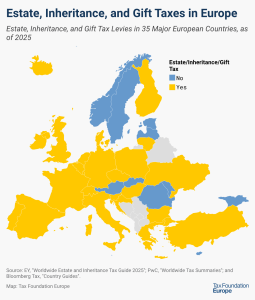
Twenty-four out of the 35 European countries covered in this map currently levy estate, inheritance, or gift taxes.
4 min read
The new public country-by-country reporting regimes adopted by the EU and Australia, and changes from the Financial Accounting Standards Board for financial accounts, are meant to promote transparency by multinational enterprises but have ubiquitous structural differences.
10 min read
Poland has one of the most restrictive approaches to the tax treatment of losses in the OECD. Loss carryover provisions allow businesses to deduct their losses in one year against taxable income in another, smoothing their taxable income over time. Their absence or restriction leads to firms with more variable profits and losses over time being taxed at higher rates, penalizing risky investment, such as research and development (R&D), and business expansion.
16 min read
While uncapping the payroll tax and raising individual income tax rates are often the go-to reform options for policymakers, base broadeners like ESI and other fringe benefits are much better alternatives. They can raise significant revenue, while improving the neutrality of the tax code and preventing the need for increases in statutory tax rates.
6 min read