As debt held by the public reaches 101 percent of GDP and Social Security risks insolvency by 2032, lawmakers will soon be forced to put US spending on a sustainable path through benefit cuts, taxA tax is a mandatory payment or charge collected by local, state, and national governments from individuals or businesses to cover the costs of general government services, goods, and activities. increases, and efficiency-enhancing reforms. The design choices lawmakers face when it comes to potential tax increases will have large implications for the economy and for taxpayers.
Many proposals, such as uncapping the payroll taxA payroll tax is a tax paid on the wages and salaries of employees to finance social insurance programs like Social Security, Medicare, and unemployment insurance. Payroll taxes are social insurance taxes that comprise 24.8 percent of combined federal, state, and local government revenue, the second largest source of that combined tax revenue., expand the payroll base by applying the payroll tax to previously untaxed labor income for higher earners. That is, the marginal dollar earned above the current payroll tax cap would face an additional 12.4 percent tax rate. While this would raise a substantial amount of revenue, it would significantly increase top tax rates on labor income, penalizing additional work.
Alternatively, policymakers could consider broadening the base another way: by applying the payroll tax to previously untaxed forms of compensation, such as employer-sponsored health insurance (ESI). Eliminating the payroll tax exclusion for ESI would raise significant revenue without substantially changing incentives to work at the margin, as it would push some taxpayers out of the taxable range under current law, so that a marginal dollar would not face the payroll tax. It would also partially eliminate a distortion in the tax code that favors ESI over other kinds of compensation, making the tax code more neutral.
Taxing Employer-Sponsored Health Insurance Would Raise More Revenue, Hurt Economy Less than Raising Taxable Maximum
To illustrate concretely, compare our estimates of two proposals to help fund Social Security.
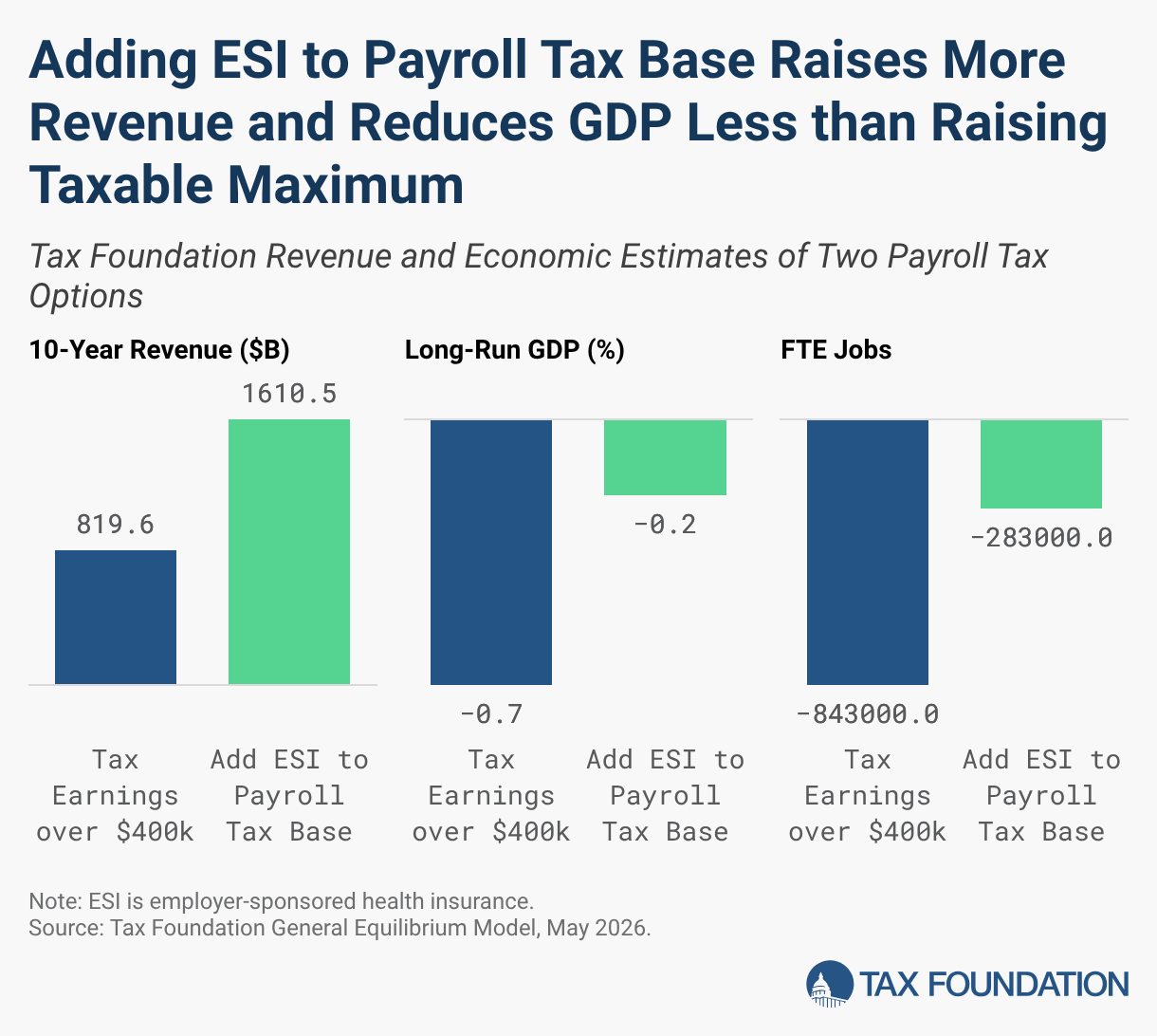
The payroll tax currently applies only to earnings under $184,500. The first option we compare (Option 45 in Options for Reforming America’s Tax Code 3.0: A Policymaker’s Guide to Tax Reform Trade-Offs) leaves that cap in place but applies the tax again to earnings above $400,000, creating a “donut hole” between $400,000 and the taxable maximum under current law. Since the $400,000 threshold would not be indexed for inflationInflation is when the general price of goods and services increases across the economy, reducing the purchasing power of a currency and the value of certain assets. The same paycheck covers less goods, services, and bills. It is sometimes referred to as a “hidden tax,” as it leaves taxpayers less well-off due to higher costs and “bracket creep,” while increasing the government’s spendin, the donut hole would eventually close around 2050, effectively uncapping the payroll tax and subjecting all wage and self-employment income to payroll taxes. This option raises $819.6 billion over 10 years on a dynamic basis, reduces long-run GDP by 0.7 percent, and reduces hours worked by 843,000 full-time equivalent jobs.
The second option (Option 46) adds ESI to the payroll tax baseThe tax base is the total amount of income, property, assets, consumption, transactions, or other economic activity subject to taxation by a tax authority. A narrow tax base is non-neutral and inefficient. A broad tax base reduces tax administration costs and allows more revenue to be raised at lower rates.. It raises $1.6 trillion on a dynamic basis over 10 years, reduces long-run GDP by 0.2 percent, and reduces hours worked by 283,000 full-time equivalent jobs.
Of the two options, broadening the base to include ESI is the more efficient way to raise revenue. It brings in almost twice as much revenue for a smaller cost to economic growth. The primary reason for the smaller GDP impact is that eliminating the exclusion would push some taxpayers above the payroll tax cap, so their marginal earnings would not be subject to the payroll tax.
Ending the exclusion has other benefits not captured by our model. Currently, workers take more of their compensation as insurance because insurance is tax-advantaged. And more expansive insurance plans typically come with lower deductibles, so patients face little of the marginal cost of the care they use, and the resulting spending raises prices for everyone, including those who never had employer coverage. Ending the exclusion would improve the neutrality of the tax code by treating more types of compensation the same, rather than providing a tax advantage for one over the other. Some compensation would shift out of health insurance and into other untaxed fringe benefits, such as employer contributions to employee savings accounts. Achieving full neutrality would require eliminating the income tax exclusion for all types of fringe benefits as well.
Taxing Employer-Sponsored Health Insurance Would Impact Middle-Income Taxpayers the Most
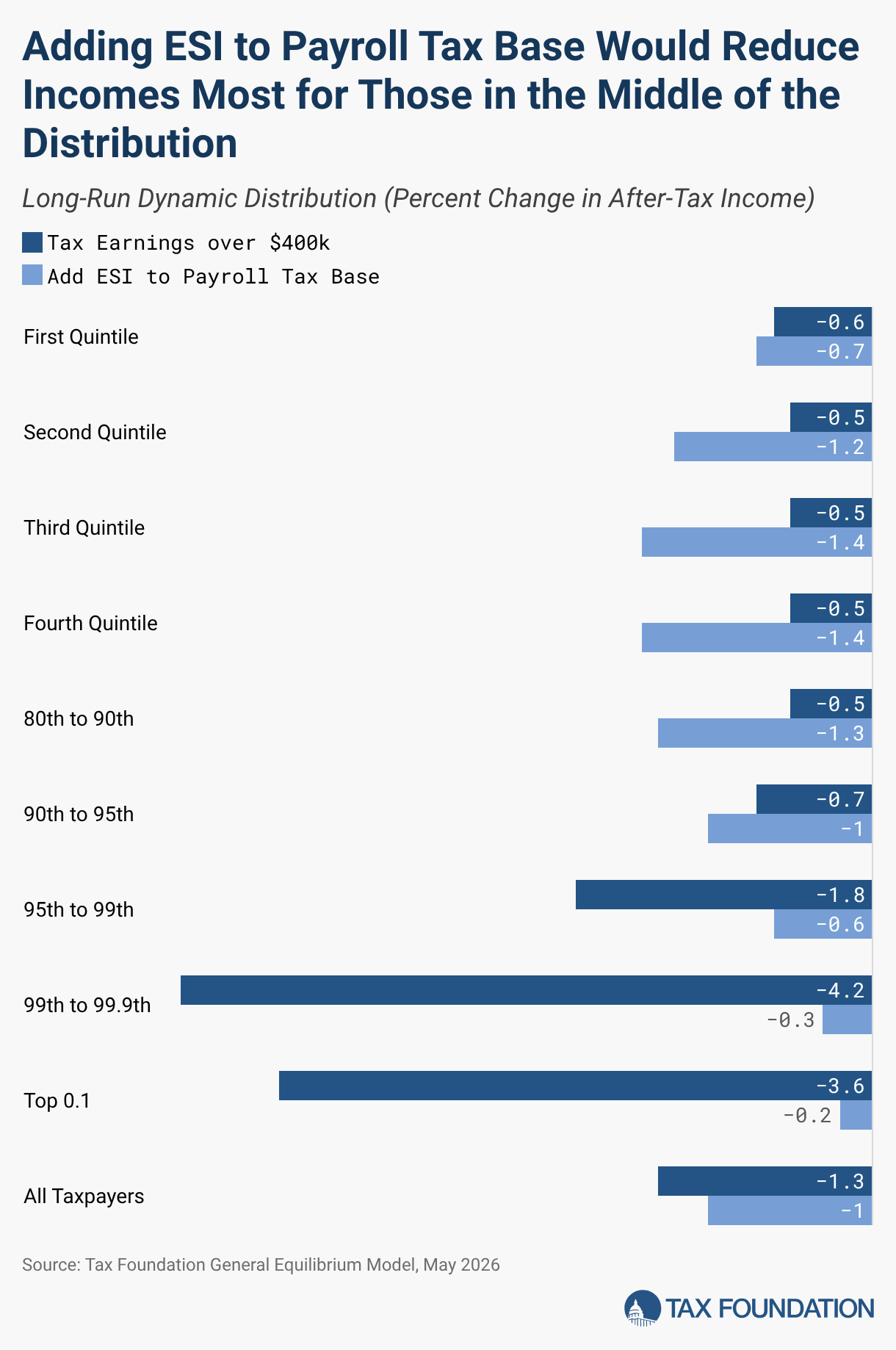
Because of the taxable maximum cap, the highest earners see little change in their tax burden from including ESI in the taxable base. Among taxpayers below the tax cap, the burden is lowest in the bottom quintile and heaviest in the middle and fourth, since low earners hold less extensive plans (or receive insurance through other sources, like Medicaid). That contrasts with the distributional burden of applying the payroll tax above $400,000 of earnings, which imposes the largest decrease in after-tax incomeAfter-tax income is the net amount of income available to invest, save, or consume after federal, state, and withholding taxes have been applied—your disposable income. Companies and, to a lesser extent, individuals, make economic decisions in light of how they can best maximize their earnings. on higher earners.
In general, when payroll tax contributions and benefits paid in retirement are assessed on a lifetime basis, Social Security as a whole is progressive: the program replaces a greater share of income in retirement for people at the bottom of the distribution compared to people at the top, with benefits in excess of what lower-income workers contributed during their working years. Taxing ESI would somewhat weaken the relationship between taxes paid during working years and benefits received during retirement years, as ESI would not be included in the benefit calculation, although it would be counted as part of the taxable payroll base.
The link could be better preserved by fully eliminating all the income and payroll tax exclusions for all fringe benefits, which would encourage employers to shift to cash compensation. Under that scenario, the link between taxes paid and benefits earned would remain, since shifting to cash compensation would raise wages used in the benefit calculation as well as raise taxes paid on compensation. On a lifetime basis, such a shift into taxable cash compensation would make taxing fringe benefits more progressive due to how Social Security calculates its replacement rates.
In comparison, uncapping the payroll tax as proposed with the “donut hole” option would, over time, severely delink taxes and benefits: income earned in excess of the current taxable maximum would face taxation, but there would be no adjustment to benefits. Policymakers could choose to adjust benefits to preserve that link, although we do not model that here.
A Broader Base Means Lower Rates (or Avoiding Higher Ones)
Untaxed compensation extends well beyond the payroll exclusion for health insurance. We estimate that over the budget window, $235.3 billion could be raised from extending the payroll tax to other fringe benefits, like life insurance or commuter benefits; $2.4 trillion from eliminating the income tax exclusion for health insurance; and $396.8 billion from extending the income tax to other fringe benefits, all on a dynamic basis.
Considered collectively, these are powerful revenue options. While uncapping the payroll tax and raising individual income taxAn individual income tax (or personal income tax) is levied on the wages, salaries, investments, or other forms of income an individual or household earns. The U.S. imposes a progressive income tax where rates increase with income. The Federal Income Tax was established in 1913 with the ratification of the 16th Amendment. Though barely 100 years old, individual income taxes are the largest source rates are often the go-to reform options for policymakers, base broadeners like ESI and other fringe benefits are much better alternatives. They can raise significant revenue, while improving the neutrality of the tax code and preventing the need for increases in statutory tax rates.
Stay informed on the tax policies impacting you.
Subscribe to our free newsletter to get the latest tax data, news and analysis.
Subscribe