Ideas, Not Mandates: Lessons Learned from a Decade of International Tax Reform
The past decade’s record suggests that countries have reliable legislative methods to improve their tax systems through ordinary tax reforms.
22 min read
The past decade’s record suggests that countries have reliable legislative methods to improve their tax systems through ordinary tax reforms.
22 min read
Facts & Figures serves as a one-stop state tax data resource that compares all 50 states on over 40 measures of tax rates, collections, burdens, and more.
2 min read
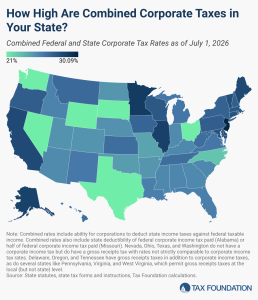
Forty-four states levy a corporate income tax, with top rates ranging from a 2 percent flat rate in North Carolina to an 11.5 percent top marginal rate in New Jersey. Four states—Georgia, Nebraska, North Carolina, and Pennsylvania—reduced their corporate income tax rates effective January 1, 2026.
5 min read
Forty-three states will ring in 2026 with notable tax changes. Eight states will see reduced individual income tax rates in the new year while four states will see reduced corporate income tax rates.
30 min read
In the spirit of change and improvement, it’s worth looking back to see which states have truly embraced tax competitiveness since 2020, and which ones have lagged behind.
6 min read
The State Tax Competitiveness Index enables policymakers, taxpayers, and business leaders to gauge how their states’ tax systems compare. While there are many ways to show how much state governments collect in taxes, the Index evaluates how well states structure their tax systems and provides a road map for improvement.
122 min read
Summer has arrived, and states are beginning to implement policy changes that were enacted during this year’s legislative session (or that have delayed effective dates or are being phased in over time).
28 min read
Facts & Figures serves as a one-stop state tax data resource that compares all 50 states on over 40 measures of tax rates, collections, burdens, and more.
2 min read
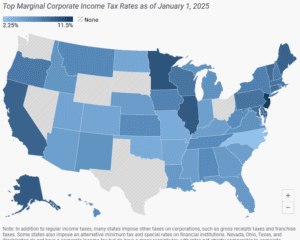
Forty-four states levy corporate income tax. Top rates range from a 2.25 percent flat rate in North Carolina to a 11.5 percent top marginal rate in New Jersey.
4 min read
Thirty-nine states will begin 2025 with notable tax changes, including nine states cutting individual income taxes. Recent years have seen a wave of significant tax reforms, and the changes scheduled for 2025 show that these efforts have not let up.
25 min read
The State Tax Competitiveness Index enables policymakers, taxpayers, and business leaders to gauge how their states’ tax systems compare. While there are many ways to show how much state governments collect in taxes, the Index evaluates how well states structure their tax systems and provides a road map for improvement.
115 min read
Due to the peculiar design of the proposed tax increase, it’s true: the largest tax increase Oregon has ever seen would create a substantial budget shortfall.
8 min read
Focusing on competitiveness, neutrality, and efficient policies to raise revenue would go a long way in increasing economic growth and stabilizing public finances over the long term.
7 min read
Under the tax created by Measure 118, Oregon businesses would be significantly disadvantaged against their larger and out-of-state rivals.
6 min read
Oregon’s Measure 118, though presented as a tax on big business, would function as an aggressive sales tax on consumers.
7 min read
Taxes are on the ballot this November—not just in the sense that candidates at all levels are offering their visions for tax policy, but also in the literal sense that voters in some states will get to decide important questions about how their states raise revenue.
9 min read
The sales tax is the second-largest source of state tax revenue and an important source of local tax revenue, but decades of base erosion threaten the tax’s share of overall revenue and have prompted years of countervailing rate increases.
72 min read
The proposal is a good example of what can be done to reduce tax burdens on residents if spending is constrained. There are real, tangible benefits associated with enacting this pro-growth reform that should not be discounted.
5 min read
To be fiscally responsible, recently proposed Pennsylvania tax cuts must be paid for in some way, either out of projected revenue growth or by offsetting reductions.
The data extraction mitigation fee is modeled after Maryland’s digital advertising tax, which has been mired in litigation since its inception and is very likely unconstitutional and in conflict with federal law.
6 min read