A forthcoming Tax Law Review article, “Taxation and Deglobalization,” by prominent legal scholar Reuven Avi-Yonah argues that after certain fixes to the tax baseThe tax base is the total amount of income, property, assets, consumption, transactions, or other economic activity subject to taxation by a tax authority. A narrow tax base is non-neutral and inefficient. A broad tax base reduces tax administration costs and allows more revenue to be raised at lower rates., including full expensingFull expensing allows businesses to immediately deduct the full cost of certain investments in new or improved technology, equipment, or buildings. It alleviates a bias in the tax code and incentivizes companies to invest more, which, in the long run, raises worker productivity, boosts wages, and creates more jobs. of investment, worries about the economic effects of a high corporate income taxA corporate income tax (CIT) is levied by federal and state governments on business profits. Many companies are not subject to the CIT because they are taxed as pass-through businesses, with income reportable under the individual income tax. rate would no longer apply. Other analysts and scholars—such as Kimberly Clausing, Jason Furman, Michael Linden, and Samantha Jacoby (see also Kyle Pomerleau’s response)—have made arguments in a similar vein: fix the base, raise the rate. Notably, these discussions generally consider top rates far below Avi-Yonah’s article, which entertains an 80 percent top rate.
There is a real danger that the well-founded admiration of expensing can slip into the belief that rates will not matter if the business tax base is correctly designed. Avi-Yonah’s article is a recent and well-articulated version of this intellectual undercurrent. While some of the reforms proposed could improve the US tax base, it is a mistake to think that they would eliminate the trade-offs involved in adopting a high corporate income tax rate.
Several of Avi-Yonah’s proposed reforms reduce the avenues through which multinationals can profit shift—reducing their taxA tax is a mandatory payment or charge collected by local, state, and national governments from individuals or businesses to cover the costs of general government services, goods, and activities. burden by moving their profits from high-tax to low-tax jurisdictions. Profit shiftingProfit shifting is when multinational companies reduce their tax burden by moving the location of their profits from high-tax countries to low-tax jurisdictions and tax havens. means that higher rates are required to collect the same tax revenue, and higher rates imply larger distortions. Some businesses are more capable of benefiting from profit shifting than others, and this non-neutrality distorts investments. Engaging in profit shifting also requires firms to directly spend resources on administration and compliance in ways that are economically unproductive. A good fix is to move the tax base toward something less prone to profit shifting.
One way to limit profit shifting is to move the US tax system toward a destination-based cash flow tax (DBCFT). A DBCFT includes denying the business tax deductionA tax deduction allows taxpayers to subtract certain deductible expenses and other items to reduce how much of their income is taxed, which reduces how much tax they owe. For individuals, some deductions are available to all taxpayers, while others are reserved only for taxpayers who itemize. For businesses, most business expenses are fully and immediately deductible in the year they occur, but ot for imports (including service imports), a zero tax rate on export income, full expensing, and denying interest expense deductions. Avi-Yonah’s specific proposals—which include a 10 percent tariffTariffs are taxes imposed by one country on goods imported from another country. Tariffs are trade barriers that raise prices, reduce available quantities of goods and services for US businesses and consumers, and create an economic burden on foreign exporters., rather than denying the deductibility of imports, and a digital services tax—differ in key respects from a DBCFT, but they can nevertheless be interpreted as moving broadly in the direction of the DBCFT reform.
A DBCFT has significant advantages. Denying the import deduction and exempting export income—together called “border adjustment”—closes off major profit-shifting mechanisms. Full expensing paired with no interest deduction—together called “cash flow taxation”—broadly reduces the distortive effects of taxation on investment decisions.
But Avi-Yonah takes this one step too far. He argues that once these reforms are in place, and the tax base is reformed, the usual worries about high corporate rates no longer apply, clearing the way for a top marginal rate of 80 percent. He writes:
Given the relationship between excessive rents — the supernormal returns of firms — to monopoly and pricing power, the corporate tax should be adjusted to collect some of these currently widespread rents. The adjustment should not impact permanent full expensing rules because they ensure normal corporate projects are effectively not taxed. For companies with profits higher than $10 billion where there is a high likelihood of monopolistic or cartel-like behavior, a progressive rate structure should tax their profits as high as 80 percent. Companies with profits lower than this should be subject to lower marginal rates, gradually decreasing with their profit level. . . . A corporate tax rate of 80% for global profits above $10 billion is hard to imagine in a globalized economy because corporations would move their profits or their headquarters. But in a deglobalizing economy, such a tax applied on a worldwide basis is more feasible, because it is harder to move without losing access to the US market.
Expensing is genuinely one of the most pro-growth reforms available, precisely because it reduces the sensitivity of investment decisions to the tax rate. Investors undertake a project only when its expected pre-tax return exceeds a minimum threshold called the user cost of capital. In the standard economic (Hall-Jorgenson) framework, this is written as follows:

In the equation, r is the required after-tax return, δ is economic depreciationDepreciation is a measurement of the “useful life” of a business asset, such as machinery or a factory, to determine the multiyear period over which the cost of that asset can be deducted from taxable income. Instead of allowing businesses to deduct the cost of investments immediately (i.e., full expensing), depreciation requires deductions to be taken over time, reducing their value and disco, τ is the tax rate, and z is the present value of cost-recovery deductions per dollar invested. Expensing sets z = 1, and the formula collapses to c = r + δ. Thus, under expensing, there is no tax rate in the formula, and so it would appear that taxes cannot distort investment decisions.
But the standard framework does not capture the entirety of the real-world tax system as it pertains to investment choices, and so one should be wary of drawing the conclusion that full expensing allows for arbitrarily high tax rates without significant economic consequences. For low or moderate rate changes, the standard framework is a good approximation; for an increase to 80 percent, the departures are too large to ignore.
To give just one specific example, consider innovation through the entry of firms, funded in part by founders who work for less than their market wage while they build the business. The inability of entrepreneurs to deduct their unpaid efforts—their “implicit wages”—for business tax purposes implies a departure from the standard user cost model. No tax system can fully allow and price a business deduction for this opportunity cost. This implies that the tax rate will not fully cancel out, even under full expensing.
To see this via an extension of the user cost formula, suppose an investment requires one dollar of explicit capital spending, fully expensed, plus a complementary input of the founder’s own effort, with opportunity cost φ per dollar of capital, which receives no business cost recoveryCost recovery refers to how the tax system permits businesses to recover the cost of investments through depreciation or amortization. Depreciation and amortization deductions affect taxable income, effective tax rates, and investment decisions.. The opportunity cost φ could be the market income the entrepreneur would earn by working at an established firm, net of labor taxes (Boskin). Comparing the required pre-tax return on this project cₕ at a high business rate τₕ to the required pre-tax return cₗ at a low business rate τₗ yields the following ratio:
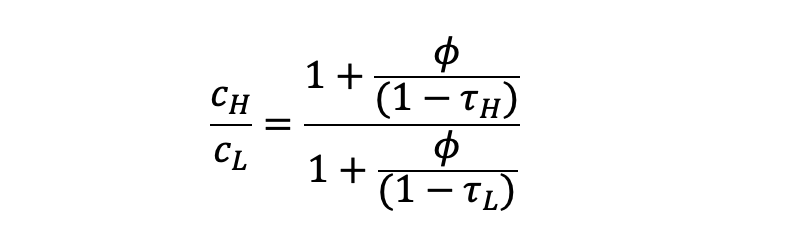
With the founder’s opportunity cost of unexpensed effort equal to half of the capital investment (motivated by estimates from Bhandari and McGrattan of sweat equity roughly matching fixed asset investment, halved by an assumed 50 percent labor tax rate), this implies raising the business rate from 21 percent to 80 percent would increase the required pre-tax return by about 114 percent. Moreover, raising the rate from 21 percent to 31 percent would increase the required return by about 6 percent, while raising the rate the same 10 percentage points from 70 percent to 80 percent would increase the required return by about 31 percent. The cost of raising the rate is thus modest when the rate is low, but very large when it is already high.
More broadly, whenever investment cost offsets are not symmetric with the taxation of gains, full expensing is no longer sufficient to ensure the tax rate cancels in the user cost calculation. An entrepreneur’s implicit wages are a stark example: in that case, part of the investment cost is not deductible for business tax purposes. But even investments deductible under the business tax can have their deduction delayed if the business is in a loss position. Indeed, if the business never turns a profit, the deduction may never be cashed in at all—and among venture-backed startups first funded between 1985 and 2009, 55 percent were terminated at a loss.
Moreover, Avi-Yonah’s particular rate proposal is progressive rather than flat, which can create asymmetric treatment. The asymmetry would arise intertemporally over the life cycle of the firm. For example, relieving early costs at 21 percent while taxing later profits at 80 percent would raise the user cost of capital, with the exact magnitude depending on timing, discounting, and the ability of firms to defer tax deductions through electing out of bonus depreciationBonus depreciation allows firms to deduct a larger portion of certain “short-lived” investments in new or improved technology, equipment, or buildings in the first year. Allowing businesses to write off more investments partially alleviates a bias in the tax code and incentivizes companies to invest more, which, in the long run, raises worker productivity, boosts wages, and creates more jobs.—which itself reintroduces the tax rate into the user cost.
These departures from the standard economic framework imply that the tax rate will still matter even under full expensing. Moving to an ideal tax base would lower the economic cost of today’s rate, and it would lower the cost of a modest rate increase. But it cannot justify an 80 percent rate.
Stay informed on the tax policies impacting you.
Subscribe to our free newsletter to get the latest tax data, news and analysis.
Subscribe