US Has Most Progressive Tax System in OECD, New Index Shows
A study from the Fraser Institute finds the US tax code is highly progressive relative to other OECD countries.
7 min read
A study from the Fraser Institute finds the US tax code is highly progressive relative to other OECD countries.
7 min read
Worldwide, 175 countries—including all major European countries—levy a value-added tax (VAT) on goods and services. However, to reduce compliance and administrative costs, most countries have VAT exemption thresholds: if a business is below a certain annual revenue threshold, it is not required to participate in the VAT system.
3 min read
Publicly held debt is projected to rise to a new record high of 106 percent of GDP within the next four years and continue to rise to 120 percent by 2036 and 175 percent by 2056.
8 min read
This study simulates several large tax increases and consistently finds that even tax increases large enough to close the primary deficit in the near term will lose ground over time and fail to put the debt on a sustainable course.
41 min read
Shifting Germany’s tax mix away from labor to consumption remains a sound policy route to strengthen the country’s labor supply, but further eroding the VAT base with preferential rates for selected goods and services would counteract this goal by depleting the extra revenue for labor tax cuts while providing less-targeted relief for low-income households.
6 min read
The US, as the world’s largest services exporter, has a stronger interest in combating discriminatory services taxation than in pursuing tariffs.
44 min read
The past decade’s record suggests that countries have reliable legislative methods to improve their tax systems through ordinary tax reforms.
22 min read
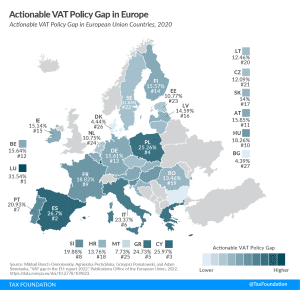
Closing the EU’s value-added tax (VAT) actionable policy gap could yield €773 billion in government revenue—four times the EU’s 2026 budget.
8 min read
Cigarette smokers in the European Union pay far more in excise taxes than they do for the cigarettes themselves. Our latest map illustrates the wide variance in cigarette excise taxes across EU Member States.
6 min read
AI is everywhere, and now it’s in the tax policy debate.
What is a border adjustment? Is it a new idea? How would it work in practice?
11 min read
The variety of approaches to taxation among European countries creates a need to evaluate these systems relative to each other. For that purpose, we have developed the European Tax Policy Scorecard—a relative comparison of European countries’ tax systems.
55 min read
Poland is proposing to broaden and raise its digital services tax (DST) from 1.5 percent to 3 percent. Because DSTs tax revenues, not profits, a company with a 10 percent profit margin would face a 30 percent effective tax rate on digital services provided in Poland.
6 min read
European policymakers would be wise to refocus tax and trade policies on what is good for Europe rather than trying to change policies in countries beyond European borders. Meanwhile, the Trump administration would be wise to recognize that the transatlantic relationship is a geoeconomic asset that can be mutually beneficial.
Formulary apportionment, global tax harmonization, and broad tax increases on services all face design, implementation, and economic barriers. When designing tax systems, policymakers should focus on doing the basic things well and avoid harmful policies that could stunt growth.
7 min read
AI technology has a wide range of potential economic outcomes. It would be a mistake to tailor tax policy to the extreme end of that range. Still, policymakers shouldn’t do nothing: they should instead make tax reforms that are sound regardless of which AI scenario emerges.
7 min read
The value-added tax (VAT) compliance gap—the additional VAT revenue that could be collected if all taxpayers, consumers, and businesses fully complied with VAT rules—continues to increase, reaching €128 billion in 2023.
8 min read
More than 175 countries worldwide—including all major European countries—levy a value-added tax (VAT) on goods and services. EU Member States’ VAT rates vary across countries, though they’re somewhat harmonized by the EU.
5 min read
Scandinavian countries are well known for their broad social safety nets and their public funding of services such as universal health care, higher education, parental leave, and child and elderly care. High levels of government spending naturally require high levels of taxation. So, how do these countries raise their tax revenues?
7 min read
For the past 12 years, the International Tax Competitiveness Index has examined which countries have truly embraced tax competitiveness and which ones have lagged behind. Our experts examine how country rankings have changed over time and identify the largest movers and shakers.
5 min read