Higher taxA tax is a mandatory payment or charge collected by local, state, and national governments from individuals or businesses to cover the costs of general government services, goods, and activities. rates can incentivize smuggling. As tax rates increase, consumers and suppliers search for ways around these costs. In cigarette markets, consumers tend to shop across borders where the tax rates are lower, and dealers develop black and gray markets to sell illegally to consumers, paying little or no tax at all. Growing cigarette tax levels and differentials have made cigarette smuggling both a national problem and a lucrative criminal enterprise.
Each year, in partnership with scholars at the Mackinac Center for Public Policy, we estimate cigarette smuggling rates for each US state and the District of Columbia. The most recent report uses data from 2023. As in previous years, the data show a strong positive relationship between cigarette smuggling and tax rates across the country.
California surpassed New York as the nationwide leader in cigarette smuggling for the first time since we’ve published our estimates. More than half the cigarettes consumed in California, an estimated 52.5 percent, weren’t purchased legally in the state. California was followed closely by New York, with an estimated smuggling rate of 51.8 percent.
On the other end of the spectrum, net outbound smuggling rates—where cigarettes are purchased in the state and consumed elsewhere—were highest in Wyoming (55.0 percent) and Virginia (47.9 percent). Wyoming and Virginia are well-positioned to accept cross-border shoppers looking to avoid higher taxes in neighboring states and areas like Colorado and Washington, DC.
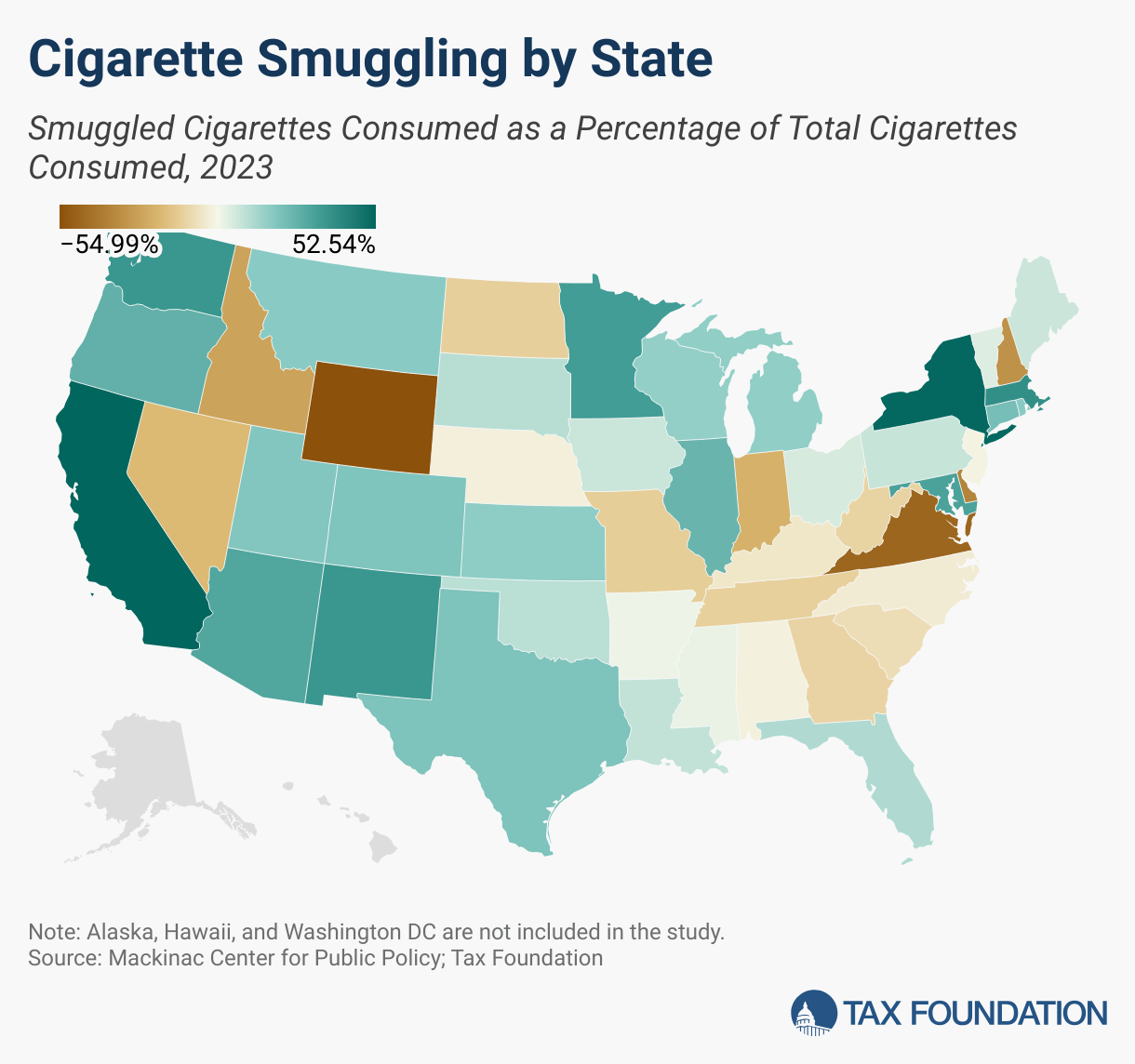
California Leads Nation in Cigarette Smuggling
Smuggled Cigarettes Consumed as a Percentage of Total Cigarettes Consumed and Forgone Tax Revenue, 2023
| State | State Tax (Cents per pack) | Smuggling Rate | Rank (Rate) | Smuggled Packs | Forgone Revenue |
|---|---|---|---|---|---|
| Alabama | 67.5 | -3.14% | 32 | (6,449,840) | $(4,353,642) |
| Arizona | 200.0 | 29.92% | 8 | 54,489,930 | $108,979,860 |
| Arkansas | 115.0 | 0.18% | 30 | 219,058 | $251,917 |
| California | 287.0 | 52.54% | 1 | 513,927,476 | $1,474,971,856 |
| Colorado | 194.0 | 19.14% | 13 | 29,335,412 | $56,910,700 |
| Connecticut | 435.0 | 21.31% | 11 | 17,389,443 | $75,644,075 |
| Delaware | 210.0 | -37.79% | 46 | (12,067,095) | $(25,340,900) |
| Florida | 133.9 | 10.52% | 20 | 77,967,986 | $104,399,134 |
| Georgia | 37.0 | -12.10% | 37 | (42,776,165) | $(15,827,181) |
| Iowa | 136.0 | 6.13% | 25 | 7,383,332 | $10,041,331 |
| Idaho | 57.0 | -27.58% | 44 | (11,306,688) | $(6,444,812) |
| Illinois | 298.0 | 24.38% | 10 | 78,005,186 | $232,455,454 |
| Indiana | 99.5 | -22.95% | 43 | (61,657,997) | $(61,349,707) |
| Kansas | 129.0 | 16.09% | 17 | 14,820,694 | $19,118,696 |
| Kentucky | 110.0 | -6.22% | 35 | (16,210,459) | $(17,831,505) |
| Louisiana | 108.0 | 7.42% | 23 | 15,269,268 | $16,490,809 |
| Massachusetts | 351.0 | 37.90% | 3 | 59,445,378 | $208,653,275 |
| Maryland | 375.0 | 31.40% | 7 | 47,883,826 | $179,564,349 |
| Maine | 200.0 | 6.02% | 26 | 3,465,404 | $6,930,808 |
| Michigan | 200.0 | 15.57% | 18 | 59,924,460 | $119,848,920 |
| Minnesota | 373.2 | 33.33% | 6 | 58,934,384 | $219,943,121 |
| Missouri | 17.0 | -13.90% | 41 | (47,032,732) | $(7,995,564) |
| Mississippi | 68.0 | 0.92% | 29 | 1,257,453 | $855,068 |
| Montana | 170.0 | 16.72% | 16 | 6,787,706 | $11,539,100 |
| North Carolina | 45.0 | -4.77% | 34 | (21,981,296) | $(9,891,583) |
| North Dakota | 44.0 | -13.37% | 40 | (4,305,028) | $(1,894,212) |
| Nebraska | 64.0 | -3.62% | 33 | (2,271,852) | $(1,453,985) |
| New Hampshire | 178.0 | -32.96% | 45 | (25,955,058) | $(46,200,004) |
| New Jersey | 270.0 | -2.51% | 31 | (4,378,411) | $(11,821,709) |
| New Mexico | 200.0 | 35.45% | 4 | 21,365,443 | $42,730,887 |
| Nevada | 180.0 | -20.05% | 42 | (13,375,063) | $(24,075,113) |
| New York | 435.0 | 51.82% | 2 | 186,796,019 | $812,562,683 |
| Ohio | 160.0 | 4.15% | 27 | 19,550,495 | $31,280,792 |
| Oklahoma | 203.0 | 8.74% | 22 | 15,473,146 | $31,410,487 |
| Oregon | 333.0 | 26.14% | 9 | 34,932,332 | $116,324,666 |
| Pennsylvania | 260.0 | 6.55% | 24 | 26,355,897 | $68,525,333 |
| Rhode Island | 425.0 | 17.00% | 15 | 5,979,941 | $25,414,750 |
| South Carolina | 57.0 | -9.22% | 36 | (18,060,248) | $(10,294,342) |
| South Dakota | 153.0 | 9.20% | 21 | 2,837,616 | $4,341,552 |
| Tennessee | 62.0 | -13.31% | 39 | (36,534,285) | $(22,651,257) |
| Texas | 141.0 | 19.45% | 12 | 166,223,650 | $234,375,346 |
| Utah | 170.0 | 18.36% | 14 | 9,757,392 | $16,587,566 |
| Virginia | 60.0 | -47.93% | 47 | (104,069,519) | $(62,441,711) |
| Vermont | 308.0 | 2.80% | 28 | 495,627 | $1,526,531 |
| Washington | 302.5 | 35.44% | 5 | 50,294,189 | $152,139,921 |
| Wisconsin | 252.0 | 15.09% | 19 | 31,606,577 | $79,648,573 |
| West Virginia | 120.0 | -12.27% | 38 | (13,027,735) | $(15,633,282) |
| Wyoming | 60.0 | -54.99% | 48 | (7,876,107) | $(4,725,664) |
Note: Estimates based on differences in legal sales and reported smoking rates. Alaska, Hawaii, and Washington DC are not included in the study.
Data compiled by Adam Hoffer, Jacob Macumber-Rosin
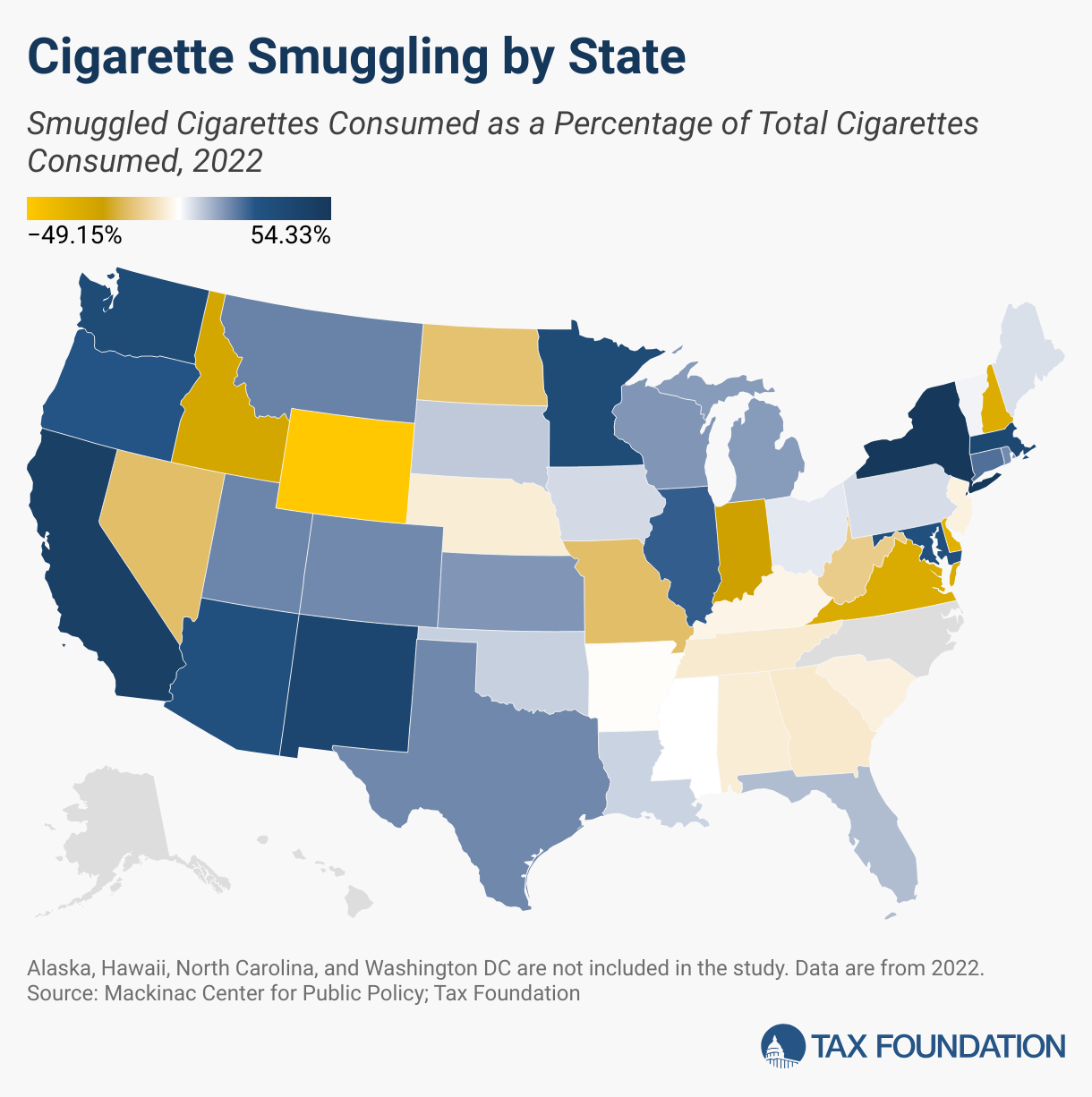
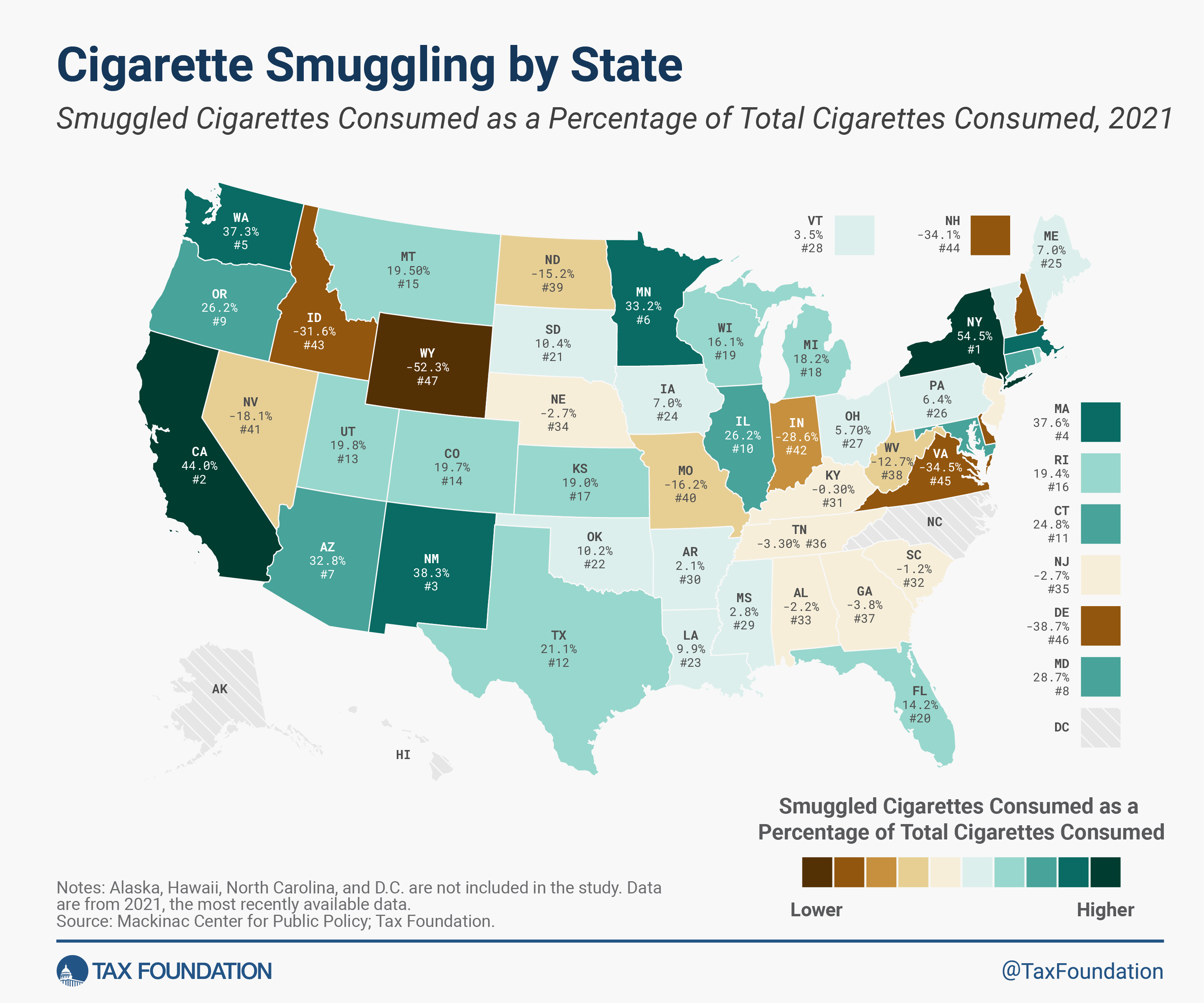


Major Changes from 2024 Estimates
- California became the largest smuggling state with a rate of 52.5 percent.
- Montana was the largest mover, improving four spots as its smuggling rate changed from 20.9 percent to 16.7 percent.
- Maine and Pennsylvania swapped spots at ranks 24 and 26, respectively.
The increase in smuggling in California is likely due to our data finally capturing the state’s prohibition on flavored cigarettes. We previously detailed the impact Massachusetts’ flavor ban had on the state’s tobacco revenue and smuggling. We also predicted California’s flavor ban would cost the state hundreds of millions of dollars annually—an estimate that has proved true—all while smoking behavior remained mostly unchanged. Illicit products have filled the void in legal sales.
Cigarette smuggling is costly for states. We estimate that the forgone revenue from smuggled cigarettes totaled more than $4 billion in 2023. California lost nearly $1.5 billion in cigarette excise taxAn excise tax is a tax imposed on a specific good or activity. Excise taxes are commonly levied on cigarettes, alcoholic beverages, soda, gasoline, insurance premiums, amusement activities, and betting, and typically make up a relatively small and volatile portion of state and local and, to a lesser extent, federal tax collections. collections, and New York missed out on more than $800 million.
Virginia was the largest benefactor of smuggling-related cigarette tax revenue, netting the state more than $62 million. Indiana was second highest, with net smuggling generating more than $61 million for the Hoosier State.
Evidence from flavor bans in Massachusetts and now California indicates that, just as with alcohol prohibition in the 1920s, consumers can and will acquire prohibited products. While consumption remains largely unchanged, consumers get pushed to illicit markets that often have more dangerous products and prop up sophisticated organized criminal enterprises supplying their demand. Flavor bans and nicotine bans (or effective bans from FDA inaction) burden consumers, domestic legal businesses, and states that lose tax revenue and face higher enforcement costs. In fact, criminal organizations seem to be the only beneficiaries.
While some states may benefit from cross-border trade, no state benefits from the illicit market of smuggled and counterfeit cigarettes. Many of these illicit cigarettes are smuggled from China, where an estimated 400 billion counterfeit cigarettes are produced annually. Counterfeit cigarettes are often more dangerous, containing toxic heavy metals and other contaminants, and some of the billions of dollars moved through cigarette smuggling internationally fund terrorism.
State enforcement agencies bear additional burdens trying, and almost entirely failing, to combat these large-scale smuggling operations. Anti-smuggling task forces in various states seize hundreds of thousands of dollars’ worth of contraband cigarettes. However, these seizures are often a minuscule amount of the overall market. Five arrests and a major seizure of 18,000 packs of cigarettes by a multi-agency investigation in New York, for instance, represented 0.007 percent of estimated annual smuggling activity in the state.
Illicit markets for tax avoidance and smuggling are also becoming an increasingly prominent issue in the vaping market as well. Lawmakers could learn the lessons of cigarette taxation and prohibition and apply them to vaping regulation, but states are often falling into the same pitfalls that hurt revenues, legal businesses, and consumers.
Legal markets suffer when untaxed and unregulated products receive significant competitive advantages from high taxes and prohibitions. Illicit markets create additional dangers for consumers, and subsequently additional burdens on public health, and undermine both legitimate domestic businesses and state revenue generation.
Policymakers should consider the unintended, but foreseeable, consequences as they determine tax rates and regulatory regimes for tobacco and nicotine products.
Stay informed on the tax policies impacting you.
Subscribe to our free newsletter to get the latest tax data, news and analysis.
Subscribe