The Spiraling Cost of Federal Healthcare Subsidies and Carveouts
The US federal government faces several fiscal challenges in the coming decades, including the growing burden of federal healthcare programs and tax preferences.
14 min read
The US federal government faces several fiscal challenges in the coming decades, including the growing burden of federal healthcare programs and tax preferences.
14 min read
The “no tax on” deductions show the drawbacks of using narrowly tailored provisions to provide tax relief.
6 min read
Oral nicotine pouches have rapidly become a popular option for consumers who want nicotine without the harmful combustion and chemicals of traditional cigarettes. As these alternative nicotine products (ANPs) successfully draw smokers to non-combustible nicotine consumption, many states have scrambled to incorporate these new products into their tax regimes.
6 min read
Policymakers considering AI-specific token or compute taxes can learn from the “bit tax” proposals of the 1990s during the rise of the internet.
6 min read
Most Americans don’t understand how the tax code works. According to a poll conducted by TaxEDU, a majority of respondents do not have a basic understanding of common tax concepts.
Jock taxes on highly paid athletes and entertainers are here to stay, but states could make life easier for the rest of us, at very little cost, by adopting reasonable nonresident filing and withholding thresholds for ordinary taxpayers.
5 min read
A Destination-Based Cash Flow Tax (DBCFT) reduces the tax code’s penalty on investment, narrows its bias toward debt over equity, and removes much of the incentive to shift profits abroad.
7 min read
As energy prices have declined, European countries have switched the focus of their windfall profits taxes—a one-time tax levied on a company or industry when economic conditions result in large, unexpected profits—from energy providers to the banking and financial sector.
7 min read
Investment in digital assets, long thought of as a niche interest reserved for enthusiasts, has broken into the mainstream. In 2026, about one in five US adults report being invested in or using cryptocurrency.
5 min read
Economists and journalists have been pointing to a labor share of income series from the Bureau of Labor Statistics (BLS) as evidence that capital is taking an ever-increasing slice of the economic pie. But a closer look at the national income accounts shows a different story.
7 min read
Ten years ago, then-Speaker Paul Ryan and Ways and Means Chairman Kevin Brady released the “Better Way” Tax Plan, the blueprint that would eventually become the Tax Cuts and Jobs Act of 2017—the largest overhaul of the US tax code in over 30 years.
Tax Foundation’s new resource, Options for Reforming America’s Tax Code 3.0, demonstrates that not all revenue-raising options are created equal—some do more harm to the economy than others for the same amount of revenue.
7 min read
A new paper finds that foreign exporters absorbed 47 percent of the tariff burden, passing on a smaller share to US importers than estimated by other studies.
6 min read
When properly measured, consistent with how we assess progressivity in tax policy, Social Security benefits are progressive.
5 min read
If America’s leaders today want to learn how to build a lasting system on the foundation of simplicity and neutrality, they should follow the Siim Kallas blueprint.
4 min read
Federal government debt is over $32 trillion, around the size of the nation’s annual economic output (its gross domestic product, or GDP). Debt levels this high mean US borrowing costs are sensitive to interest rate changes that may otherwise seem small.
5 min read
California levies the highest tax on gasoline at 73.6 cents per gallon (cpg), followed by Illinois at 70.4 cpg and Indiana at 63.1 cpg.
10 min read
How we support savings in the US is too complex, and Trump Accounts worsen the problem. If lawmakers truly want to increase savings for taxpayers from day one, they should look to the UK and Canada, which have done it successfully for many years.
In 2025, the CTP reduced the backlog of premarket tobacco product applications (PMTAs) by about 70 percent. This year, the CTP is already accelerating PMTA reviews further and allowing some leeway for products under review but not yet officially authorized. This is great progress, but much more can be made.
7 min read
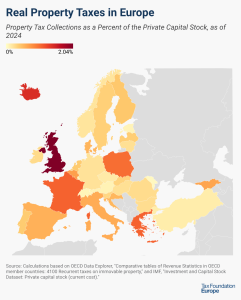
Twenty-four out of the 35 European countries covered in this map currently levy estate, inheritance, or gift taxes.
4 min read