Wireless services are often the sole means of communication and connectivity for Americans, especially younger people and low-income households, yet government taxes and fees continue to rise. In 2026, a typical American household with four phones on a shared plan, paying $100 per month for taxable wireless service, will pay about $345 per year in taxes, fees, and government surcharges in 2026—up from $330 in 2025. This increase continues a longstanding trend of government-imposed costs that drive up consumer bills.
The wireless market has become increasingly competitive. The result has been steady declines in the average price for wireless services. Over the past two decades, the average monthly revenue per wireless line has fallen from $50.64 per month to $33.14 per month. Unfortunately, this price reduction for consumers has been partially offset by higher taxes. Over the same time, taxes have increased from 16.2 to 28.8 percent of a monthly bill.
Taxes on wireless services increased to their highest level ever, driven by another federal Universal Service Fund (FUSF) surcharge rate increase and a small increase in state and local taxes. The state and local taxA tax is a mandatory payment or charge collected by local, state, and national governments from individuals or businesses to cover the costs of general government services, goods, and activities. burden increased from 14.25 percent to 14.42 percent, while the FUSF surcharge rate increased from 13.26 percent to 14.39 percent.
There are nearly 600 million wireless subscriber connections in the United States. In total, wireless subscribers will pay approximately $11.4 billion in taxes to state and local governments in 2026 based on the tax rates calculated in this report, including:
- $4.6 billion in sales taxes and other non-discriminatory consumption taxes that also apply to other taxable goods and services
- $4.2 billion in state and local 911 and 988 fees, which includes hundreds of millions of dollars that are not actually used for 911 purposes in some states
- $2.5 billion in additional telecommunications-specific taxes
The map illustrates the combined state and local tax burdens in each state. Illinois has the highest wireless taxes in the country with state and local rates more than 25.0 percent, followed by Arkansas at 22.0 percent and Washington state at 21.9 percent. The lowest wireless taxes and fees were levied in Idaho, at 3.4 percent, followed by Nevada at 6.1 percent and Montana at 7.1 percent.
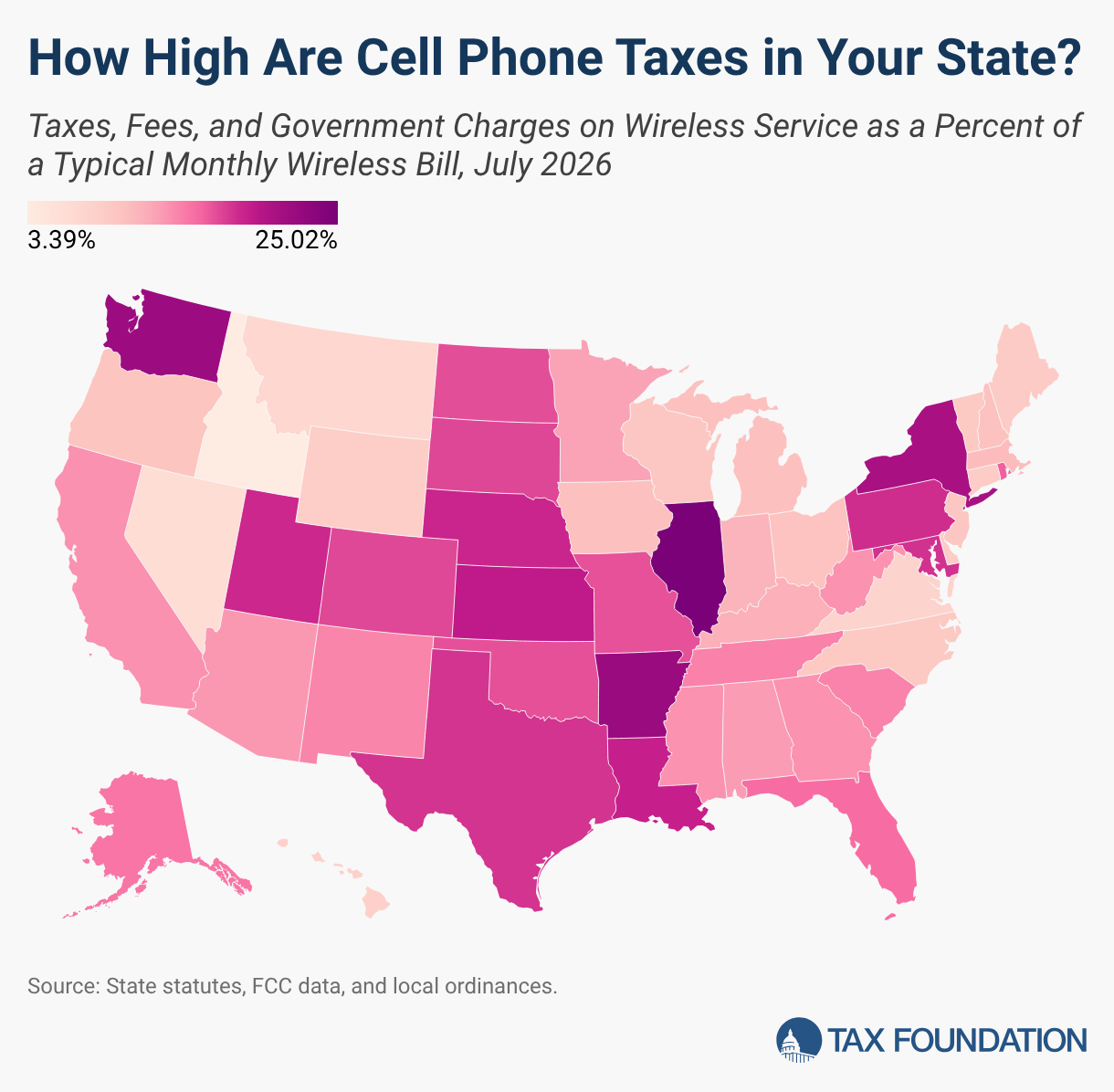
We compare the percentage rates of the taxes, fees, and government surcharges imposed on taxable wireless services, referred to hereafter as “taxes.” Flat rate impositions, such as a $1.00 per month per line 911 fee, are converted to a percentage using the average monthly industry revenue per line as tracked by the Cellular Telecommunications and Internet Association (CTIA). For a full description of the methodology used to determine tax rates in the states, and a detailed discussion of the policy implications of wireless taxes, please refer to the 2025 Report.
The Permanent Internet Tax Freedom Act prevents state and local governments from imposing taxes on internet access services, including wireless internet access. Without the protection of this federal law, the high excise taxAn excise tax is a tax imposed on a specific good or activity. Excise taxes are commonly levied on cigarettes, alcoholic beverages, soda, gasoline, insurance premiums, amusement activities, and betting, and typically make up a relatively small and volatile portion of state and local and, to a lesser extent, federal tax collections. rates applied to taxable wireless services could be applied to internet access, and consumer tax burdens would be significantly higher.
Most states impose a flat, per-line tax on telecommunications customers to fund capital and operating expenses for state and local emergency 911 systems. These fees vary significantly among states and localities. Most counties in Missouri charge no fee, while Chicago levies $5.00 per line per month.
In 2021, a new tax began appearing on customer bills. The FCC mandated that a new three-digit number, 988, be designated nationally to contact suicide prevention hotlines that will be operated by the states. A law passed by Congress authorized states to impose 988 taxes to pay for some of the creation and operation of 988 crisis hotline centers. In 2021, Virginia was the first state to impose a new 988 tax at $0.12 per line per month. Since then, 10 additional states have enacted 988 taxes on wireless consumers.
Nearly half of all states impose their own state Universal Service Fund (SUSF) charge on wireless services. SUSFs provide subsidies for many of the same purposes as the FUSF. Under federal law, the federal government imposes the charge as a percentage of interstate revenues, and states may impose a charge as a percentage of intrastate revenues. Recently, however, some states have shifted from a percentage-based charge to a per-line SUSF imposition, which has resulted in a large portion of the SUSF burden being borne by multi-line wireless plans.
In addition to 911 fees, 988 fees, SUSF, and FUSF charges, 13 states impose wireless taxes that are either in addition to sales taxes or in lieu of sales taxes but at a higher rate. In 2025, the Maine legislature voted to repeal the Service Provider Tax that imposed a higher state tax rate on wireless services.
Policymakers should be cautious about expanding wireless taxes, fees, and government surcharges for two primary reasons. First, wireless taxes are regressive and have a disproportionate impact on low-income consumers. Excessive taxes and fees increase the cost of access to wireless services for low-income consumers at a time when many rely on wireless services as their only telecommunications service.
Second, discriminatory taxes may slow investment in wireless infrastructure. Ample evidence exists that investments in wireless networks provide economic benefits to the broader economy because so many sectors—transportation, health care, energy, education, and even government—use wireless networks to boost productivity and efficiency. These economic benefits were especially important during the COVID-19 pandemic because wireless networks enabled employees to work remotely and allowed students to continue their studies.
These trends have continued post-pandemic. Network investment is important not only to consumers and businesses that use these wireless networks but also to the entire American economy.
Applying the sales taxA sales tax is levied on retail sales of goods and services and, ideally, should apply to all final consumption with few exemptions. Many governments exempt goods like groceries; base broadening, such as including groceries, could keep rates lower. A sales tax should exempt business-to-business transactions which, when taxed, cause tax pyramiding. , a traditional broad-based consumption taxA consumption tax is typically levied on the purchase of goods or services and is paid directly or indirectly by the consumer in the form of retail sales taxes, excise taxes, tariffs, value-added taxes (VAT), or income taxes where all savings are tax-deductible., is perfectly appropriate, but excessive targeted taxation of wireless services lacks the traditional justifications—a user-pays system or the internalization of social costs—for excise taxation, raising consumer costs and discouraging investment.
Taxes, Fees, and Government Charges on Wireless Service, July 2026
| State | State and Local Wireless Rate | Federal USF Rate | Combined Federal/State/Local Rate | Rank |
|---|---|---|---|---|
| Alabama | 12.73% | 14.39% | 27.12% | 28 |
| Alaska | 14.70% | 14.39% | 29.09% | 19 |
| Arizona | 12.95% | 14.39% | 27.34% | 27 |
| Arkansas | 22.04% | 14.39% | 36.43% | 2 |
| California | 13.24% | 14.39% | 27.63% | 23 |
| Colorado | 16.76% | 14.39% | 31.15% | 13 |
| Connecticut | 8.73% | 14.39% | 23.12% | 43 |
| Delaware | 8.68% | 14.39% | 23.07% | 44 |
| Florida | 15.11% | 14.39% | 29.50% | 18 |
| Georgia | 13.23% | 14.39% | 27.62% | 24 |
| Hawaii | 8.15% | 14.39% | 22.54% | 46 |
| Idaho | 3.39% | 14.39% | 17.78% | 50 |
| Illinois | 25.02% | 14.39% | 39.41% | 1 |
| Indiana | 11.29% | 14.39% | 25.68% | 31 |
| Iowa | 10.11% | 14.39% | 24.50% | 33 |
| Kansas | 19.11% | 14.39% | 33.50% | 5 |
| Kentucky | 11.55% | 14.39% | 25.94% | 30 |
| Louisiana | 18.60% | 14.39% | 32.99% | 6 |
| Maine | 8.82% | 14.39% | 23.21% | 42 |
| Maryland | 17.59% | 14.39% | 31.98% | 10 |
| Massachusetts | 10.78% | 14.39% | 25.17% | 32 |
| Michigan | 10.10% | 14.39% | 24.49% | 34 |
| Minnesota | 12.35% | 14.39% | 26.74% | 29 |
| Mississippi | 13.19% | 14.39% | 27.58% | 26 |
| Missouri | 16.38% | 14.39% | 30.77% | 16 |
| Montana | 7.07% | 14.39% | 21.46% | 48 |
| Nebraska | 18.31% | 14.39% | 32.70% | 7 |
| Nevada | 6.07% | 14.39% | 20.46% | 49 |
| New Hampshire | 10.02% | 14.39% | 24.41% | 35 |
| New Jersey | 9.34% | 14.39% | 23.73% | 38 |
| New Mexico | 13.81% | 14.39% | 28.20% | 22 |
| New York | 20.64% | 14.39% | 35.03% | 4 |
| North Carolina | 9.14% | 14.39% | 23.53% | 41 |
| North Dakota | 16.50% | 14.39% | 30.89% | 14 |
| Ohio | 9.81% | 14.39% | 24.20% | 36 |
| Oklahoma | 16.42% | 14.39% | 30.81% | 15 |
| Oregon | 9.57% | 14.39% | 23.96% | 37 |
| Pennsylvania | 17.88% | 14.39% | 32.27% | 9 |
| Rhode Island | 15.77% | 14.39% | 30.16% | 17 |
| South Carolina | 13.90% | 14.39% | 28.29% | 21 |
| South Dakota | 16.78% | 14.39% | 31.17% | 12 |
| Tennessee | 14.03% | 14.39% | 28.42% | 20 |
| Texas | 17.49% | 14.39% | 31.88% | 11 |
| Utah | 18.18% | 14.39% | 32.57% | 8 |
| Vermont | 9.17% | 14.39% | 23.56% | 40 |
| Virginia | 7.84% | 14.39% | 22.23% | 47 |
| Washington | 21.85% | 14.39% | 36.24% | 3 |
| West Virginia | 13.22% | 14.39% | 27.61% | 25 |
| Wisconsin | 9.32% | 14.39% | 23.71% | 39 |
| Wyoming | 8.45% | 14.39% | 22.84% | 45 |
| District of Columbia | 12.29% | 14.39% | 26.68% | 30 |
Stay informed on the tax policies impacting you.
Subscribe to our free newsletter to get the latest tax data, news and analysis.
Subscribe