With taxA tax is a mandatory payment or charge collected by local, state, and national governments from individuals or businesses to cover the costs of general government services, goods, and activities. season underway, millions of Americans are gathering the necessary paperwork to file their income tax returns, which for many is a time-consuming, resource-intensive, and tedious task. According to the Internal Revenue Service (IRS), this tax season, nonbusiness individual income taxpayers will spend an average of 8 hours and $160 filing their federal tax returns, while owners of pass-through businesses will spend an average of 21 hours and $610 to file. When state (and sometimes local) filing is required, the costs of compliance grow even higher. And for taxpayers who work in more than one state and are required to file nonresident income tax returns, the complexity of filing in multiple states (and sometimes multiple localities) can be enough to frustrate even professional tax preparers.
Some taxpayers respond to exceedingly complex or burdensome tax laws by cutting corners, while many unknowingly make mistakes due to a lack of tax expertise. One area of the tax code in which extreme complexity and low compliance go hand-in-hand—and where reform is desperately needed—is in states’ individual income taxAn individual income tax (or personal income tax) is levied on the wages, salaries, investments, or other forms of income an individual or household earns. The U.S. imposes a progressive income tax where rates increase with income. The Federal Income Tax was established in 1913 with the ratification of the 16th Amendment. Though barely 100 years old, individual income taxes are the largest source filing and withholdingWithholding is the income an employer takes out of an employee’s paycheck and remits to the federal, state, and/or local government. It is calculated based on the amount of income earned, the taxpayer’s filing status, the number of allowances claimed, and any additional amount the employee requests. laws.
Nonresident Individual Income Tax Filing Thresholds
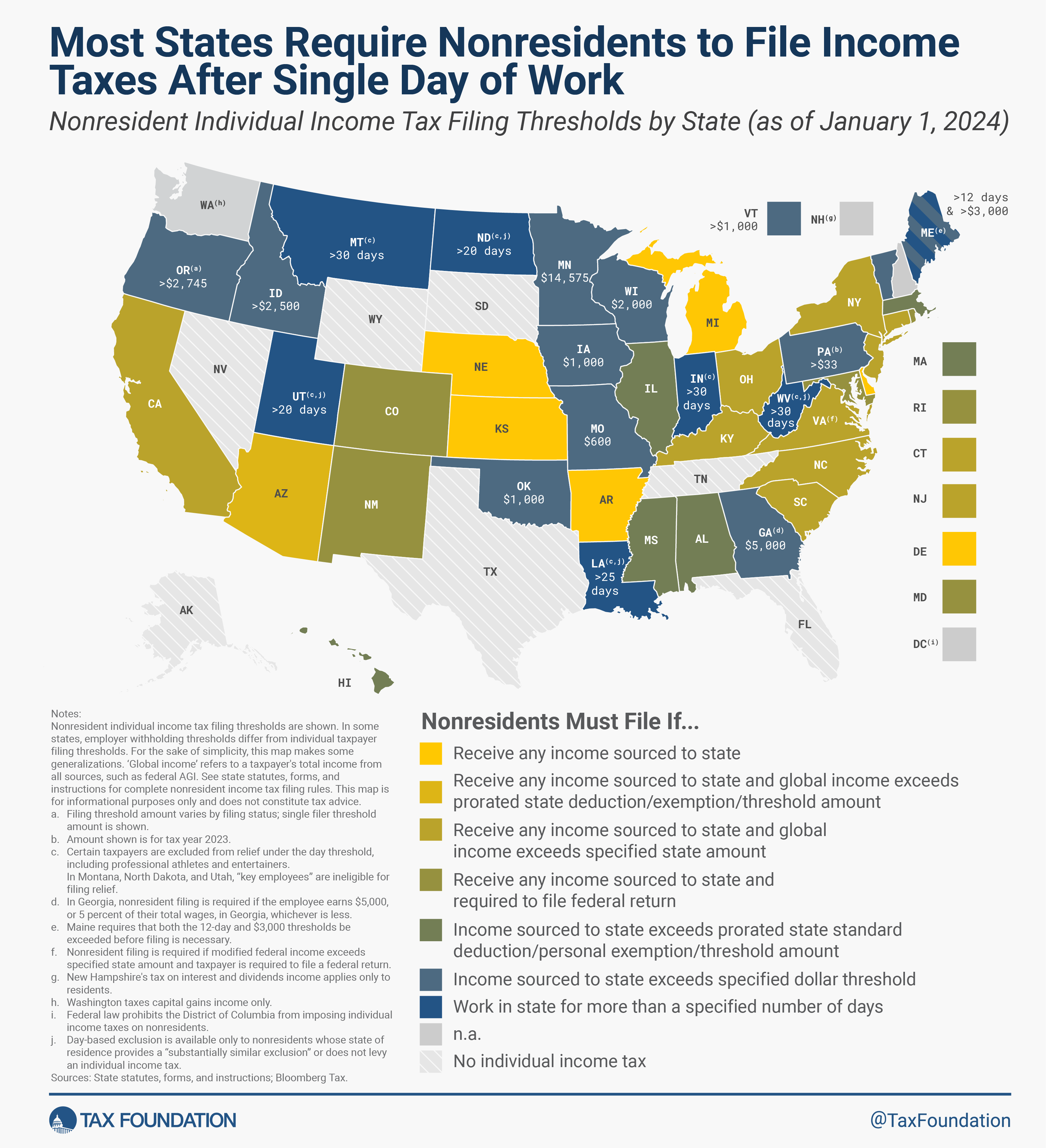
As of January 1, 2026, 22 states have no meaningful nonresident filing threshold, requiring most nonresidents to file an individual income tax return if they spend even a single day working in the state. Meanwhile, 19 states have filing thresholds that relieve nonresidents from filing when they perform limited work in the state. Of these, eight states’ thresholds are based on the number of days worked in the state, ranging from 20 days (with a mutuality requirement, explained later) in North Dakota to 30 days (with no mutuality requirement) in Illinois, Indiana, Louisiana, and Montana.
Nine states’ thresholds are based on the amount of income earned in the state, ranging from $100 in Vermont to $15,300 in Minnesota. Two states, Connecticut and Maine, require nonresidents to file only if they spend a certain number of days working in the state and earn a certain amount of income in the state. Finally, nine states do not levy an individual income tax on wage or salary income at all, while federal law prohibits the District of Columbia from applying its individual income tax to nonresidents.
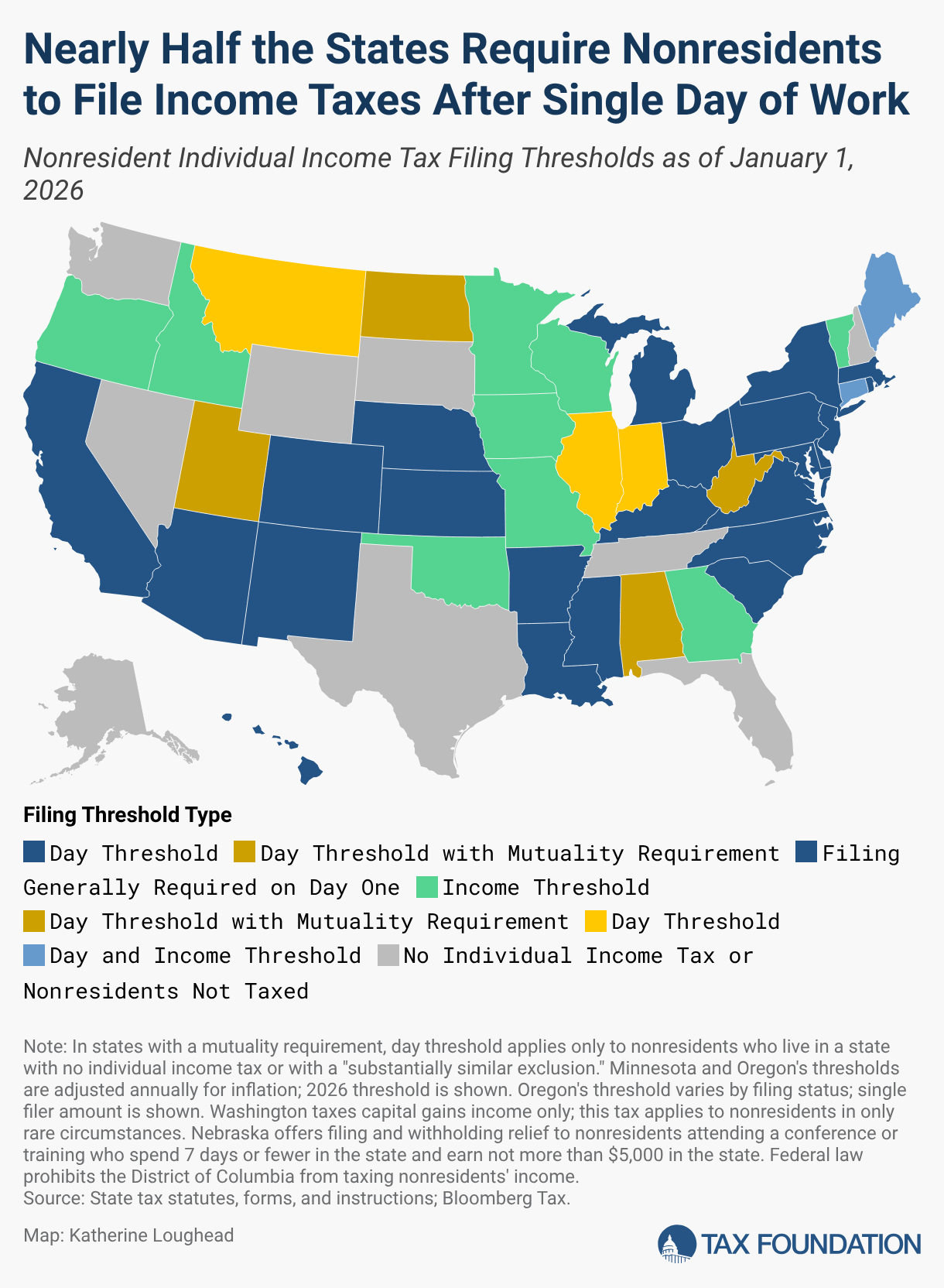
Nonresident Individual Income Tax Filing and Withholding Thresholds (as of January 1, 2026)
| State | Filing Threshold | Withholding Threshold |
|---|---|---|
| Alabama | > 30 days (a) | > 30 days (a) |
| Alaska | n.a. | n.a. |
| Arizona | 1 day | 60 days |
| Arkansas | 1 day | 1 day |
| California | 1 day | > $1,500 |
| Colorado | 1 day | 1 day |
| Connecticut | > 15 days and > $6,000 | > 15 days |
| Delaware | 1 day | 1 day |
| Florida | n.a. | n.a. |
| Georgia | $5,000 or 5% of wages | > 23 days or > $5,000 or > 5% of wages |
| Hawaii | 1 day | > 60 days |
| Idaho | > $2,500 | $1,000 |
| Illinois | > 30 days | > 30 days |
| Indiana | > 30 days | > 30 days |
| Iowa | $1,000 | 1 day |
| Kansas | 1 day | 1 day |
| Kentucky | 1 day | 1 day |
| Louisiana | > 30 days | > 30 days |
| Maine | > 12 days and > $3,000 | > 12 days and > $3,000 |
| Maryland | 1 day | 1 day |
| Massachusetts | 1 day | 1 day |
| Michigan | 1 day | 1 day |
| Minnesota | $15,300 (MN sources) (b) | $15,300 (all sources) (b) |
| Mississippi | 1 day | 1 day |
| Missouri | $600 | 1 day |
| Montana | > 30 days | > 30 days |
| Nebraska | 1 day (c) | 1 day (c) |
| Nevada | n.a. | n.a. |
| New Hampshire | n.a. | n.a. |
| New Jersey | 1 day | 1 day |
| New Mexico | 1 day | > 15 days |
| New York | 1 day | > 14 days |
| North Carolina | 1 day | 1 day |
| North Dakota | > 20 days (a) | > 20 days (a) |
| Ohio | 1 day | $300 quarterly |
| Oklahoma | $1,000 | > $300 quarterly |
| Oregon | > $2,910 (b)(d) | 1 day |
| Pennsylvania | 1 day | 1 day |
| Rhode Island | 1 day | 1 day |
| South Carolina | 1 day | > $2,000 |
| South Dakota | n.a. | n.a. |
| Tennessee | n.a. | n.a. |
| Texas | n.a. | n.a. |
| Utah | > 20 days (a) | > 20 days (a) |
| Vermont | > $100 | 30 days |
| Virginia | 1 day | 1 day |
| Washington | n.a. | n.a. |
| West Virginia | > 30 days (a) | > 30 days (a) |
| Wisconsin | $2,000 | $2,000 |
| Wyoming | n.a. | n.a. |
| District of Columbia | n.a. (e) | n.a. (e) |
(b) Threshold is adjusted annually for inflation.
(c) Nebraska offers filing and withholding relief to nonresidents attending a conference or training who spend 7 days or fewer in the state and earn not more than $5,000 in the state.
(d) Threshold varies by filing status; single filer amount is shown.
(e) Federal law prohibits the District of Columbia from taxing nonresidents' income.
Source: Tax Foundation; Bloomberg Tax; state statutes.
Data compiled by Katherine Loughead
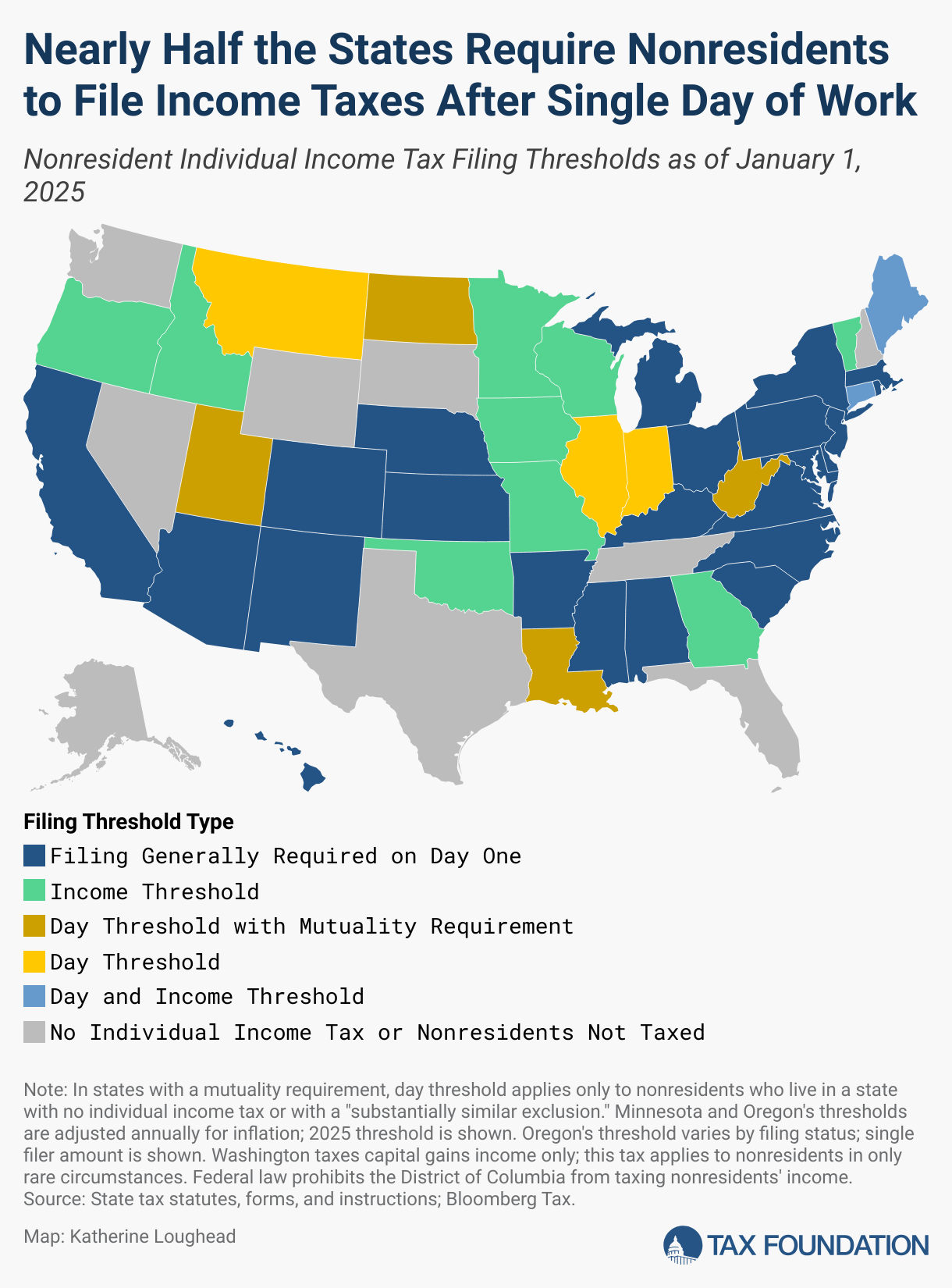
Nonresident Income Tax Filing by State
Nonresident Individual Income Tax Filing and Withholding Thresholds as of January 1, 2025
| State | Filing Threshold | Withholding Threshold |
|---|---|---|
| Alabama | 1 day | 1 day |
| Alaska | n.a. | n.a. |
| Arizona | 1 day | 60 days |
| Arkansas | 1 day | 1 day |
| California | 1 day | > $1,500 |
| Colorado | 1 day | 1 day |
| Connecticut | > 15 days and > $6,000 | > 15 days |
| Delaware | 1 day | 1 day |
| Florida | n.a. | n.a. |
| Georgia | $5,000 or 5% of wages | > 23 days or > $5,000 or > 5% of wages |
| Hawaii | 1 day | > 60 days |
| Idaho | > $2,500 | $1,000 |
| Illinois | 1 day | > 30 days |
| Indiana | > 30 days | > 30 days |
| Iowa | $1,000 | 1 day |
| Kansas | 1 day | 1 day |
| Kentucky | 1 day | 1 day |
| Louisiana | > 25 days (a) | > 25 days (a) |
| Maine | > 12 days and > $3,000 | > 12 days and > $3,000 |
| Maryland | 1 day | 1 day |
| Massachusetts | 1 day | 1 day |
| Michigan | 1 day | 1 day |
| Minnesota | $14,950 (MN sources) (b) | $14,950 (all sources) (b) |
| Mississippi | 1 day | 1 day |
| Missouri | $600 | 1 day |
| Montana | > 30 days | > 30 days |
| Nebraska | 1 day | 1 day |
| Nevada | n.a. | n.a. |
| New Hampshire | n.a. | n.a. |
| New Jersey | 1 day | 1 day |
| New Mexico | 1 day | > 15 days |
| New York | 1 day | > 14 days |
| North Carolina | 1 day | 1 day |
| North Dakota | > 20 days (a) | > 20 days (a) |
| Ohio | 1 day | $300 quarterly |
| Oklahoma | $1,000 | > $300 quarterly |
| Oregon | > $2,800 (b)(c) | 1 day |
| Pennsylvania | 1 day | 1 day |
| Rhode Island | 1 day | 1 day |
| South Carolina | 1 day | > $2,000 |
| South Dakota | n.a. | n.a. |
| Tennessee | n.a. | n.a. |
| Texas | n.a. | n.a. |
| Utah | > 20 days (a) | > 20 days (a) |
| Vermont | > $100 | 30 days |
| Virginia | 1 day | 1 day |
| Washington | n.a. | n.a. |
| West Virginia | > 30 days (a) | > 30 days (a) |
| Wisconsin | $2,000 | $2,000 |
| Wyoming | n.a. | n.a. |
| District of Columbia | n.a. (d) | n.a. (d) |
(b) Threshold is adjusted annually for inflation.
(c) Threshold varies by filing status; single filer amount is shown.
(d) Federal law prohibits the District of Columbia from taxing nonresidents' income.
Source: Tax Foundation; Bloomberg Tax; state statutes.
Data compiled by Katherine Loughead
Notable Changes for 2026
- Alabama, which previously offered no meaningful relief for nonresidents, adopted a 30-day nonresident filing and withholding threshold with a mutuality requirement specifying that such relief is available only to residents of states that provide a “substantially similar exclusion” or do not levy an individual income tax.
- Louisiana increased its nonresident filing and withholding threshold from 25 to 30 days and, importantly, repealed the mutuality requirement that was previously in place.
- Minnesota’s nonresident filing threshold matches its standard deductionThe standard deduction reduces a taxpayer’s taxable income by a set amount determined by the government. Taxpayers who take the standard deduction cannot also itemize their deductions; it serves as an alternative. for single filers, which is adjusted for inflationInflation is when the general price of goods and services increases across the economy, reducing the purchasing power of a currency and the value of certain assets. The same paycheck covers less goods, services, and bills. It is sometimes referred to as a “hidden tax,” as it leaves taxpayers less well-off due to higher costs and “bracket creep,” while increasing the government’s spendin. This threshold increased from $14,950 in 2025 to $15,300 in 2026.
- Oregon’s nonresident filing threshold varies by filing status and matches the state’s standard deduction, which is indexed for inflation. Oregon’s filing threshold increased from $2,835 to $2,910 for single filers and from $5,670 to $5,820 for joint filers.
Credits for Taxes Paid to Other States
Individuals who reside in a state with an income tax can claim a credit from their home state for income taxes paid to other states, so while paying income taxes to other states as a nonresident does not necessarily increase an individual’s total state tax liability (this depends on whether the other state has higher rates on that income), it does substantially increase the complexity and costs associated with filing. Since states tax individuals where they live and where they work, it is common for more than one state to stake a legitimate claim to the same share of a taxpayer’s income. Credits for taxes paid to other states are therefore critical to prevent double taxation.
Mutuality Requirements
In some states with day-based thresholds, those thresholds do not apply to everyone. Currently, four states—Alabama, North Dakota, Utah, and West Virginia—have a “mutuality requirement” that extends filing relief only to nonresidents who live in a state that does not levy an individual income tax or that offers a “substantially similar” exclusion. For example, in general, a resident of Indiana who works in Utah for 20 days or fewer is not required to file in Utah, since Indiana has a similar threshold. However, since Colorado does not have a meaningful filing threshold, a Colorado resident who spends even a single day working in Utah is not eligible for Utah’s safe harbor and is therefore required to file on day one. Since “substantially similar exclusion” is not clearly defined in regulations, taxpayers can be left in the dark on whether their own state’s provisions are adequate to qualify for relief elsewhere.
Illinois, Indiana, Louisiana, and Montana, with 30-day thresholds, are currently the only states that have day-based thresholds that apply broadly to nonresidents regardless of which state they hail from. Forgoing mutuality requirements is the simpler and more neutral approach, as this relieves compliance burdens for more individuals and businesses and treats nonresidents neutrally, regardless of the decisions made by policymakers in the states in which they reside.
Filing on Day One
In states that require nonresidents to file for a single day of work in the state, the costs of compliance can be much higher than the amount of taxes remitted. There are many situations in which a taxpayer might owe only a few dollars—or nothing at all—but still face a legal obligation to file, which can cost $59 or more using tax filing software. This can add up quickly for those who travel to different states and municipalities for work.
Additionally, low- or zero-dollar tax returns can easily cost states more to process than is remitted with the return. In practice, revenue departments are typically much more concerned about the compliance of high-income nonresidents (such as professional athletes and entertainers) than of average taxpayers who spend a short time working in the state. And unless an employer adjusts an individual’s withholding for work performed in non-domiciliary states, revenue departments typically do not know (or cannot prove) that an individual spent time working in the state without filing a tax return. Ultimately, keeping laws on the books that are unenforceable or are not worth enforcing is bad tax policy, especially when such policies generate little revenue while creating steep compliance burdens for the honest taxpayers who try to comply.
Nonresident Filing and Withholding Thresholds Oftentimes Do Not Match
In 16 states, nonresident income tax filing and withholding thresholds differ. For example, employers are only required to withhold Arizona’s income taxes when a nonresident employee spends 60 days or more working in Arizona, but the nonresident employee is required to file on day one. Some taxpayers, unaware that filing and withholding thresholds often differ, may mistakenly interpret their employer’s lack of withholding to mean they have no filing obligation.
In states like Idaho, Iowa, Minnesota, and Oklahoma, the reverse is true, with filing thresholds that are more generous than withholding thresholds. While this may sound like a form of relief for individuals, such discrepancies can result in over-withholding that puts individual taxpayers on the hook to file a nonresident return if they want to receive a refund. (And such refunds typically only help taxpayers when their income tax liability in their non-domiciliary state would have been substantially higher than their tax liability on that same income in their home state.) For more information about states’ nonresident income tax withholding thresholds, see our nonresident income tax primer.
Nonresident Individual Income Tax Filing and Withholding Thresholds (as of January 1, 2026)
| State | Filing Threshold | Withholding Threshold |
|---|---|---|
| Alabama | > 30 days (a) | > 30 days (a) |
| Alaska | n.a. | n.a. |
| Arizona | 1 day | 60 days |
| Arkansas | 1 day | 1 day |
| California | 1 day | > $1,500 |
| Colorado | 1 day | 1 day |
| Connecticut | > 15 days and > $6,000 | > 15 days |
| Delaware | 1 day | 1 day |
| Florida | n.a. | n.a. |
| Georgia | $5,000 or 5% of wages | > 23 days or > $5,000 or > 5% of wages |
| Hawaii | 1 day | > 60 days |
| Idaho | > $2,500 | $1,000 |
| Illinois | > 30 days | > 30 days |
| Indiana | > 30 days | > 30 days |
| Iowa | $1,000 | 1 day |
| Kansas | 1 day | 1 day |
| Kentucky | 1 day | 1 day |
| Louisiana | > 30 days | > 30 days |
| Maine | > 12 days and > $3,000 | > 12 days and > $3,000 |
| Maryland | 1 day | 1 day |
| Massachusetts | 1 day | 1 day |
| Michigan | 1 day | 1 day |
| Minnesota | $15,300 (MN sources) (b) | $15,300 (all sources) (b) |
| Mississippi | 1 day | 1 day |
| Missouri | $600 | 1 day |
| Montana | > 30 days | > 30 days |
| Nebraska | 1 day (c) | 1 day (c) |
| Nevada | n.a. | n.a. |
| New Hampshire | n.a. | n.a. |
| New Jersey | 1 day | 1 day |
| New Mexico | 1 day | > 15 days |
| New York | 1 day | > 14 days |
| North Carolina | 1 day | 1 day |
| North Dakota | > 20 days (a) | > 20 days (a) |
| Ohio | 1 day | $300 quarterly |
| Oklahoma | $1,000 | > $300 quarterly |
| Oregon | > $2,910 (b)(d) | 1 day |
| Pennsylvania | 1 day | 1 day |
| Rhode Island | 1 day | 1 day |
| South Carolina | 1 day | > $2,000 |
| South Dakota | n.a. | n.a. |
| Tennessee | n.a. | n.a. |
| Texas | n.a. | n.a. |
| Utah | > 20 days (a) | > 20 days (a) |
| Vermont | > $100 | 30 days |
| Virginia | 1 day | 1 day |
| Washington | n.a. | n.a. |
| West Virginia | > 30 days (a) | > 30 days (a) |
| Wisconsin | $2,000 | $2,000 |
| Wyoming | n.a. | n.a. |
| District of Columbia | n.a. (e) | n.a. (e) |
(b) Threshold is adjusted annually for inflation.
(c) Nebraska offers filing and withholding relief to nonresidents attending a conference or training who spend 7 days or fewer in the state and earn not more than $5,000 in the state.
(d) Threshold varies by filing status; single filer amount is shown.
(e) Federal law prohibits the District of Columbia from taxing nonresidents' income.
Source: Tax Foundation; Bloomberg Tax; state statutes.
Local Income Taxes Too?
Adding to the complexity, 14 states—Alabama, Colorado, Delaware, Indiana, Iowa, Maryland, Michigan, Missouri, New Jersey, New York, Ohio, Oregon, Pennsylvania, and West Virginia—have local income taxes that sometimes apply to nonresidents, increasing the costs of compliance, especially for those who spend only a short time working in any given city or county. Ultimately, more states should move away from local income taxes altogether or avoid applying them to nonresidents (as is the case in Kansas and Kentucky).
Opportunities for Reform
At the federal level, the Mobile Workforce State Income Tax Simplification Act would establish a uniform 30-day nonresident individual income tax filing and withholding threshold across the states. But unless Congress acts, taxpayers will continue to face a complex patchwork of state laws.
This leaves state policymakers with an opportunity to adopt state-level reforms that reduce complexity and compliance costs for individuals and employers and streamline administrative and enforcement costs for states. More states should consider following in the footsteps of Illinois, Indiana, Louisiana, and Montana, adopting 30-day filing and withholding thresholds, which many stakeholders agree strike an appropriate balance between reducing compliance burdens and allocating revenue to states in which a substantial amount of work is performed by nonresidents. If most states adopted such thresholds, the state income tax landscape would become substantially less burdensome for America’s increasingly mobile workforce.
Stay informed on the tax policies impacting you.
Subscribe to our free newsletter to get the latest tax data, news and analysis.
Subscribe