
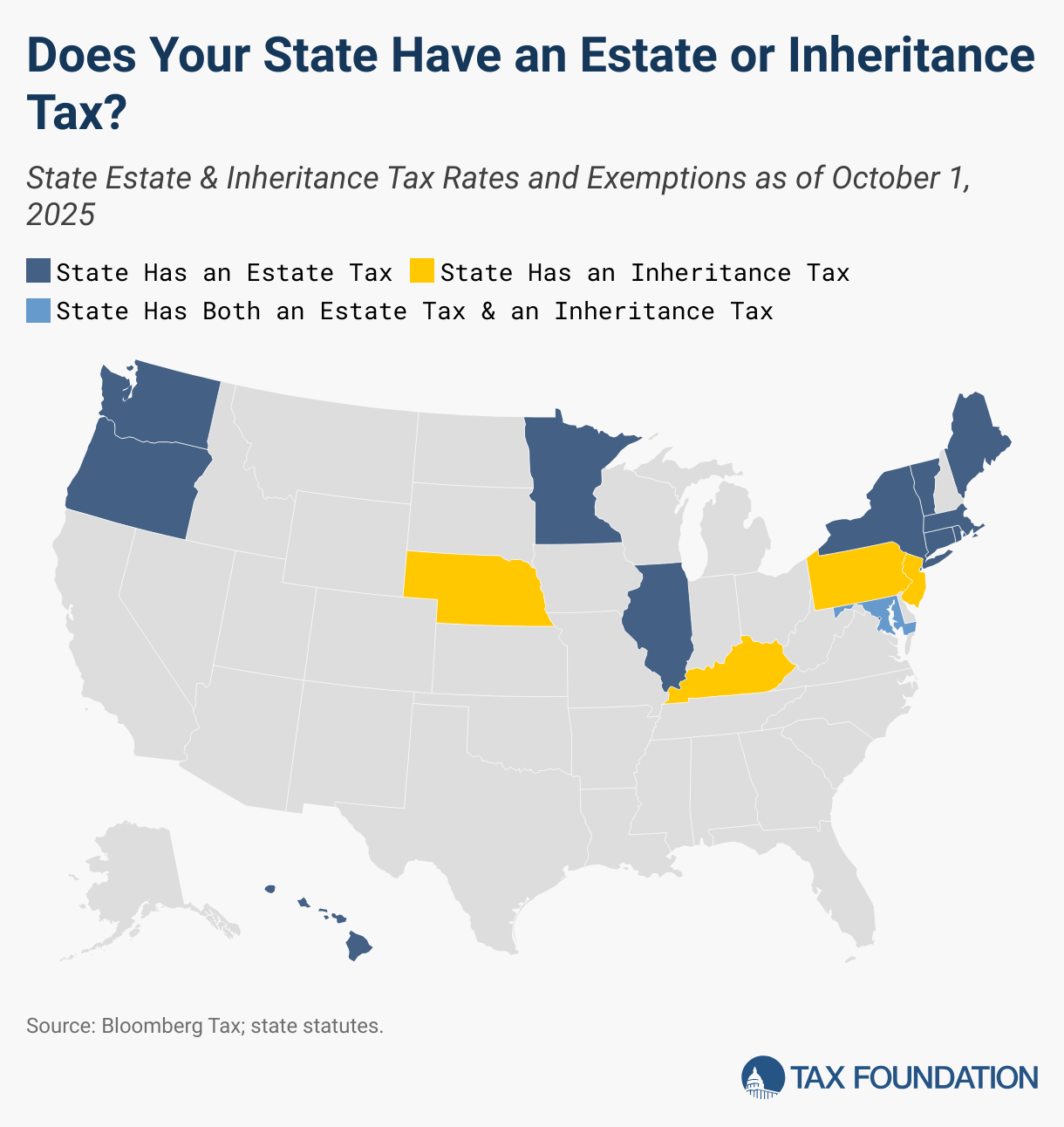
In addition to the federal estate taxAn estate tax is imposed on the net value of an individual’s taxable estate, after any exclusions or credits, at the time of death. The tax is paid by the estate itself before assets are distributed to heirs., which has a top marginal rate of 40 percent, 12 states and the District of Columbia impose estate taxes, while five states levy inheritance taxes. Maryland is the only state that imposes both an estate and an inheritance taxAn inheritance tax is levied upon the value of inherited assets received by a beneficiary after a decedent’s death. Not to be confused with estate taxes, which are paid by the decedent’s estate based on the size of the total estate before assets are distributed, inheritance taxes are paid by the recipient or heir based on the value of the bequest received..
Estate taxes are paid by a decedent’s estate before assets are distributed to heirs and are thus imposed on the overall value of the estate. They typically fall on the estates of residents who die while domiciled in the taxing state, as well as nonresident decedents who owned taxable property in the state. Inheritance taxes are remitted by the recipient(s) of a bequest and are thus based on the amount distributed to each beneficiary. They are paid to the state in which the decedent was domiciled or owned taxable property, regardless of the location of the heir.
Most estate and some inheritance taxes are progressive, with the taxA tax is a mandatory payment or charge collected by local, state, and national governments from individuals or businesses to cover the costs of general government services, goods, and activities. on a decedent’s estate or a beneficiary’s inheritance exposed to rates that increase with marginal increases in the total value of assets.
Hawaii and Washington have the highest estate tax top marginal rates in the nation at 20 percent. The top rate applies to taxable estate values exceeding $10 million in Hawaii and $9 million in Washington. While Washington’s top rate applies to a slightly lower taxable estate value, Washington’s estate tax is more burdensome because its exemption is lower ($3 million compared to $5.49 million in Hawaii), exposing more estates to taxation, and because its marginal rates get higher faster than Hawaii’s.
Eight states and the District of Columbia assess a 16 percent top estate tax rate on marginal taxable estate values ranging from $5 million in Vermont to $10.1 million in Minnesota and New York. Connecticut levies an estate tax at a flat rate of 12 percent, while Vermont imposes a flat rate of 16 percent. Combined with its high exemption value of $15 million, Connecticut’s estate tax is less burdensome than many others and is in a prime position for possible reforms and eventual elimination.
With the passage of the One Big Beautiful Bill Act (OBBBA) in 2025, the federal estate tax exemption threshold increased to $15 million starting in 2026 and is indexed for inflationInflation is when the general price of goods and services increases across the economy, reducing the purchasing power of a currency and the value of certain assets. The same paycheck covers less goods, services, and bills. It is sometimes referred to as a “hidden tax,” as it leaves taxpayers less well-off due to higher costs and “bracket creep,” while increasing the government’s spendin from 2027 onward.
Currently, Connecticut is the only state that conforms its estate tax exemption to the federal threshold. New York has the second highest exemption at $7.35 million. At the other end of the spectrum, Oregon and Rhode Island have the least generous exemptions, at only $1 million and $1,838,056, respectively. Four states—Connecticut, Maine, New York, and Rhode Island—and the District of Columbia currently index their exemption amounts for inflation.
All five states with an inheritance tax—Kentucky, Maryland, Nebraska, New Jersey, and Pennsylvania—structure their tax such that the rate varies based on the proximity of the bequest recipient to the decedent. States give preferential treatment, including lower rates and higher exemption thresholds, to close relatives while taxing more distant beneficiaries at higher rates and with lower exemption thresholds.
Kentucky and New Jersey have the highest top marginal inheritance tax rates, each at 16 percent, while Maryland has the lowest top inheritance tax rate at a flat 10 percent on all recipients who are not spouses or lineal heirs (although Maryland also levies an estate tax).

State Estate & Inheritance Tax Rates and Exemptions as of October 1, 2026
| State | Estate Tax Exemption | Estate Tax Rate | Inheritance Tax Exemption | Inheritance Tax Rate |
|---|---|---|---|---|
| Connecticut | $15,000,000 | 12% | n.a. | n.a. |
| Hawaii | $5,490,000 | 10%-20% | n.a. | n.a. |
| Illinois | $4,000,000 | 0.8%-16.0% | n.a. | n.a. |
| Kentucky | n.a. | n.a. | $1,000 | 0%-16% |
| Maine | $7,160,000 | 8%-12% | n.a. | n.a. |
| Maryland | $5,000,000 | 0.8%-16.0% | $1,000 | 0%-10% |
| Massachusetts | $2,000,000 | 0.8%-16.0% | n.a. | n.a. |
| Minnesota | $3,000,000 | 13%-16% | n.a. | n.a. |
| Nebraska | n.a. | n.a. | $100,000 | 0%-15% |
| New Jersey | n.a. | n.a. | $25,000 | 0%-16% |
| New York | $7,350,000 | 3.06%-16.00% | n.a. | n.a. |
| Oregon | $1,000,000 | 10%-16% | n.a. | n.a. |
| Pennsylvania | n.a. | n.a. | No exemption | 0%-15% |
| Rhode Island | $1,838,056 | 0.8%-16.0% | n.a. | n.a. |
| Vermont | $5,000,000 | 16% | n.a. | n.a. |
| Washington | $3,000,000 | 10%-20% | n.a. | n.a. |
| District of Columbia | $4,988,400 | 11.2%-16.0% | n.a. | n.a. |
In Kentucky, Nebraska, and New Jersey, the inheritance tax exemption varies by class of beneficiary. Maximum exemption amount is shown. In Maryland, no inheritance tax is imposed if the estate's total value does not exceed $50,000.
Source: Bloomberg Tax; state statutes.
Data compiled by Nicole Fox
Does Your State Have an Estate or Inheritance Tax?
State Estate & Inheritance Tax Rates and Exemptions as of October 1, 2025
| State | Estate Tax Exemption | Estate Tax Rate | Inheritance Tax Exemption | Inheritance Tax Rate |
|---|---|---|---|---|
| Connecticut | $13,990,000 | 12% | n.a. | n.a. |
| Hawaii | $5,490,000 | 10%-20% | n.a. | n.a. |
| Illinois | $4,000,000 | 0.8%-16.0% | n.a. | n.a. |
| Kentucky | n.a. | n.a. | $1,000 | 0%-16% |
| Maine | $7,000,000 | 8%-12% | n.a. | n.a. |
| Maryland | $5,000,000 | 0.8%-16.0% | $1,000 | 0%-10% |
| Massachusetts | $2,000,000 | 0.8%-16.0% | n.a. | n.a. |
| Minnesota | $3,000,000 | 13%-16% | n.a. | n.a. |
| Nebraska | n.a. | n.a. | $100,000 | 0%-15% |
| New Jersey | n.a. | n.a. | $25,000 | 0%-16% |
| New York | $7,160,000 | 3.06%-16.00% | n.a. | n.a. |
| Oregon | $1,000,000 | 10%-16% | n.a. | n.a. |
| Pennsylvania | n.a. | n.a. | No exemption | 0%-15% |
| Rhode Island | $1,802,431 | 0.8%-16.0% | n.a. | n.a. |
| Vermont | $5,000,000 | 16% | n.a. | n.a. |
| Washington | $3,000,000 | 10%-35% | n.a. | n.a. |
| District of Columbia | $4,873,200 | 11.2%-16.0% | n.a. | n.a. |
Source: Bloomberg Tax; state statutes.
Data compiled by Katherine Loughead
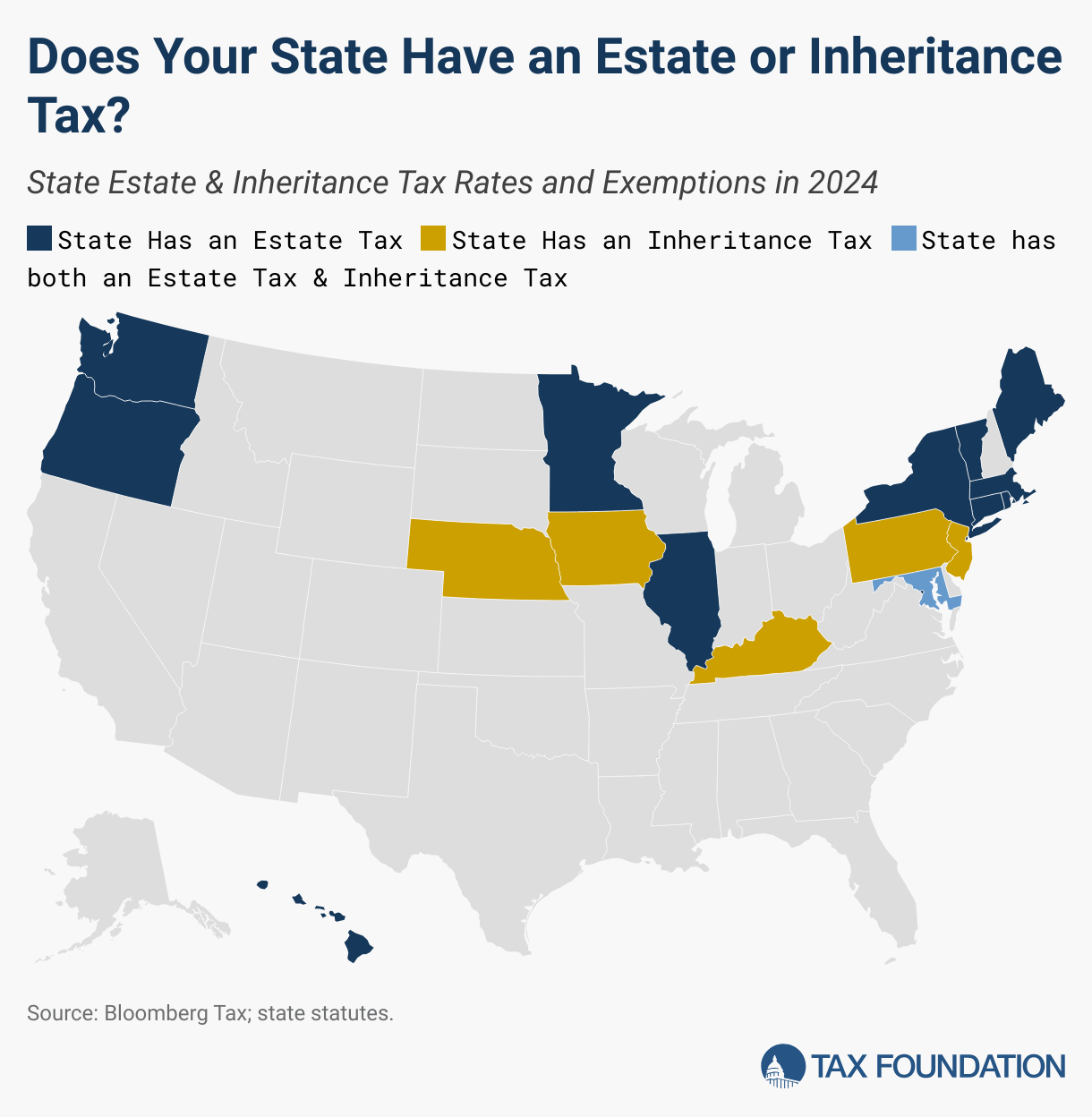
Does Your State Have an Estate or Inheritance Tax?
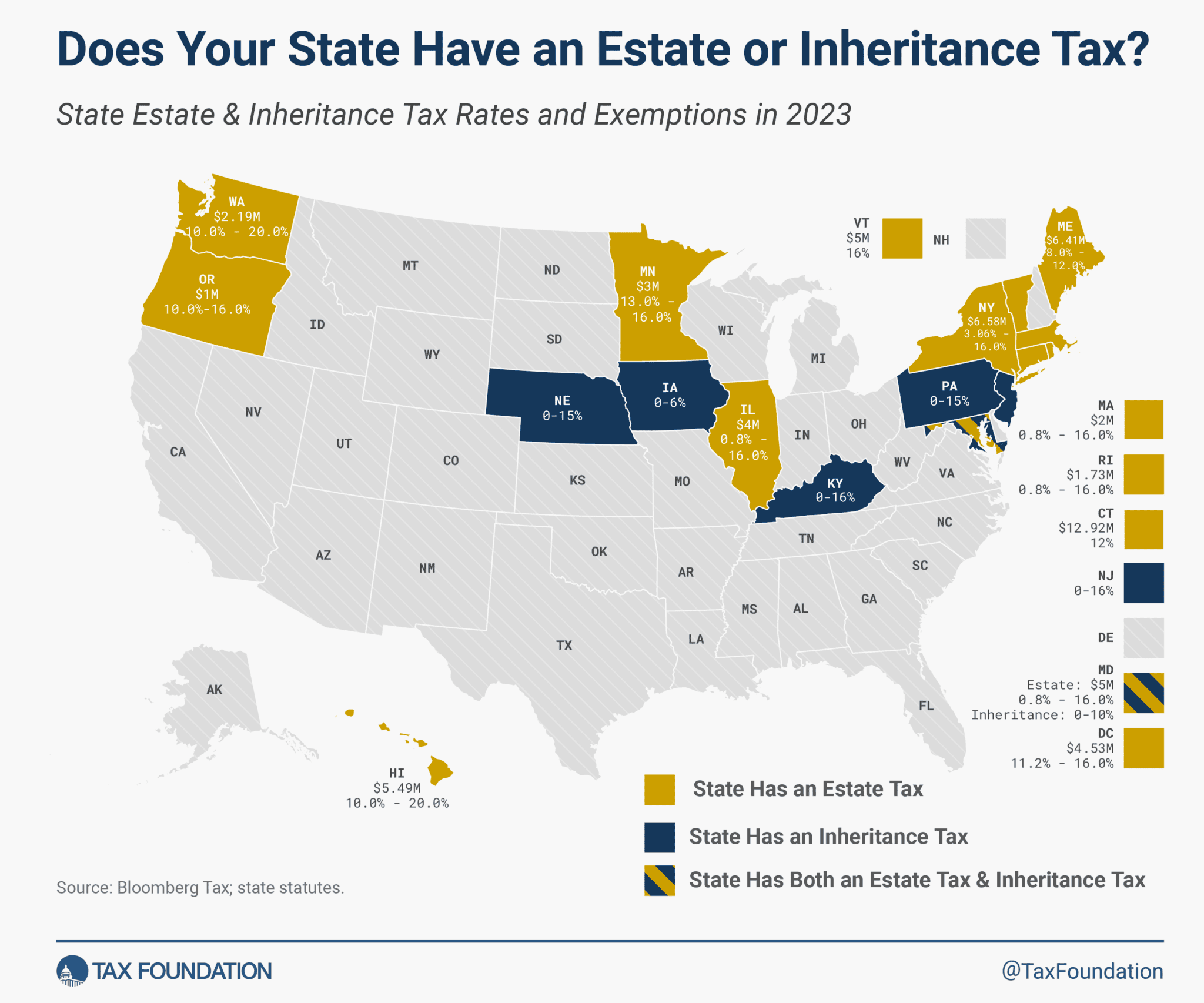
State Estate & Inheritance Tax Rates and Exemptions in 2024
| State | Estate Tax Exemption | Inheritance Tax Exemption | Estate Tax Rate | Inheritance Tax Rate |
|---|---|---|---|---|
| Connecticut | 13,610,000.00 $ | 12% | ||
| Hawaii | 5,490,000.00 $ | 10.0% - 20.0% | ||
| Illinois | 4,000,000.00 $ | 0.8% - 16.0% | ||
| Iowa | 0 - 2% | |||
| Kentucky | 1,000.00 $ | 0-16% | ||
| Maine | 6,800,000.00 $ | 8.0% - 12.0% | ||
| Maryland | 5,000,000.00 $ | 0.8% - 16.0% | 0-10% | |
| Massachusetts | 2,000,000.00 $ | 0.8% - 16.0% | ||
| Minnesota | 3,000,000.00 $ | 13.0% - 16.0% | ||
| Nebraska | 100,000.00 $ | 0-15% | ||
| New Jersey | 25,000.00 $ | 0-16% | ||
| New York | 6,940,000.00 $ | 3.06% - 16.0% | ||
| Oregon | 1,000,000.00 $ | 10.0%-16.0% | ||
| Pennsylvania | 0-15% | |||
| Rhode Island | 1,774,583.00 $ | 0.8% - 16.0% | ||
| Vermont | 5,000,000.00 $ | 16% | ||
| Washington | 2,193,000.00 $ | 10.0% - 20.0% | ||
| District of Columbia | 4,715,600.00 $ | 11.2% - 16.0% |
Data compiled by Joseph Johns
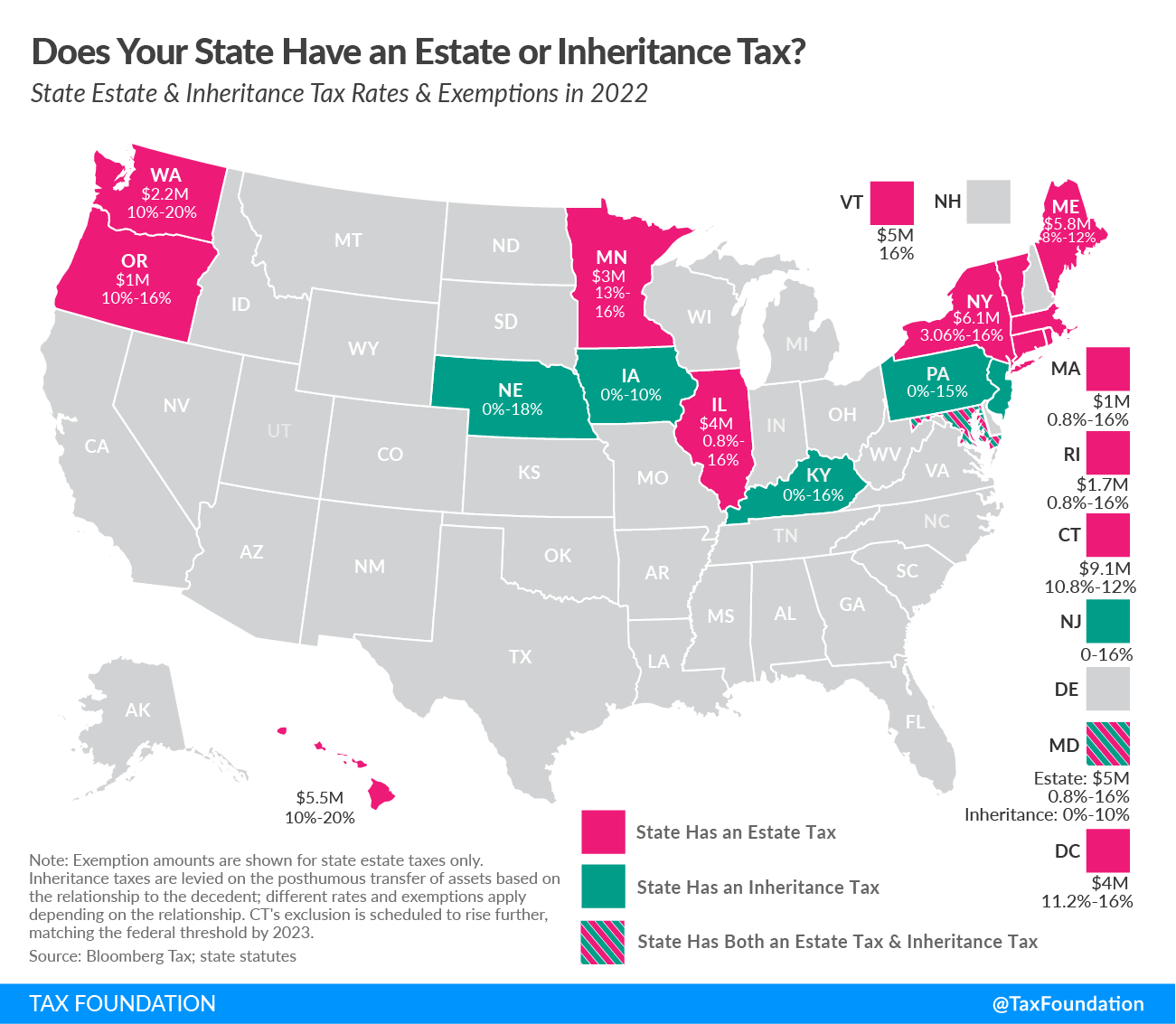
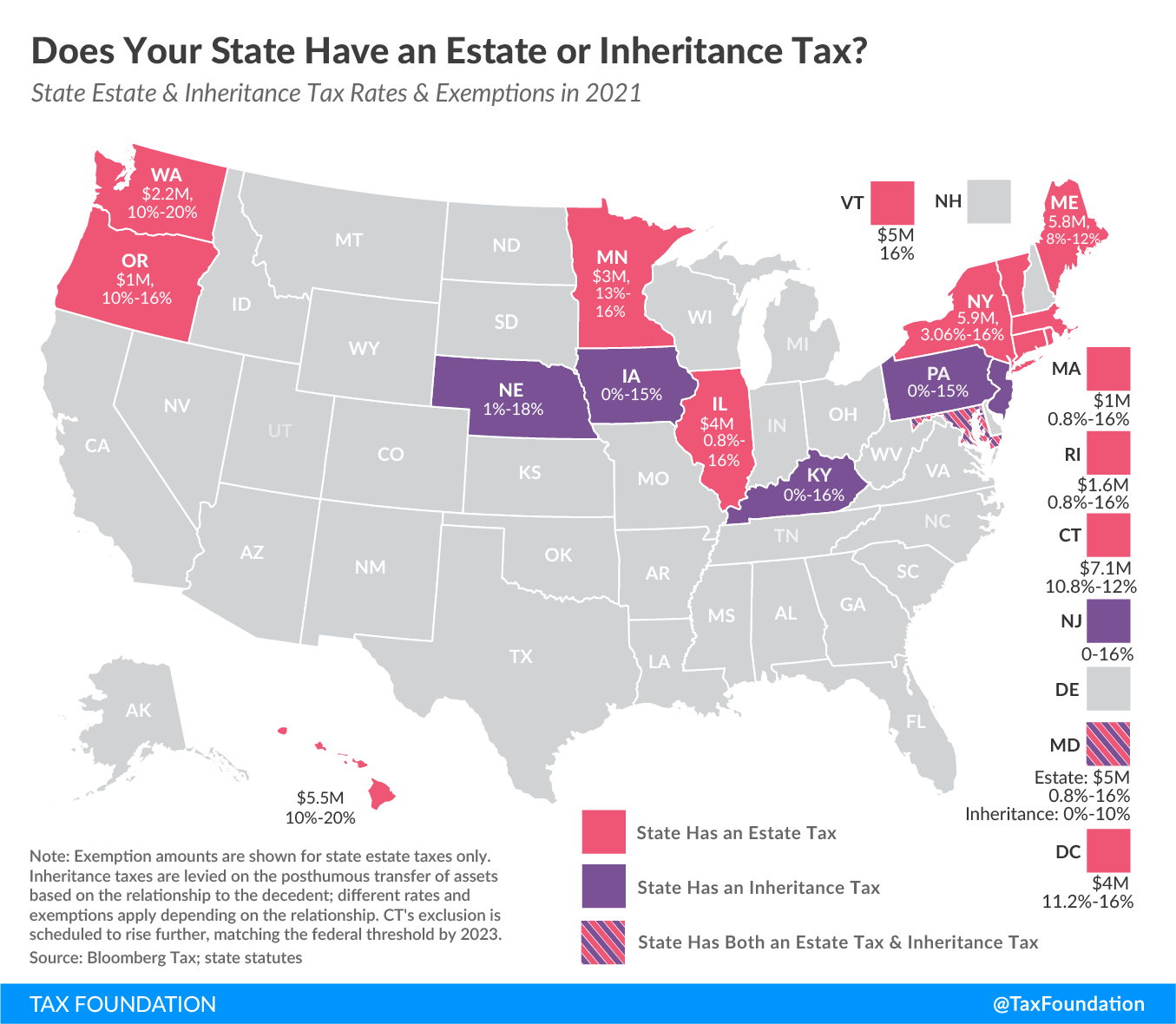
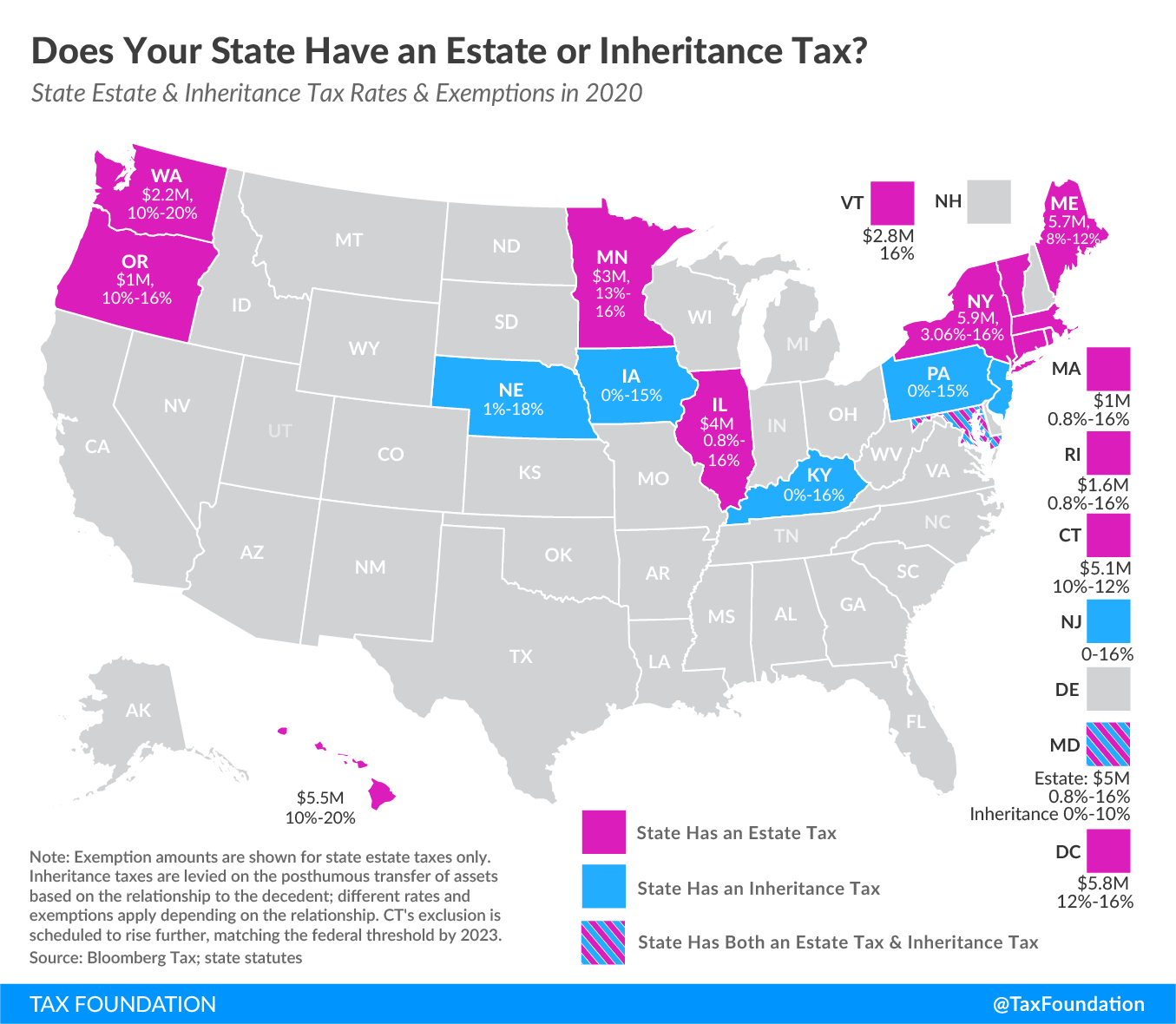
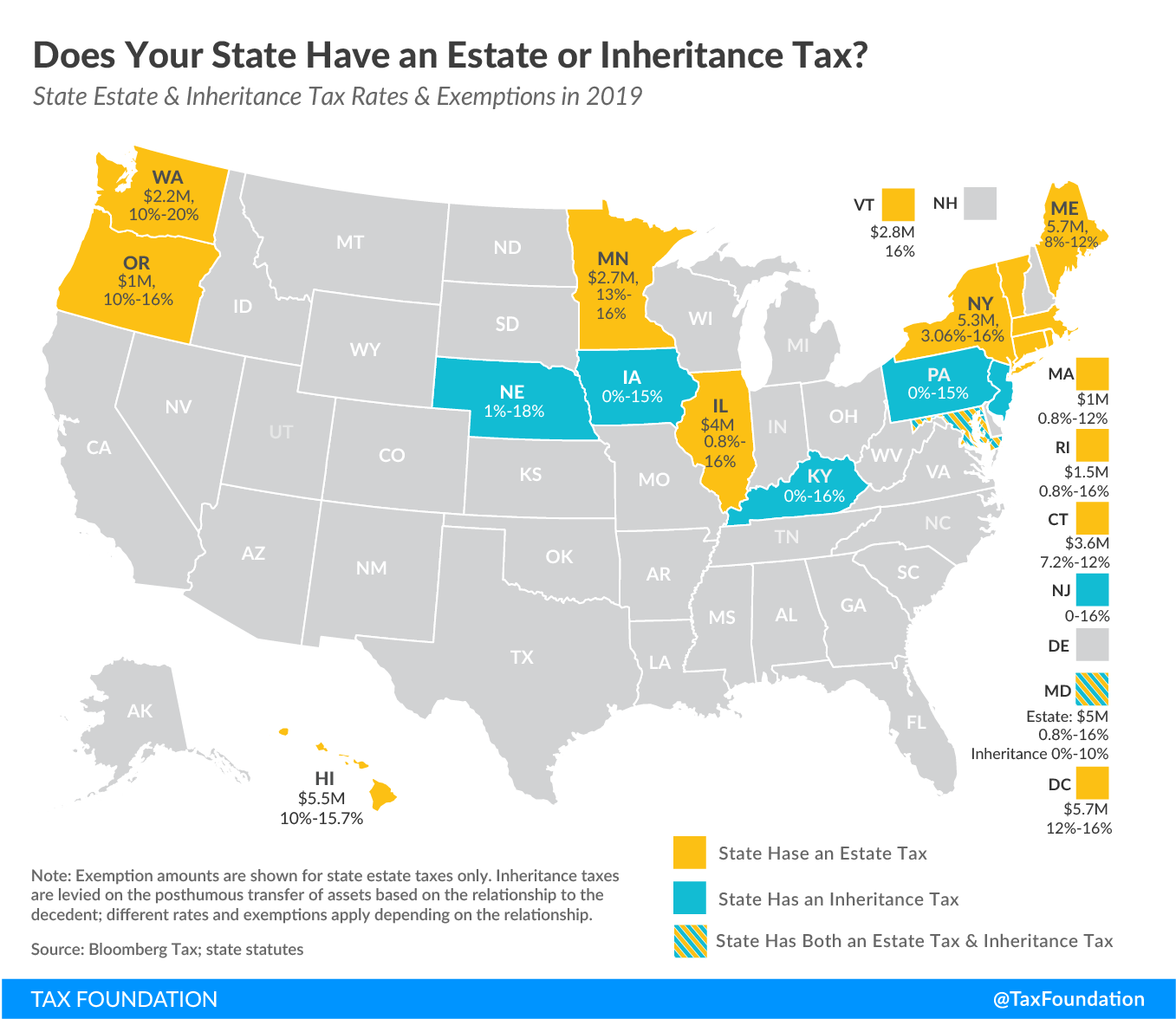
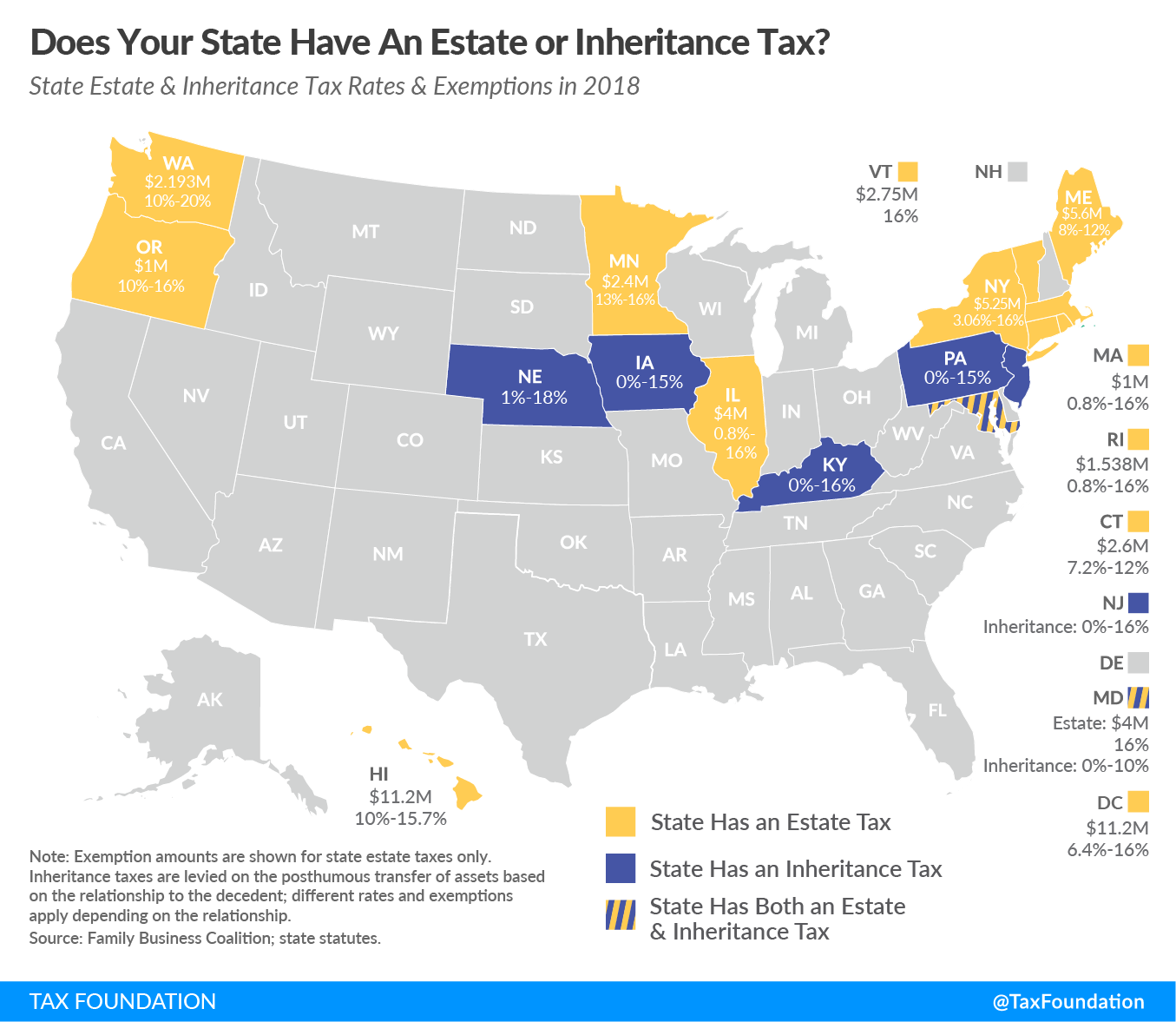
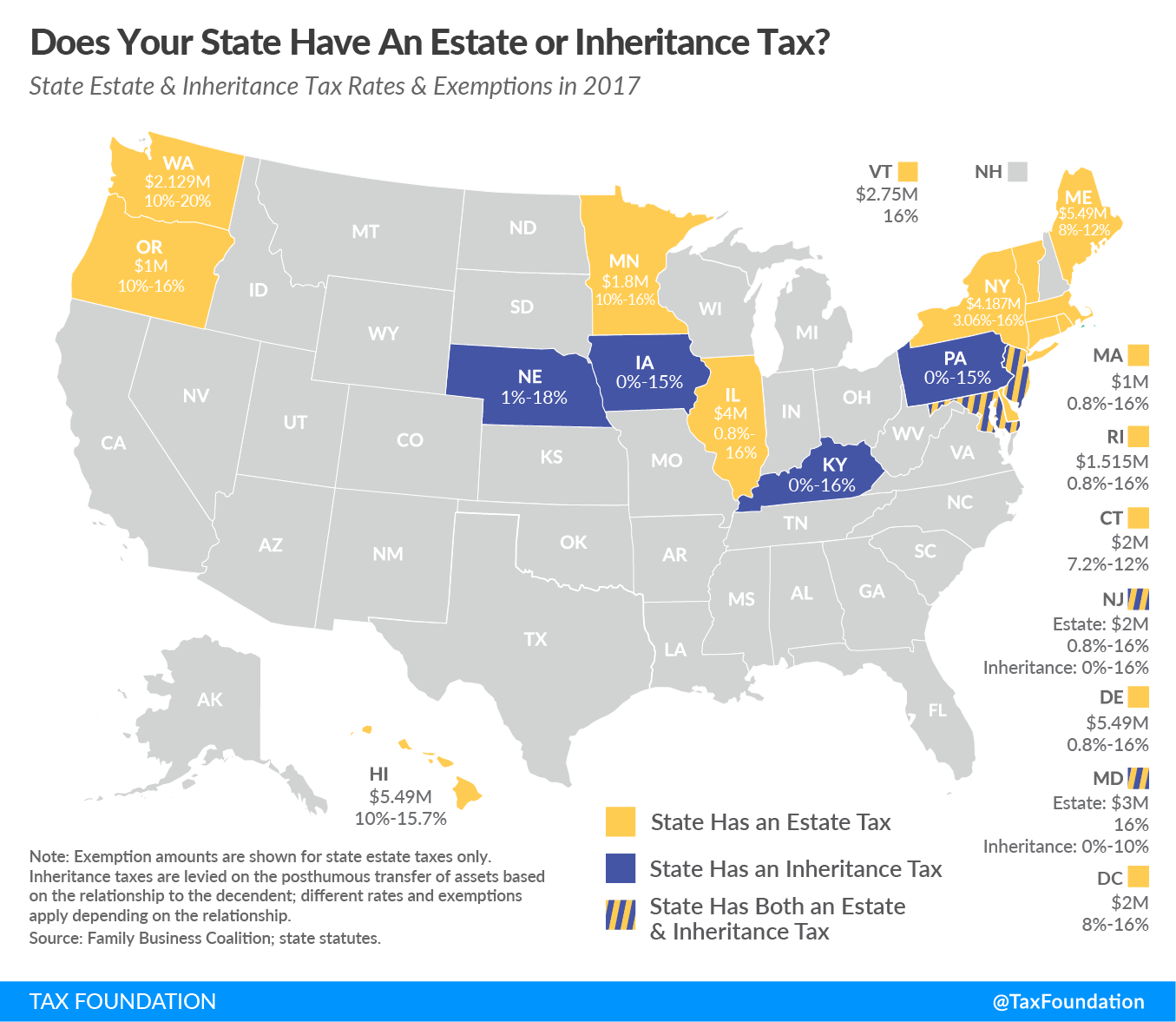
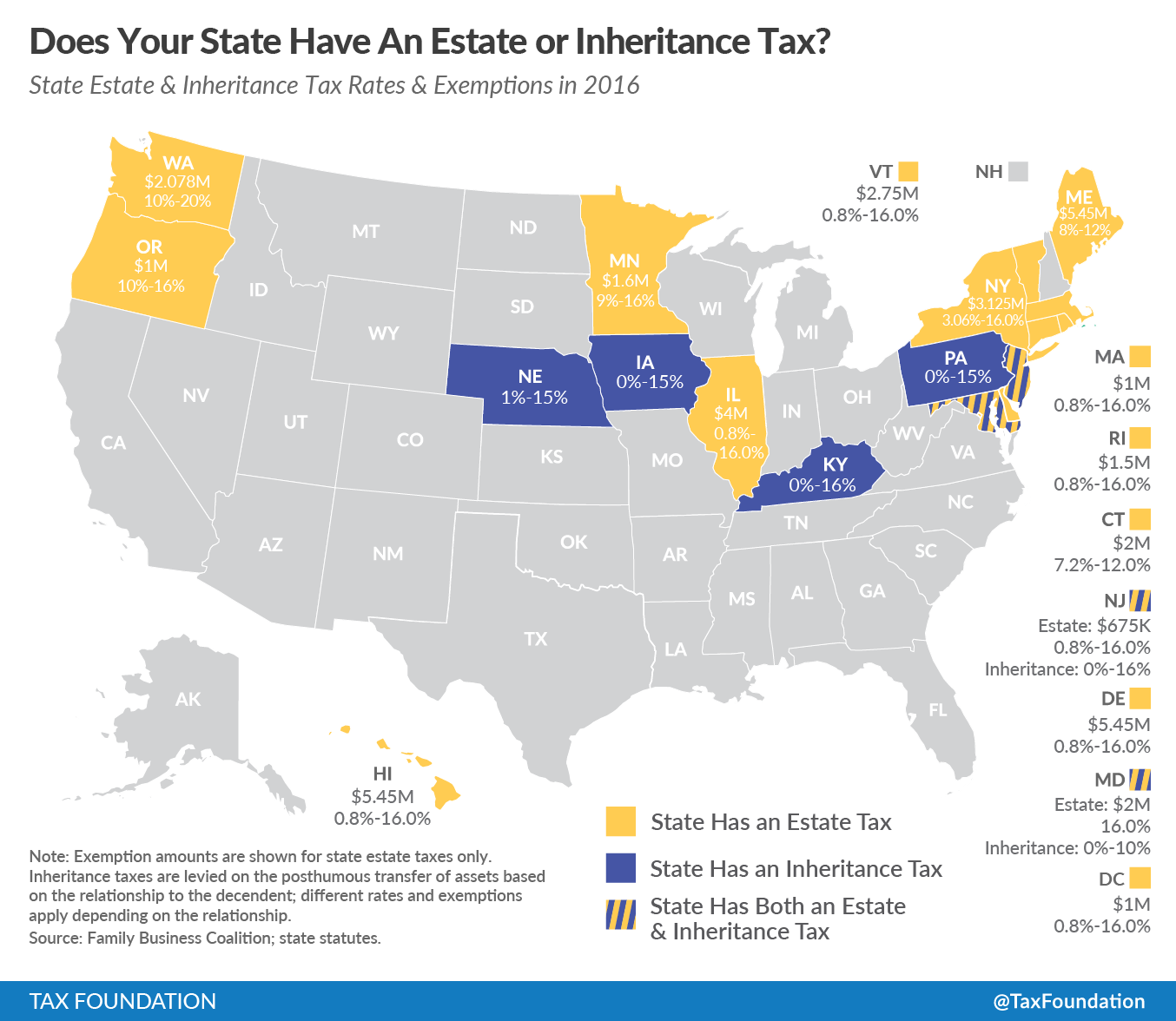
Estate and inheritance taxes are economically harmful. They disincentivize in-state investment, incentivize inefficient tax avoidance strategies, and can drive high-net-worth individuals out of state, thereby reducing overall economic activity. The handful of states that still impose them should consider gradually eliminating them or at least conforming to federal exemption levels.
Concerns about the economic effects of estate and inheritance taxes have contributed to significant policy changes over time. Prior to 2005, the federal government incentivized states to assess state-level estate taxes by offering a federal credit against state estate taxes paid. This made estate taxes an attractive option for states since taxpayers paid the same amount in estate taxes whether their state levied the tax or not. After the federal government phased out the state estate tax creditA tax credit is a provision that reduces a taxpayer’s final tax bill, dollar-for-dollar. A tax credit differs from deductions and exemptions, which reduce taxable income rather than the taxpayer’s tax bill directly. in 2005, some states stopped collecting estate taxes by default, as their provisions were directly linked with the federal credit, while others repealed their tax legislatively.
After the federal changes, many states recognized the adverse impacts of estate and inheritance taxes and either increased their exemptions or eliminated them completely to boost their economic competitiveness.
Delaware repealed its estate tax in 2018. New Jersey completed the phaseout of its estate tax that same year but still imposes an inheritance tax. In 2021, Vermont completed a phase-up of its estate tax exemption, nearly doubling it to $5 million. Connecticut phased in an increase to its exemption over six years, matching the federal estate tax exemption by 2023 while simultaneously transitioning to a flat tax rate. Nebraska increased its inheritance tax exemptions and reduced its rates effective as of 2023. Iowa repealed its inheritance tax as of 2025.
2026 Notable Changes
- Washington enacted SB 6347 in June 2026, restoring its top marginal estate tax rate to 20 percent, thereby reversing the increase to 35 percent that was adopted in 2025. The new law also resets Washington’s estate tax exemption to $3 million, effective July 1, 2026. While the law retained language providing for inflation adjustments to the exemption, an update from the Washington Department of Revenue noted that the exemption amount is not set to increase in future years due to an expired CPI in the statute.
- Maryland enacted HB 17/SB 277 clarifying the sourcing of intangible property for inheritance tax purposes for multistate estates. Effective for decedents dying on or after July 1, 2026, intangible assets such as stocks, bonds, investment accounts, and partnership interests are deemed to be located at the decedent's domicile for inheritance tax purposes. The legislation also repeals a reciprocal exemption for personal property, other than tangible personal property, that passes from certain nonresident decedents.
During the 2025-2026 biennium, policymakers in Maryland, Minnesota, Nebraska, New Jersey, Oregon, and Rhode Island introduced structurally sound changes to their estate and inheritance taxes. Although proposed reforms in these states were not ultimately adopted, their introduction reflects that policymakers acknowledge the burden estate and inheritance taxes impose.
States that levy estate and/or inheritance taxes impose punitive tax burdens on generational transfers of wealth, which can hurt family farms and businesses. Many business owners are “asset rich but cash poor,” so when estate and inheritance taxes are levied on the value of illiquid assets, like real estate or the value of the business, recipients may be forced to sell some of their inherited assets to pay the tax bill. The financial and administrative burdens associated with these taxes hamper economic growth and entrepreneurial activity, and taxpayers’ efforts to avoid or minimize tax burdens lead to deadweight loss and economic distortions.
Currently, 16 states and the District of Columbia levy estate and/or inheritance taxes. Policymakers should consider phasing out or eliminating these taxes to promote the stability of family businesses, minimize economic distortions, and prevent further hardships imposed on friends and family already grieving a loss.
Stay informed on the tax policies impacting you.
Subscribe to our free newsletter to get the latest tax data, news and analysis.
Subscribe