Michigan’s Tax Gamble Could Risk Its Competitive Edge
Michigan voters may soon consider a dramatic change to the state’s income tax.


Andrey Yushkov was a Senior Policy Analyst with the Center for State Tax Policy at the Tax Foundation. He holds a PhD in public policy from Indiana University, an MS in economics from the University of Bonn, and a BS from St. Petersburg University.
Prior to joining the Tax Foundation, Andrey worked as a consultant at Leontief Centre, participated in several World Bank and other international development projects dealing with the issues of public financial management and project evaluation in the public sector, and taught public budgeting and finance at Indiana University. His scholarly work on fiscal federalism was published in Public Finance Review and Eurasian Geography and Economics, among other outlets. In his free time, Andrey enjoys traveling, playing chess, biking, and listening to new classical recordings.

Michigan voters may soon consider a dramatic change to the state’s income tax.

If Michiganders are interested in increasing the state’s spending on education or other priorities—and believe that current revenues are insufficient to support such an increase—there are several ways to do so without significantly affecting residents’ incentives to live and work in Michigan.
4 min read
For owners of pass-through businesses, the reconciliation package (1) raises the state and local tax (SALT) deduction cap, (2) denies the benefit of pass-through entity-level taxes that had previously worked around the SALT cap for such pass-through businesses, and (3) increases the Section 199A deduction for qualifying pass-through entities.
4 min read
Policymakers may consider a broader, more comprehensive property tax reform that creates a uniform system with effective levy limits to prevent unauthorized increases in property tax revenues and, in most cases, property tax bills.
4 min read
The proposed changes to federal tax code conformity in Oregon are a good example of a change that could significantly reshape the state’s tax code in the future, despite being framed as temporary technical adjustments.
4 min read
This legislative session, local taxes are a major topic of debate in Indiana. Although the state’s property tax system is already nationally competitive, dramatic increases in assessed values have created discontent in recent years.
8 min read
While Governor Moore’s tax plan is still being fiercely debated in Maryland, legislators have introduced several additional proposals—mostly aimed at increasing taxes on businesses—to generate revenue and address the state’s chronic budget deficit.
6 min read
While evaluating new estate tax bills this legislative session, Oregon legislators should consider the state’s competitive tax landscape and interstate migration patterns.
4 min read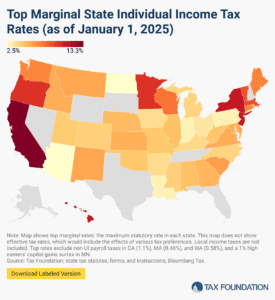
Individual income taxes are a major source of state government revenue, accounting for more than a third of state tax collections. How do income taxes compare in your state?
12 min read
Facing a projected $3 billion budget deficit in fiscal year 2026, with forecasts of a growing gap over the next five years, Governor Wes Moore (D) has included about $1 billion in proposed tax increases in his budget proposal.
7 min read
Recent data suggest that tax competitiveness plays a significant role in residents’ relocation decisions.
3 min read
The State Tax Competitiveness Index enables policymakers, taxpayers, and business leaders to gauge how their states’ tax systems compare. While there are many ways to show how much state governments collect in taxes, the Index evaluates how well states structure their tax systems and provides a road map for improvement.
115 min read
Georgia should focus on policies that restrict the overall growth of property taxes, not policies that functionally freeze property taxes for current owners by shifting costs onto new owners and into the sales tax.
6 min read
Taxes are on the ballot this November—not just in the sense that candidates at all levels are offering their visions for tax policy, but also in the literal sense that voters in some states will get to decide important questions about how their states raise revenue.
9 min read
The latest IRS and Census data show that people and businesses favor states with low and structurally sound tax systems, which can impact the state’s economic growth and governmental coffers.
8 min read
States would do better to broaden the sales tax base to include currently exempt classes of final consumption than to impose disproportionate taxes on prepared foods.
6 min read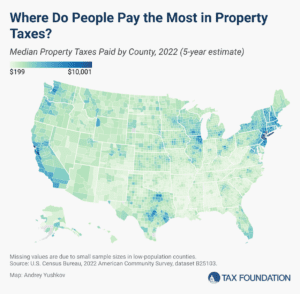
Property taxes are the primary tool for financing local governments and generate a significant share of state and local revenues.
6 min read
To stay competitive in an increasingly mobile post-pandemic world, states and localities must learn from the tax policy successes and failures of their neighbors and communities across the nation.
27 min read
Two bills in Georgia will lower the flat individual income tax rate and align the corporate income tax rate with the individual income tax rate.
4 min read
By violating the principles of simplicity, neutrality, and stability, and failing to raise significant revenue, worldwide combined reporting at the state level is doomed to fail.
6 min read