





Cigarette smokers in the European Union pay far more in excise taxes than they do for the cigarettes themselves. The EU Tobacco TaxA tax is a mandatory payment or charge collected by local, state, and national governments from individuals or businesses to cover the costs of general government services, goods, and activities. Directive requires all Member States to levy a minimum excise taxAn excise tax is a tax imposed on a specific good or activity. Excise taxes are commonly levied on cigarettes, alcoholic beverages, soda, gasoline, insurance premiums, amusement activities, and betting, and typically make up a relatively small and volatile portion of state and local and, to a lesser extent, federal tax collections. on cigarettes and other tobacco products. EU countries levy a specific ad quantum cigarette tax (a fixed amount per cigarette) and an ad valorem excise tax (an additional percentage of the retail sales price).
The current minimum cigarette excise rates in the EU are €1.80 ($2.11) per 20-cigarette pack, and the minimum total excise duty is at least 60 percent of the national weighted average retail price. The minimums have remained the same since 2014, but the Tobacco Tax Directive is expected to be updated soon. Member States that levy a higher specific rate of at least €2.30 per pack do not need to meet the 60 percent requirement. The two excise taxes are levied before adding the broadly applied value-added tax (VAT).
The EU Directive only establishes minimum rates, but all countries levy higher rates.
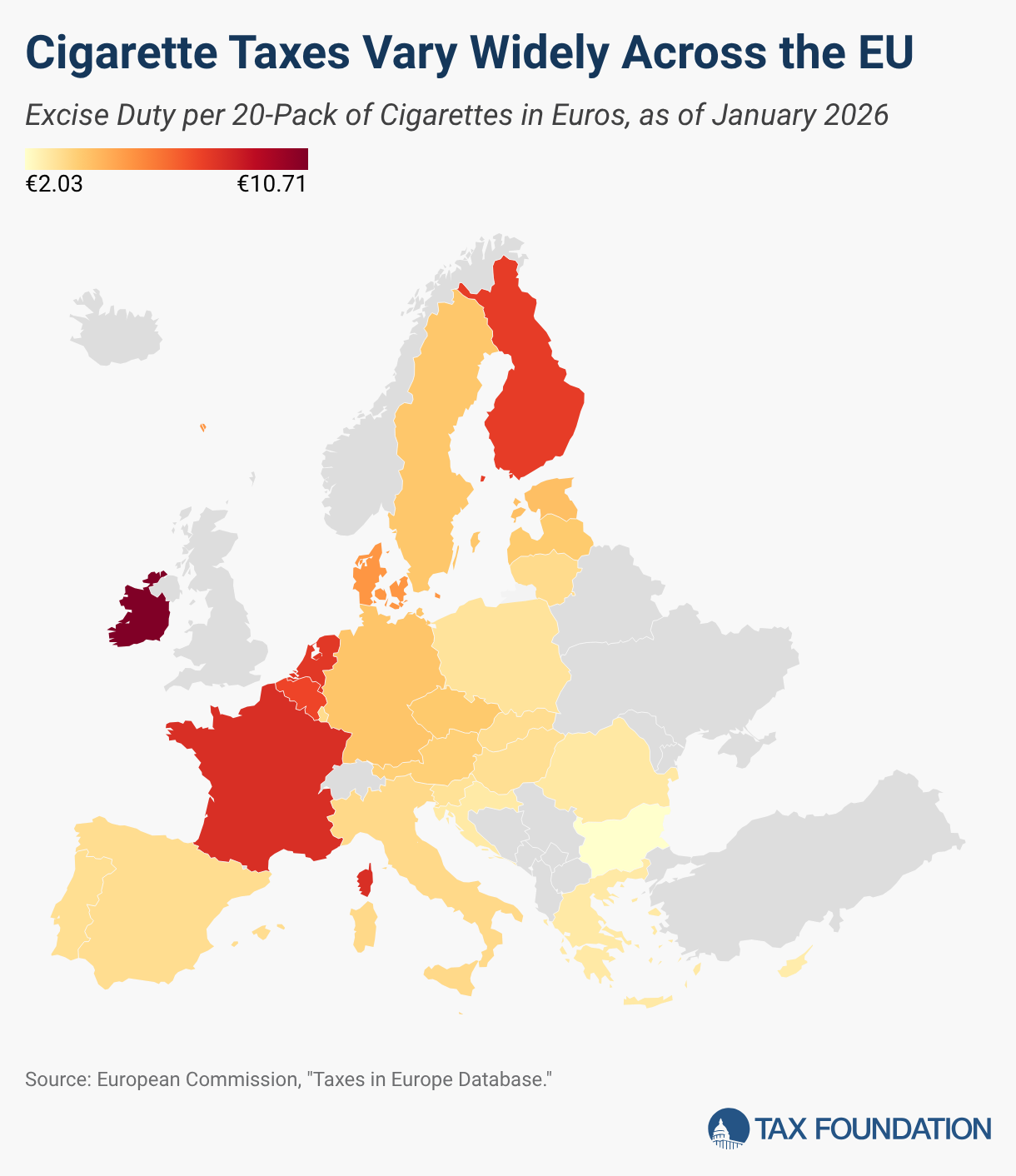
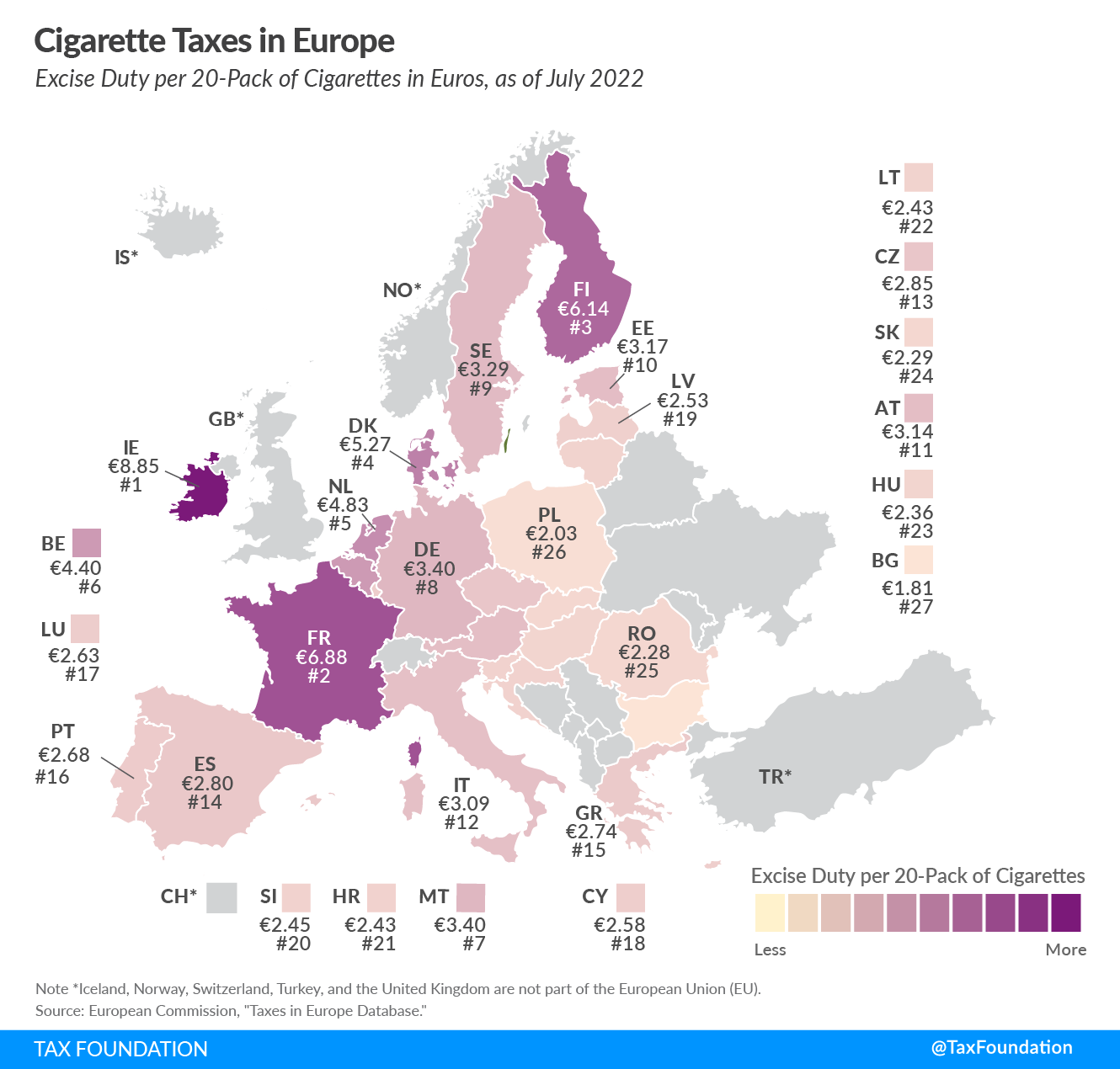
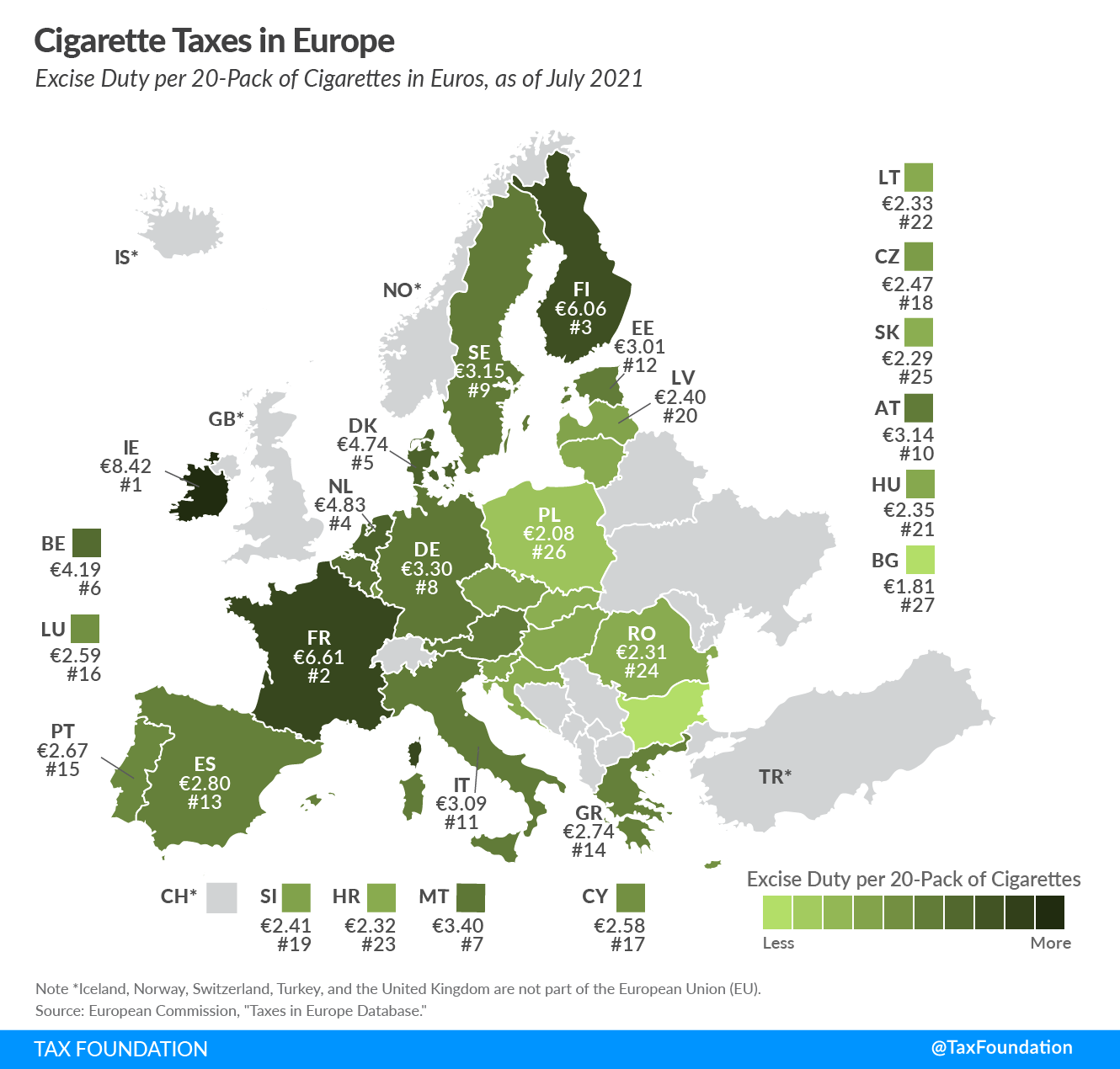
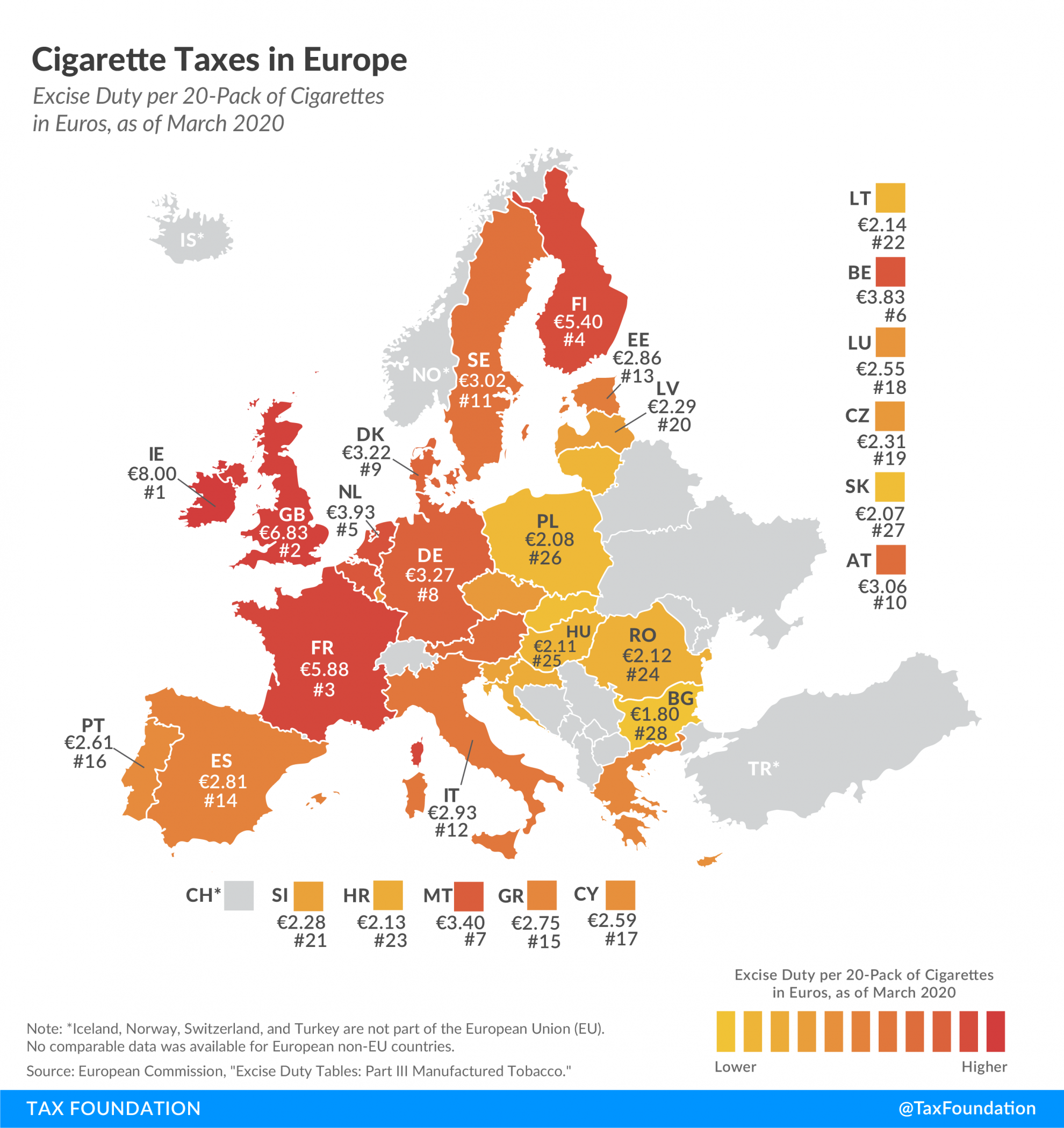
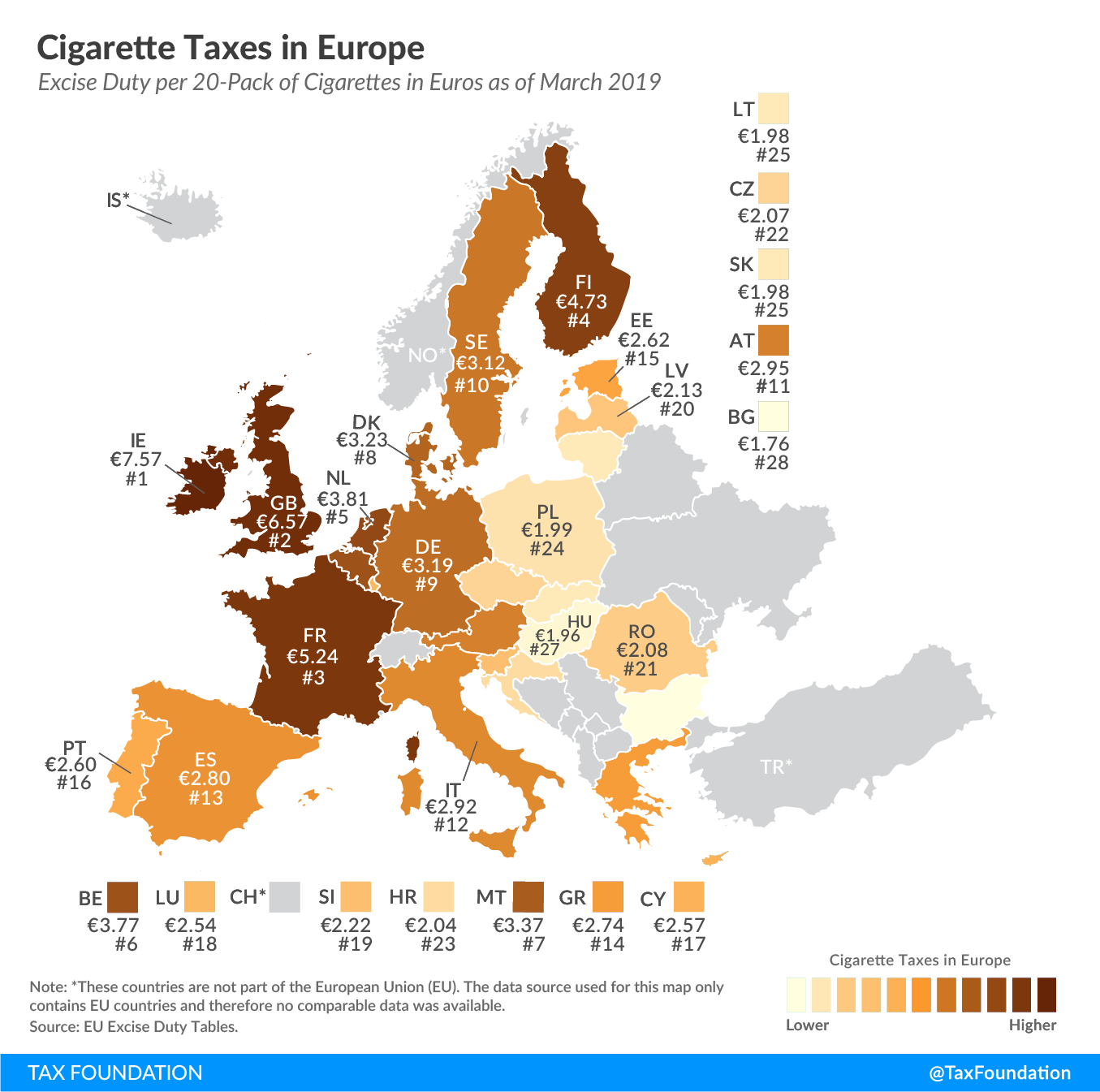
This map illustrates the wide variance in cigarette excise taxes across EU Member States. The highest tax in the EU is levied in Ireland at €10.71 ($12.58) per pack of 20 cigarettes, followed by France at €8.09 ($9.51) and the Netherlands at €7.77 ($9.13). The lowest excise tax per pack of 20 cigarettes is levied in Bulgaria at €2.03 ($2.38), followed by Cyprus at €2.64 ($3.10) and Croatia at €2.73 ($3.21).
2026 Data
2025
2024
2023
2022
2021
2020
2019
Expand or Collapse Table
Cigarette Taxes in the European Union
Excise Duties on Cigarettes in EU Member States as of January 1, 2026
| Excise Duty per 20-Pack | Excise Duty per 20-Pack | Total Tax per 20-Pack (Excise Duty and VAT) | Total Tax per 20-Pack (Excise Duty and VAT) | Average Retail Selling Price per 20-Pack (Including Tax) | Average Retail Selling Price per 20-Pack (Including Tax) | Tax as a Share of Average Retail Selling Price (Includes Excise Duties and VAT) | |
|---|---|---|---|---|---|---|---|
| EUR | USD | EUR | USD | EUR | USD | ||
| Austria | € 3.58 | $4.20 | € 4.57 | $5.37 | € 5.96 | $7.00 | 76.69% |
| Belgium | € 7.30 | $8.58 | € 9.24 | $10.85 | € 11.14 | $13.09 | 82.93% |
| Bulgaria | € 2.03 | $2.38 | € 2.55 | $2.99 | € 3.12 | $3.67 | 81.55% |
| Croatia | € 2.73 | $3.21 | € 3.65 | $4.28 | € 4.56 | $5.36 | 79.91% |
| Cyprus | € 2.64 | $3.10 | € 3.36 | $3.95 | € 4.53 | $5.32 | 74.25% |
| Czechia | € 3.76 | $4.42 | € 4.80 | $5.63 | € 5.97 | $7.01 | 80.33% |
| Denmark | € 5.27 | $6.19 | € 6.92 | $8.12 | € 8.25 | $9.69 | 83.88% |
| Estonia | € 4.08 | $4.79 | € 5.11 | $6.00 | € 5.35 | $6.28 | 95.52% |
| Finland | € 7.60 | $8.93 | € 9.71 | $11.41 | € 10.37 | $12.18 | 93.63% |
| France | € 8.09 | $9.51 | € 10.11 | $11.87 | € 12.07 | $14.18 | 83.71% |
| Germany | € 3.91 | $4.59 | € 5.08 | $5.97 | € 7.33 | $8.61 | 69.31% |
| Greece | € 2.74 | $3.22 | € 3.55 | $4.17 | € 4.20 | $4.93 | 84.66% |
| Hungary | € 3.07 | $3.61 | € 4.26 | $5.00 | € 5.58 | $6.55 | 76.33% |
| Ireland | € 10.71 | $12.58 | € 13.71 | $16.11 | € 16.04 | $18.84 | 85.48% |
| Italy | € 3.26 | $3.83 | € 4.24 | $4.98 | € 5.40 | $6.34 | 78.46% |
| Latvia | € 3.74 | $4.39 | € 4.57 | $5.36 | € 4.76 | $5.59 | 95.93% |
| Lithuania | € 3.21 | $3.76 | € 4.03 | $4.74 | € 4.78 | $5.62 | 84.41% |
| Luxembourg | € 3.18 | $3.74 | € 4.00 | $4.70 | € 5.64 | $6.62 | 70.97% |
| Malta | € 3.44 | $4.04 | € 4.28 | $5.03 | € 5.54 | $6.51 | 77.27% |
| Netherlands | € 7.77 | $9.13 | € 9.59 | $11.27 | € 10.52 | $12.36 | 91.21% |
| Poland | € 2.93 | $3.45 | € 3.71 | $4.35 | € 4.13 | $4.85 | 89.72% |
| Portugal | € 3.09 | $3.63 | € 4.08 | $4.79 | € 5.27 | $6.19 | 77.34% |
| Romania | € 2.77 | $3.25 | € 3.64 | $4.27 | € 5.00 | $5.88 | 72.70% |
| Slovak Republic | € 3.13 | $3.67 | € 4.10 | $4.81 | € 5.20 | $6.11 | 78.81% |
| Slovenia | € 2.99 | $3.52 | € 3.87 | $4.55 | € 4.87 | $5.72 | 79.49% |
| Spain | € 3.13 | $3.68 | € 4.01 | $4.71 | € 5.07 | $5.96 | 79.06% |
| Sweden | € 3.84 | $4.51 | € 5.15 | $6.05 | € 6.58 | $7.72 | 78.33% |
| Average | € 4.22 | $4.96 | € 5.40 | $6.35 | € 6.56 | $7.71 | 81.55% |
Source: European Commission, “Taxes in Europe Database."
Data compiled by Jacob Macumber-Rosin and Adam Hoffer
Expand or Collapse Table
Cigarette Taxes in the European Union
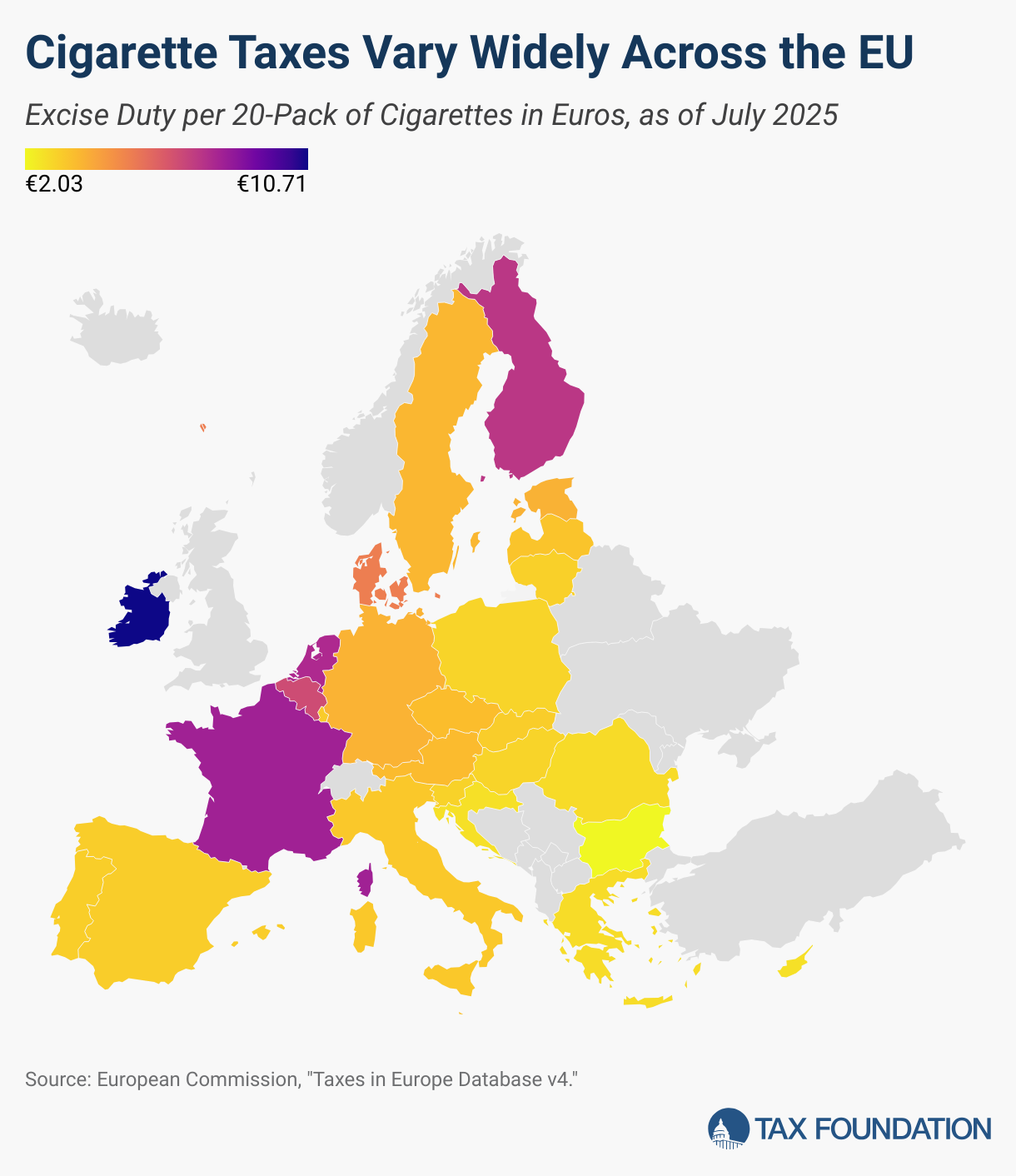
Excise Duties on Cigarettes in EU Member States as of July 1, 2025
| Excise Duty per 20-Pack | Excise Duty per 20-Pack | Total Tax per 20-Pack (Excise Duty and VAT) | Total Tax per 20-Pack (Excise Duty and VAT) | Average Retail Selling Price per 20-Pack (Including Tax) | Average Retail Selling Price per 20-Pack (Including Tax) | Tax as a Share of Average Retail Selling Price (Includes Excise Duties and VAT) | |
|---|---|---|---|---|---|---|---|
| EUR | USD | EUR | USD | EUR | USD | ||
| Austria (AT) | €3.58 | $4.22 | €4.57 | $5.40 | €5.96 | $7.04 | 76.69% |
| Belgium (BE) | €6.74 | $7.96 | €8.36 | $9.87 | €9.35 | $11.04 | 89.45% |
| Bulgaria (BG) | €2.03 | $2.39 | €2.55 | $3.01 | €3.12 | $3.69 | 81.55% |
| Croatia (HR) | €2.63 | $3.10 | €3.51 | $4.15 | €4.43 | $5.23 | 79.34% |
| Cyprus (CY) | €2.64 | $3.12 | €3.36 | $3.97 | €4.53 | $5.35 | 74.25% |
| Czech Republic (CZ) | €3.52 | $4.16 | €4.52 | $5.34 | €5.74 | $6.77 | 78.82% |
| Denmark (DK) | €5.27 | $6.22 | €6.92 | $8.17 | €8.25 | $9.74 | 83.88% |
| Estonia (EE) | €3.84 | $4.53 | €4.87 | $5.75 | €5.35 | $6.32 | 91.04% |
| Finland (FI) | €7.39 | $8.72 | €9.49 | $11.21 | €10.37 | $12.24 | 91.55% |
| France (FR) | €8.09 | $9.55 | €10.11 | $11.93 | €12.07 | $14.25 | 83.71% |
| Germany (DE) | €3.80 | $4.48 | €4.97 | $5.86 | €7.33 | $8.65 | 67.76% |
| Greece (GR) | €2.74 | $3.24 | €3.55 | $4.20 | €4.20 | $4.96 | 84.66% |
| Hungary (HU) | €2.93 | $3.46 | €4.09 | $4.83 | €5.45 | $6.44 | 75.05% |
| Ireland (IE) | €10.71 | $12.64 | €13.71 | $16.19 | €16.04 | $18.94 | 85.48% |
| Italy (IT) | €3.26 | $3.85 | €4.24 | $5.00 | €5.40 | $6.37 | 78.46% |
| Latvia (LV) | €3.35 | $3.95 | €4.17 | $4.93 | €4.76 | $5.62 | 87.65% |
| Lithuania (LT) | €3.05 | $3.60 | €3.88 | $4.58 | €4.78 | $5.64 | 81.10% |
| Luxembourg (LU) | €3.16 | $3.73 | €3.97 | $4.69 | €5.64 | $6.65 | 70.53% |
| Malta (MT) | €3.44 | $4.06 | €4.28 | $5.05 | €5.54 | $6.54 | 77.27% |
| Netherlands (NL) | €7.77 | $9.17 | €9.59 | $11.33 | €10.52 | $12.42 | 91.21% |
| Poland (PL) | €2.93 | $3.46 | €3.71 | $4.38 | €4.13 | $4.88 | 89.72% |
| Portugal (PT) | €3.09 | $3.65 | €4.05 | $4.79 | €5.16 | $6.09 | 78.57% |
| Romania (RO) | €2.77 | $3.26 | €3.58 | $4.23 | €5.11 | $6.03 | 70.09% |
| Slovakia (SK) | €3.13 | $3.69 | €4.10 | $4.84 | €5.20 | $6.14 | 78.81% |
| Slovenia (SI) | €2.99 | $3.53 | €3.87 | $4.57 | €4.87 | $5.75 | 79.49% |
| Spain (ES) | €3.13 | $3.70 | €4.01 | $4.73 | €5.07 | $5.99 | 79.06% |
| Sweden (SE) | €3.71 | $4.37 | €4.99 | $5.89 | €6.41 | $7.57 | 77.78% |
| Average | €4.14 | $4.88 | €5.30 | $6.25 | €6.47 | $7.64 | 80.85% |
Source: European Commission, “Taxes in Europe Database."
Data compiled by Adam Hoffer and Jacob Macumber-Rosin

Changes from 2025
- Belgium increased the excise duty on a pack of 20 cigarettes by €0.56.
- Latvia increased the excise duty on a pack of 20 cigarettes by €0.39.
- Estonia increased the excise duty on a pack of 20 cigarettes by €0.24.
- Czechia increased the excise duty on a pack of 20 cigarettes by €0.24.
- Finland increased the excise duty on a pack of 20 cigarettes by €0.22.
- Lithuania increased the excise duty on a pack of 20 cigarettes by €0.16.
- Hungary increased the excise duty on a pack of 20 cigarettes by €0.14.
- Sweden increased the excise duty on a pack of 20 cigarettes by €0.13.
- Germany increased the excise duty on a pack of 20 cigarettes by €0.11.
- Croatia increased the excise duty on a pack of 20 cigarettes by €0.11.
- Other countries changed the excise duty on a pack of 20 cigarettes by less than €0.10.
The excise taxes are levied in addition to the VAT applied to cigarettes.
EU Average Tax Types and Rates on a Pack of 20 Cigarettes as of January 2026
| Tax | Average Rates and Prices |
|---|---|
| Base Market Price (excluding taxes) | €1.16 |
| plus Excise duty (minimum 60% of RSP) | €4.22 (64.3% of RSP) |
| equals Pre-VAT Price | €5.38 |
| plus VAT | €1.18 (18.0% of RSP) |
| equals Retail Selling Price (including all taxes) | €6.56 |
Considering the total taxes, the average tax share of weighted average retail prices in EU countries ranges from 69.31 percent in Germany to 95.52 percent in Estonia. The data are calculated and published by the European Commission using weighted average prices from the previous years, pursuant to Article 8 (Subsection 2) of the Tobacco Tax Directive.
Cigarette taxes are regressive because smoking is more prevalent among people with lower incomes. The narrow base and declining consumption trend make cigarette excise taxes a volatile source of revenue. Cigarette tax increases tend to invite cigarette smuggling and drive consumers to illicit markets.
KPMG estimates that more than 38 billion counterfeit and contraband cigarettes were consumed in the EU in 2024, more than 10 percent greater than in 2023. This amounts to 9.2 percent of total cigarette consumption and an estimated loss of €14.9 billion ($17.5 billion) in tax revenues. The largest EU markets for illicit cigarettes as a percentage of total consumption were in France (38 percent), Ireland (32 percent), and Lithuania and Finland (both at 20 percent). France alone accounts for almost half of all illicit consumption in the EU.
Major updates to the EU Tobacco Tax Directive are being considered. The revision of the directive has been proposed, but nothing has been finalized.
The proposal in its current form threatens to burden alternative tobacco products to a relatively high degree, which is likely to discourage smokers from switching to those less harmful products. Alternative tobacco products should be taxed according to their degree of harm to encourage consumers moving down the harm continuum, and overall tax burdens should be low enough to keep consumers away from more dangerous illicit markets.
As cigarette smoking continues, and consumption of counterfeit and contraband cigarettes continues to grow, the European Commission may reconsider updates to the EU tobacco tax policy. Alternative tobacco products like snus, heat-not-burn products, vapor, and oral pouches can help smokers switch to less harmful products, and tax policy should embrace harm reduction to optimize health outcomes and tax revenues.
Stay informed on the tax policies impacting you.
Subscribe to our free newsletter to get the latest tax data, news and analysis.
SubscribeAbout the Authors

Jacob Macumber-Rosin is an Excise Tax Policy Analyst with the Tax Foundation. Jacob holds a BS in economics (politics and the economy) as well as a BS in civic and economic thought and leadership from Arizona State University.

Adam Hoffer is the Director of Excise Tax Policy at the Tax Foundation. Dr. Hoffer earned his PhD in Economics from West Virginia University and his undergraduate degree from Washington & Jefferson College.