





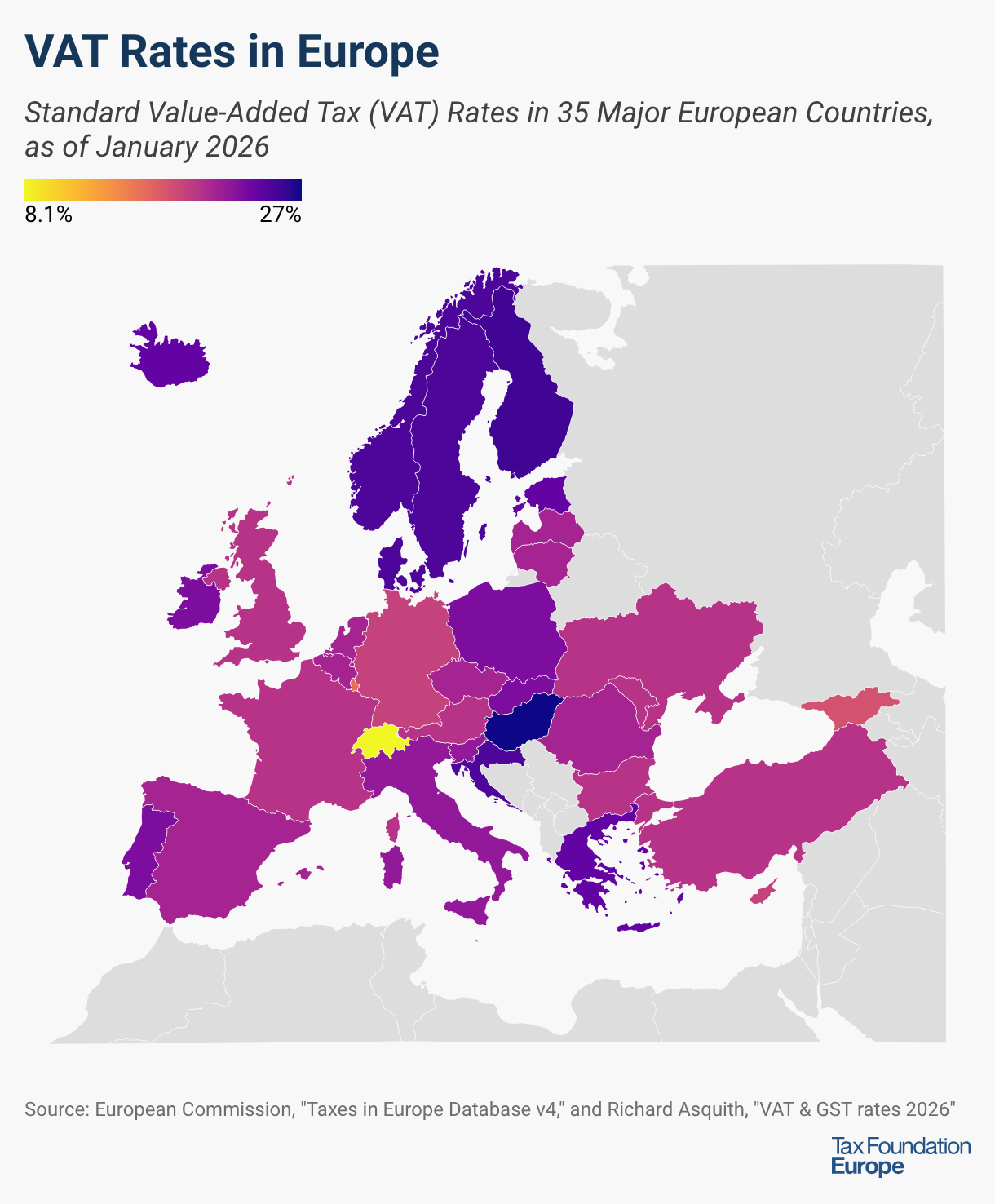
Worldwide, 175 countries—including all major European countries—levy a value-added taxA tax is a mandatory payment or charge collected by local, state, and national governments from individuals or businesses to cover the costs of general government services, goods, and activities. (VAT) on goods and services. As today’s tax map shows, EU Member States’ VAT rates vary, though they’re somewhat harmonized by the EU.
The VAT is a consumption taxA consumption tax is typically levied on the purchase of goods or services and is paid directly or indirectly by the consumer in the form of retail sales taxes, excise taxes, tariffs, value-added taxes (VAT), or income taxes where all savings are tax-deductible. assessed on the value added in each production stage of a good or service. Every business along the value chain receives a tax creditA tax credit is a provision that reduces a taxpayer’s final tax bill, dollar-for-dollar. A tax credit differs from deductions and exemptions, which reduce taxable income rather than the taxpayer’s tax bill directly. for the VAT already paid. The end consumer does not, making it a tax on final consumption.
2026 Data
2025
2024
2023
2022
2021
2020
2019
Expand or Collapse Table
VAT Rates in Europe, as of January 2026
| Country | Super-Reduced Rate (%) | Reduced Rate (%) | Parking Rate (%) | Standard Rate (%) |
|---|---|---|---|---|
| Austria (AT) | - | 10 / 13 | 13 | 20 |
| Belgium (BE) | - | 6 / 12 | 12 | 21 |
| Bulgaria (BG) | - | 9 | - | 20 |
| Croatia (HR) | - | 5 / 13 | - | 25 |
| Cyprus (CY) | - | 5 / 9 | - | 19 |
| Czech Republic (CZ) | - | 12 | - | 21 |
| Denmark (DK) | - | - | - | 25 |
| Estonia (EE) | - | 9 / 13 | - | 24 |
| Finland (FI) | - | 10 /13.5 | - | 25.5 |
| France (FR) | 2.1 | 5.5 / 10 | - | 20 |
| Georgia (GE) | - | - | - | 18 |
| Germany (DE) | - | 7 | - | 19 |
| Greece (GR) | - | 6 / 13 | - | 24 |
| Hungary (HU) | - | 5 / 18 | - | 27 |
| Iceland (IS) | - | 11 | - | 24 |
| Ireland (IE) | 4.8 | 9 / 13.5 | 13.5 | 23 |
| Italy (IT) | 4 | 5 / 10 | - | 22 |
| Latvia (LV) | - | 5 / 12 | - | 21 |
| Lithuania (LT) | - | 5 / 9 | - | 21 |
| Luxembourg (LU) | 3 | 8 | 14 | 17 |
| Malta (MT) | - | 5 / 7 | 12 | 18 |
| Moldova (MD) | - | 8 / 12 | - | 20 |
| Netherlands (NL) | - | 9 | - | 21 |
| Norway (NO) | - | 12 / 15 | - | 25 |
| Poland (PL) | - | 5 / 8 | - | 23 |
| Portugal (PT) | - | 6 / 13 | 13 | 23 |
| Romania (RO) | - | 11 | - | 21 |
| Slovakia (SK) | - | 5 / 19 | - | 23 |
| Slovenia (SI) | - | 5 / 9.5 | - | 22 |
| Spain (ES) | 4 | 10 | - | 21 |
| Sweden (SE) | - | 6 / 12 | - | 25 |
| Switzerland (CH) | 2.6 / 3.8 | 8.1 | ||
| Turkey (TR) | 1 | 10 | - | 20 |
| Ukraine | - | 7 / 14 | - | 20 |
| United Kingdom (GB) | - | 5 | - | 20 |
Source: European Union, “VAT rules and rates,” https://europa.eu/youreurope/business/taxation/vat/vat-rules-rates/index_en.htm; European Commission, "Taxes in Europe Database v4," https://ec.europa.eu/taxation_customs/tedb/; Richard Asquith, "VAT & GST rates 2026," VATCalc, https://vatcalc.com/vat-rates/.

Expand or Collapse Table
2025 VAT Rates in Europe
VAT Rates in Europe, as of January 2025
| Country | Super-Reduced Rate (%) | Reduced Rate (%) | Parking Rate (%) | Standard Rate (%) |
|---|---|---|---|---|
| Austria (AT) | - | 10 / 13 | 13 | 20 |
| Belgium (BE) | - | 6 / 12 | 12 | 21 |
| Bulgaria (BG) | - | 9 | - | 20 |
| Croatia (HR) | - | 5 / 13 | - | 25 |
| Cyprus (CY) | - | 5 / 9 | - | 19 |
| Czech Republic (CZ) | - | 12 | - | 21 |
| Denmark (DK) | - | - | - | 25 |
| Estonia (EE) | - | 9 / 13 | - | 22 |
| Finland (FI) | - | 10 /14 | - | 25.5 |
| France (FR) | 2.1 | 5.5 / 10 | - | 20 |
| Georgia (GE) | - | - | - | 18 |
| Germany (DE) | - | 7 | - | 19 |
| Greece (GR) | - | 6 / 13 | - | 24 |
| Hungary (HU) | - | 5 / 18 | - | 27 |
| Iceland (IS) | - | 11 | - | 24 |
| Ireland (IE) | 4.8 | 9 / 13.5 | 13.5 | 23 |
| Italy (IT) | 4 | 5 / 10 | - | 22 |
| Latvia (LV) | - | 5 / 12 | - | 21 |
| Lithuania (LT) | - | 5 / 9 | - | 21 |
| Luxembourg (LU) | 3 | 8 | 14 | 17 |
| Malta (MT) | - | 5 / 7 | 12 | 18 |
| Moldova (MD) | - | 8 / 12 | - | 20 |
| Netherlands (NL) | - | 9 | - | 21 |
| Norway (NO) | - | 12 / 15 | - | 25 |
| Poland (PL) | - | 5 / 8 | - | 23 |
| Portugal (PT) | - | 6 / 13 | 13 | 23 |
| Romania (RO) | - | 5 / 9 | - | 19 |
| Slovakia (SK) | - | 5 / 19 | - | 23 |
| Slovenia (SI) | - | 5 / 9.5 | - | 22 |
| Spain (ES) | 4 | 10 | - | 21 |
| Sweden (SE) | - | 6 / 12 | - | 25 |
| Switzerland (CH) | 2.6 / 3.8 | 8.1 | ||
| Turkey (TR) | 1 | 10 | - | 20 |
| Ukraine | - | 7 / 14 | - | 20 |
| United Kingdom (GB) | - | 5 | - | 20 |
Source: European Union, “VAT rules and rates,” https://europa.eu/youreurope/business/taxation/vat/vat-rules-rates/index_en.htm#shortcut-5; European Commission, "Taxes in Europe Database v4," https://ec.europa.eu/taxation_customs/tedb/; Richard Asquith, "VAT & GST rates 2025," VATCalc, https://vatcalc.com/vat-rates/.
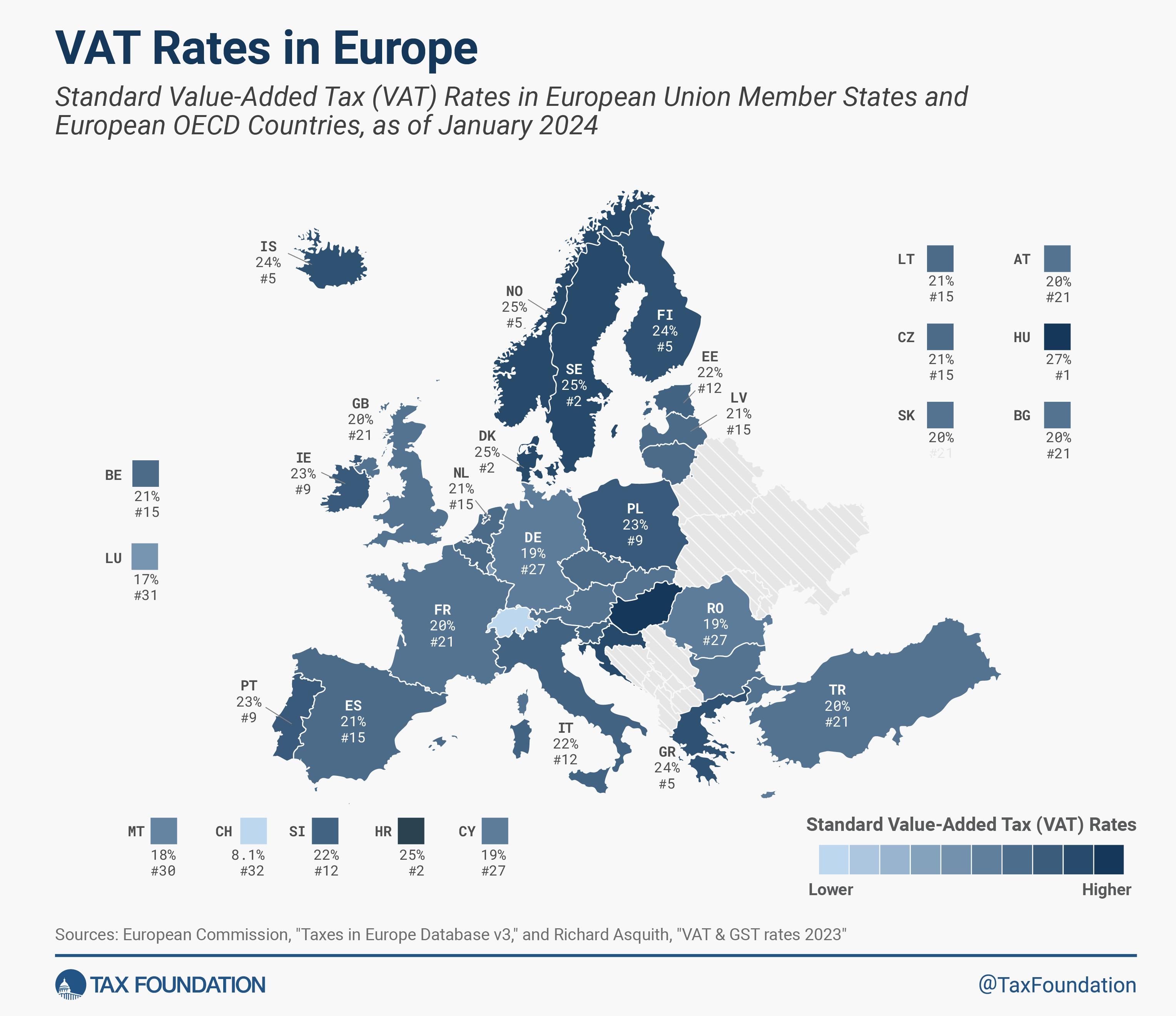
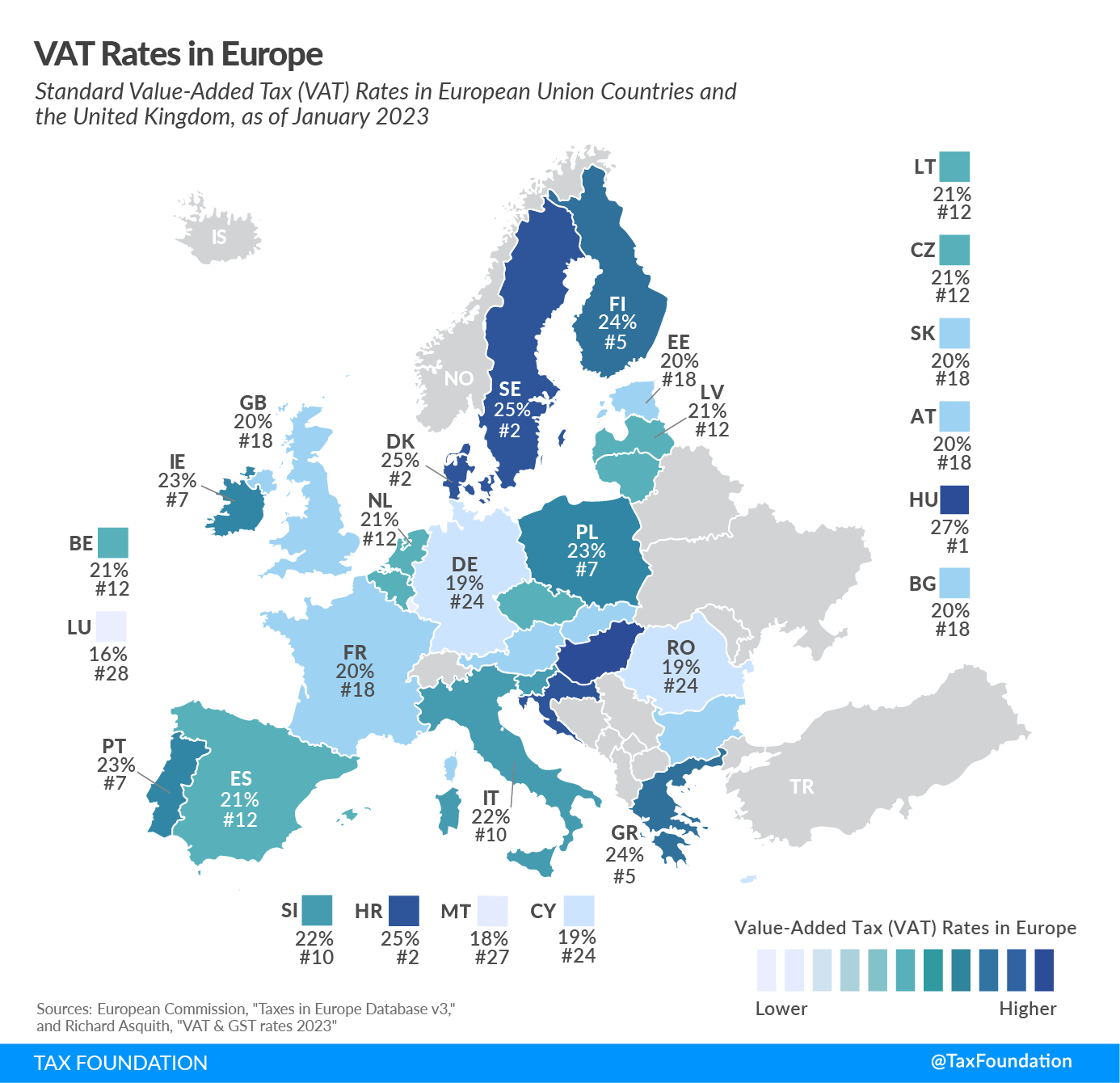
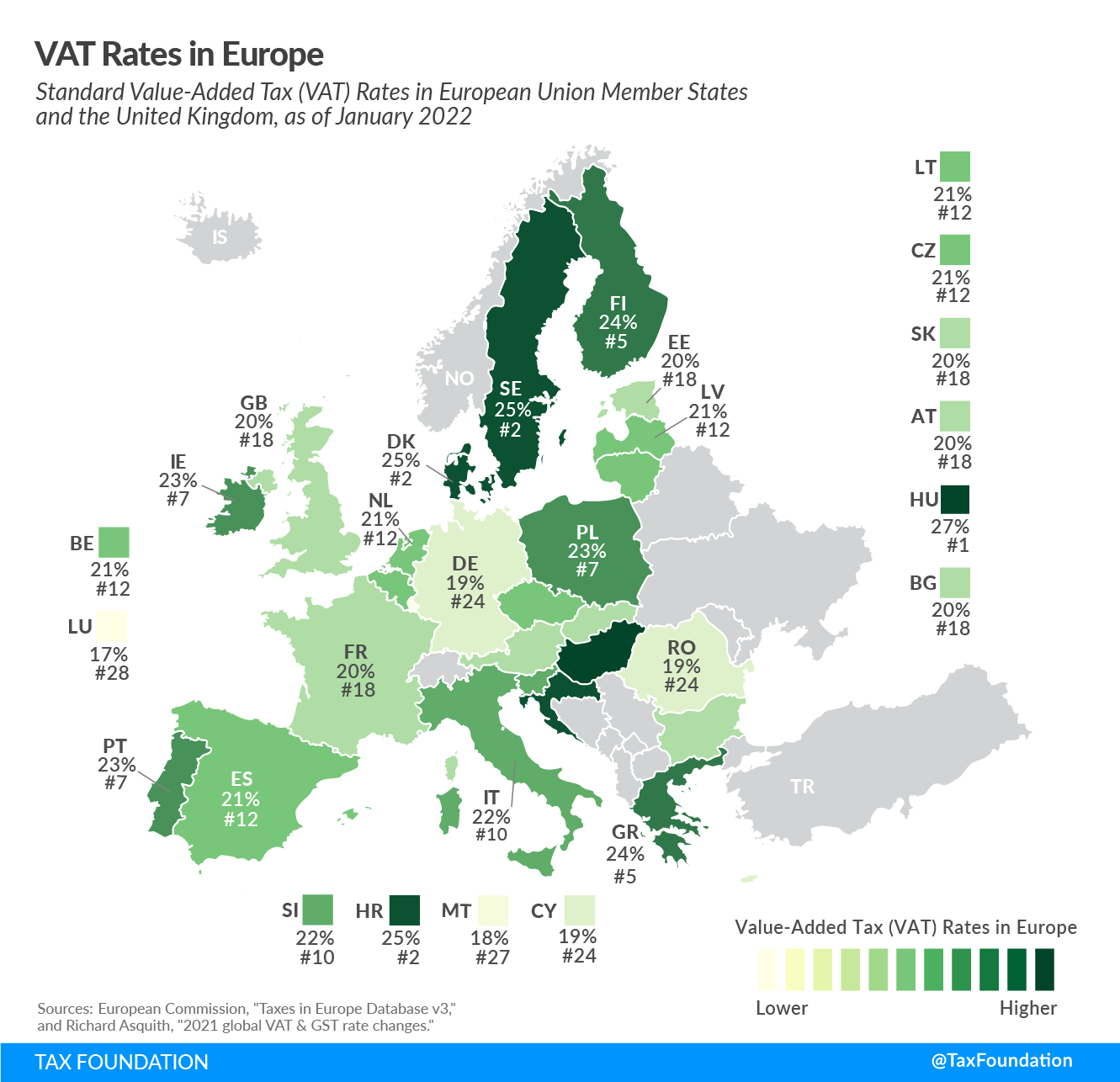
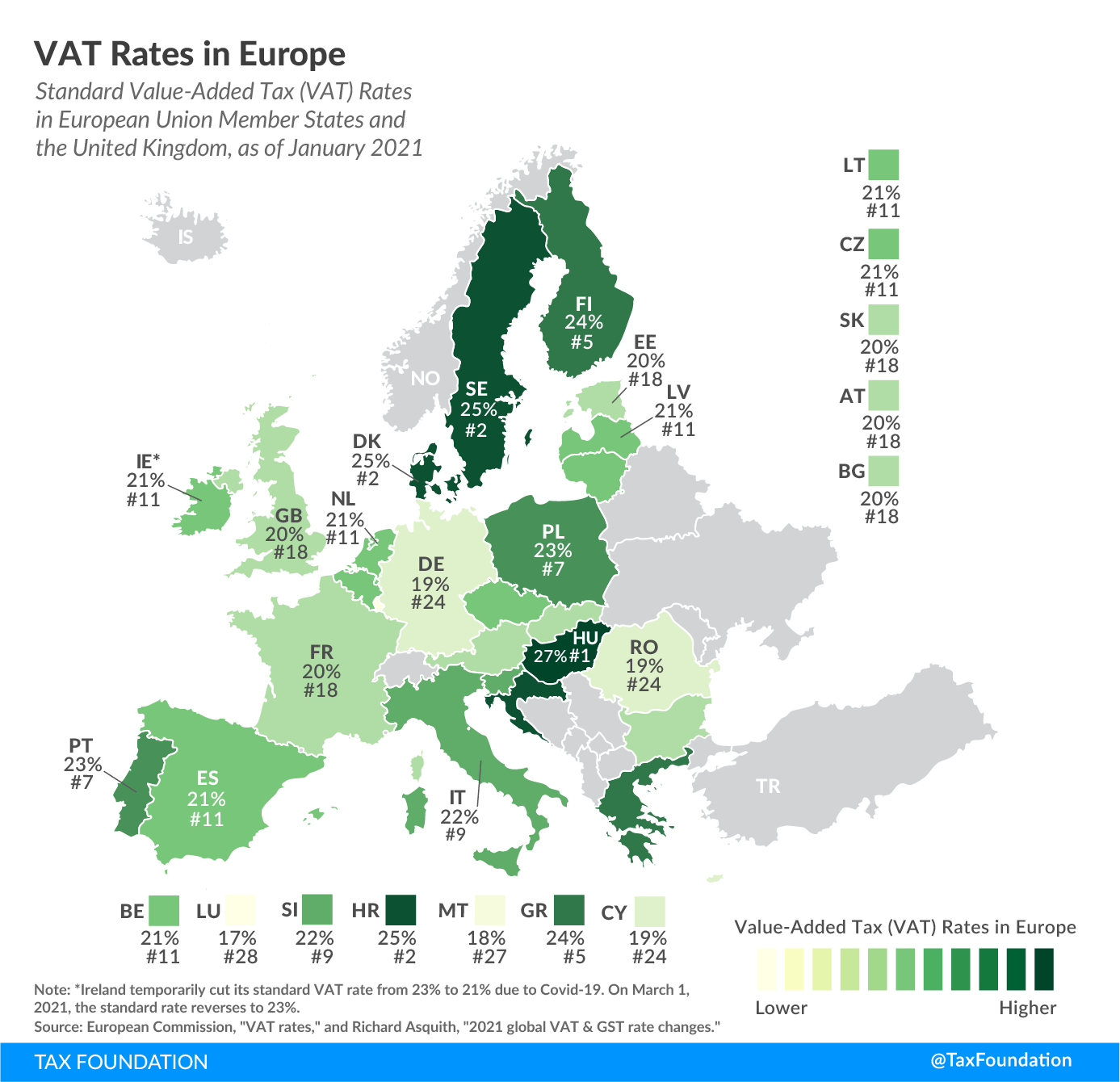
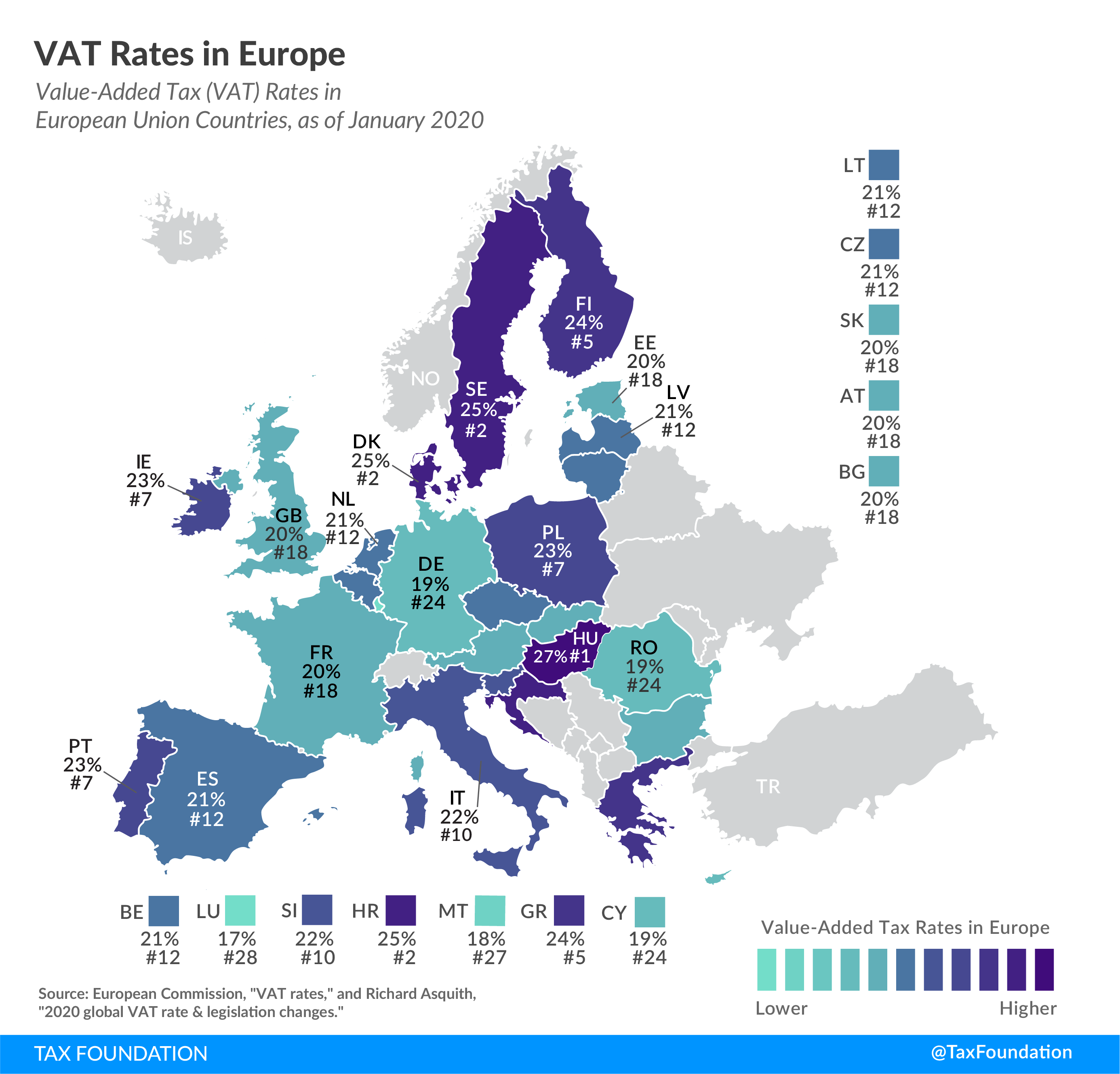
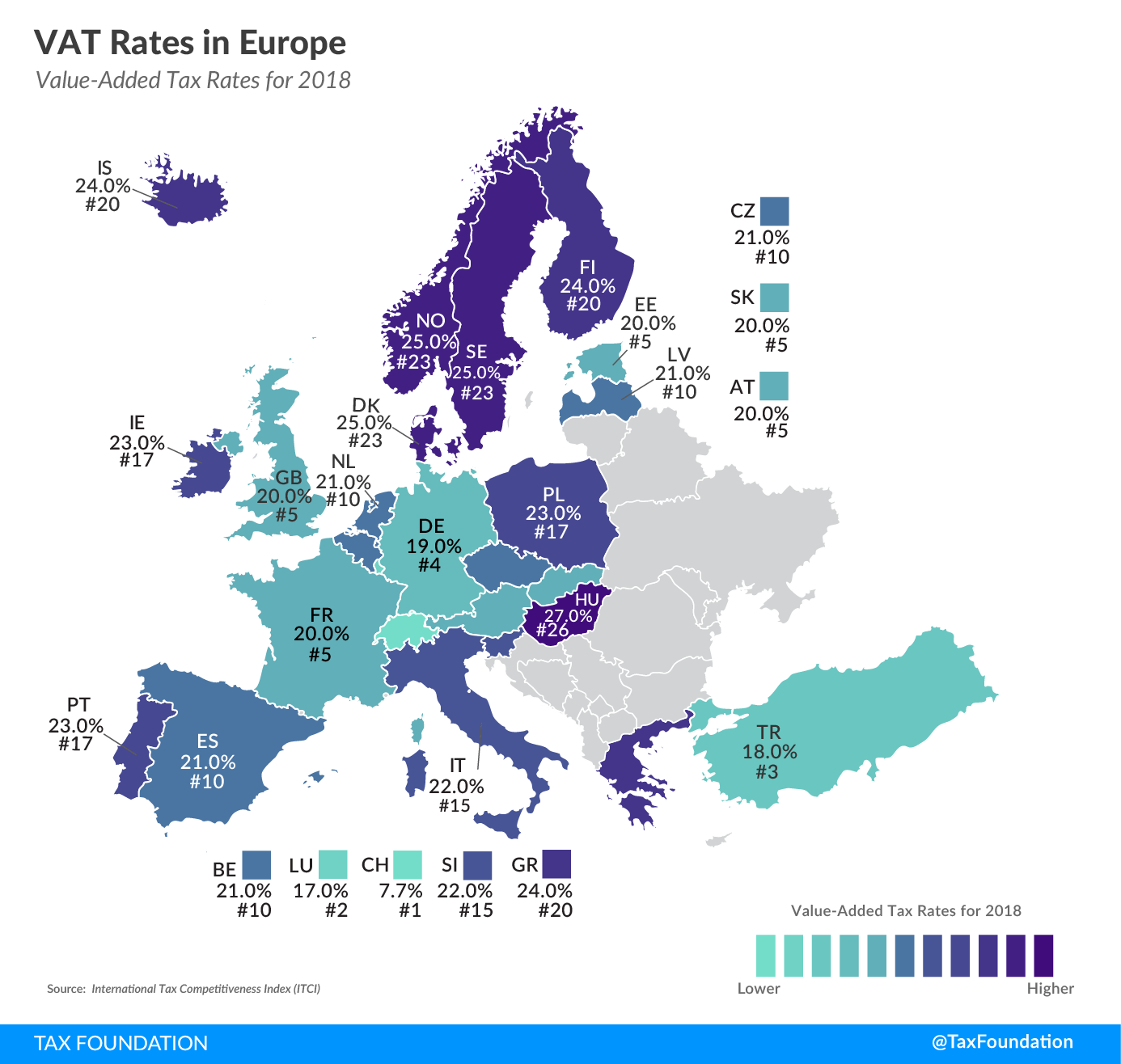
The EU countries with the highest standard VAT rates are Hungary (27 percent), Finland (25.5 percent), and Croatia, Denmark, and Sweden (all at 25 percent). Luxembourg levies the lowest standard VAT rate at 17 percent, followed by Malta (18 percent), Cyprus, and Germany (both 19 percent). The EU’s average standard VAT rate is 21.9 percent, nearly seven percentage points higher than the minimum standard VAT rate required by EU regulation.
Among the eight major European countries that are not part of the European Union—Georgia, Iceland, Moldova, Norway, Switzerland, Turkey, Ukraine, and the United Kingdom—only Switzerland levies a standard VAT rate below the EU minimum at a rate of 8.1 percent. In comparison, the United States’ combined state and local sales taxA sales tax is levied on retail sales of goods and services and, ideally, should apply to all final consumption with few exemptions. Many governments exempt goods like groceries; base broadening, such as including groceries, could keep rates lower. A sales tax should exempt business-to-business transactions which, when taxed, cause tax pyramiding. rates averaged only 7.5 percent in 2025.
Generally, consumption taxes are an economically efficient way of raising tax revenue. Ideally, to minimize economic distortions, there should be only one standard rate that is levied on all final consumption, with as few exemptions as possible. However, EU countries levy reduced rates and exempt certain goods and services from VAT.
One of the main reasons for reduced VAT rates and VAT-exempted goods/services is the promotion of equity, as lower-income households tend to spend a larger share of their incomes on goods and services, such as food and public transportation. Other reasons include encouraging the consumption of “merit goods” (e.g., books), promoting local services (e.g., tourism), and correcting externalities (e.g., clean power).
However, evidence shows that reduced VAT rates and VAT exemptions are not necessarily effective at achieving these policy goals and can even be regressive in some instances. Reduced rates and exemptions can lead to higher administrative and compliance costs and can create economic distortions. A recent study shows that scrapping VAT reduced rates in EU countries will allow standard rates to drop under 15 percent. To address equity concerns, the Organisation for Economic Co-operation and Development instead recommends measures that directly increase poorer households’ real incomes.
Many European countries have made changes to their VAT rates since last year. Austria zero-rated some hygiene products from 2026. Estonia has increased its standard rate from 22 to 24 percent in July 2025. Germany is eroding its VAT base by moving food in restaurants from the 19 percent standard rate to the 7 percent reduced rate from 2026. Greece extended the 30 percent reduction in all VAT rates to more islands. Lithuania broadened its VAT base by moving some reduced-rate items from the 9 to the 12 percent bracket, a reversal of previous policy changes in 2023. The Netherlands moved accommodation services from the 9 percent reduced rate to the 21 percent standard rate. Finland has further lowered its reduced rate from 14 to 13.5 percent, widening the gap to its 25.5 percent standard rate. Romania has increased its standard rate from 19 to 21 percent in August 2025 and consolidated its 5 and 9 percent brackets into a single 11 percent reduced rate.
Stay informed on the tax policies impacting you.
Subscribe to our free newsletter to get the latest tax data, news and analysis.
SubscribeAbout the Author

Alex Mengden is an Economist at the Tax Foundation, where he focuses on international tax issues and tax policy in Europe. He holds a BA in philosophy and economics from the University of Bayreuth and an MSc in economics from the Ludwig Maximilian University of Munich.