





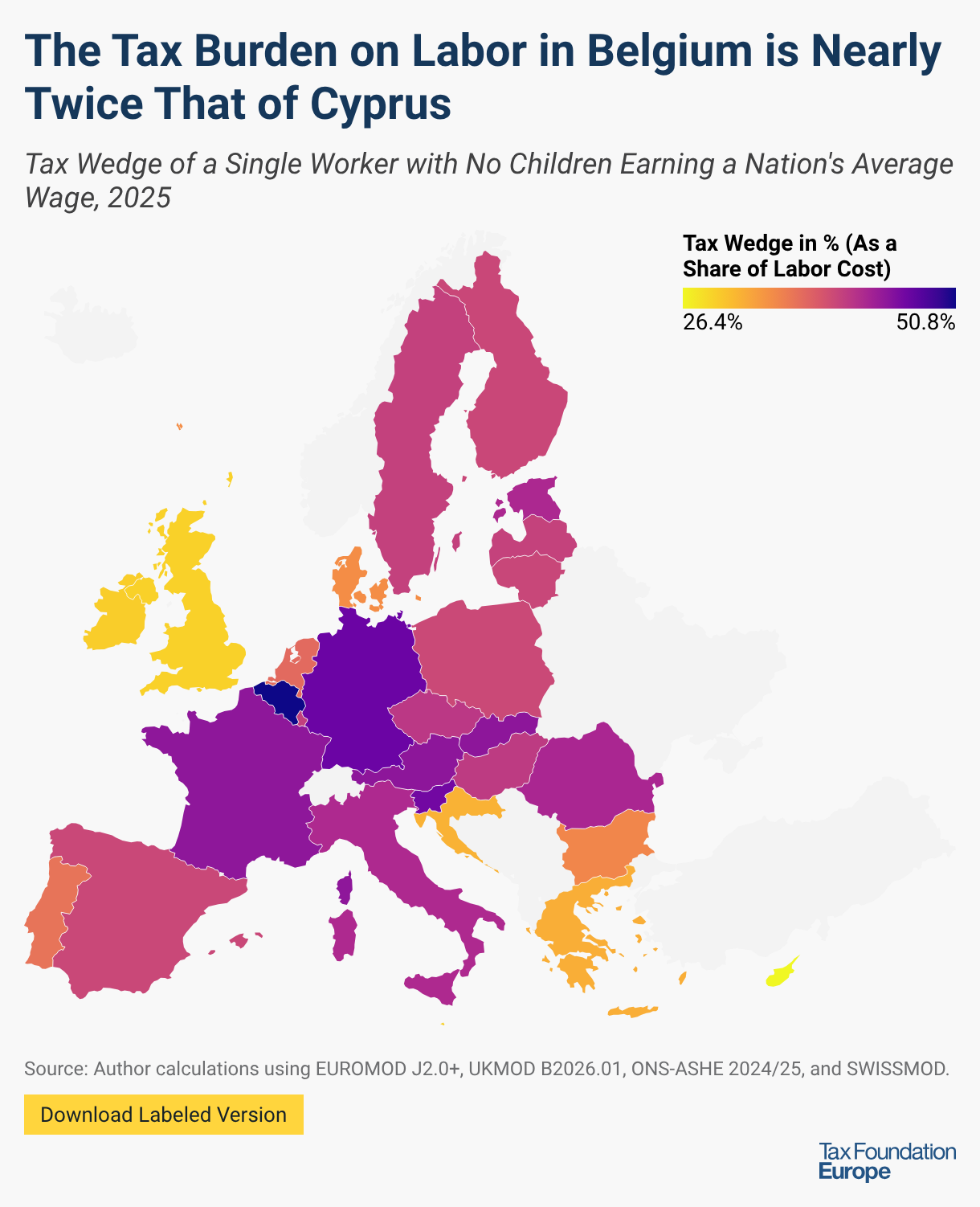
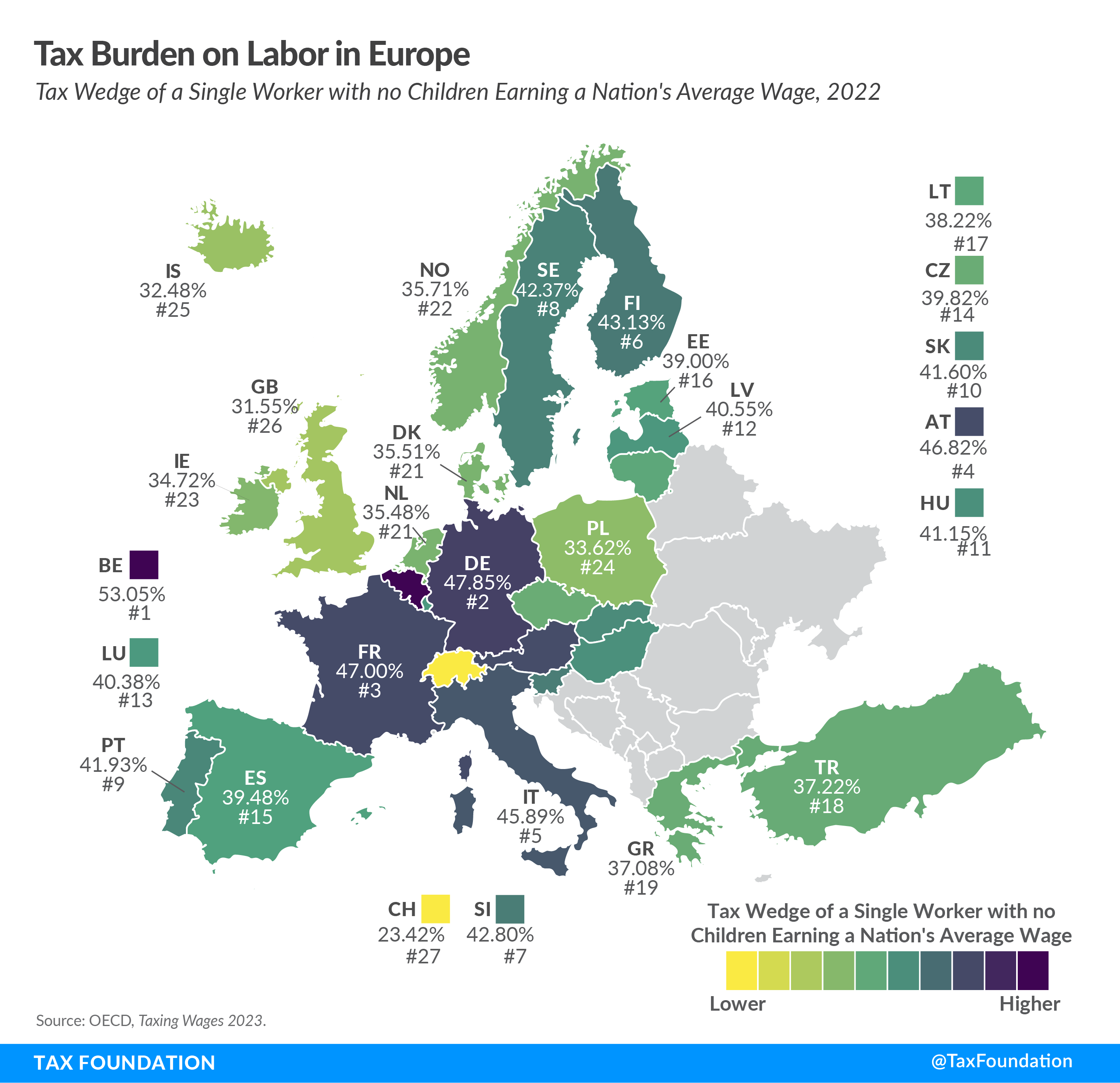
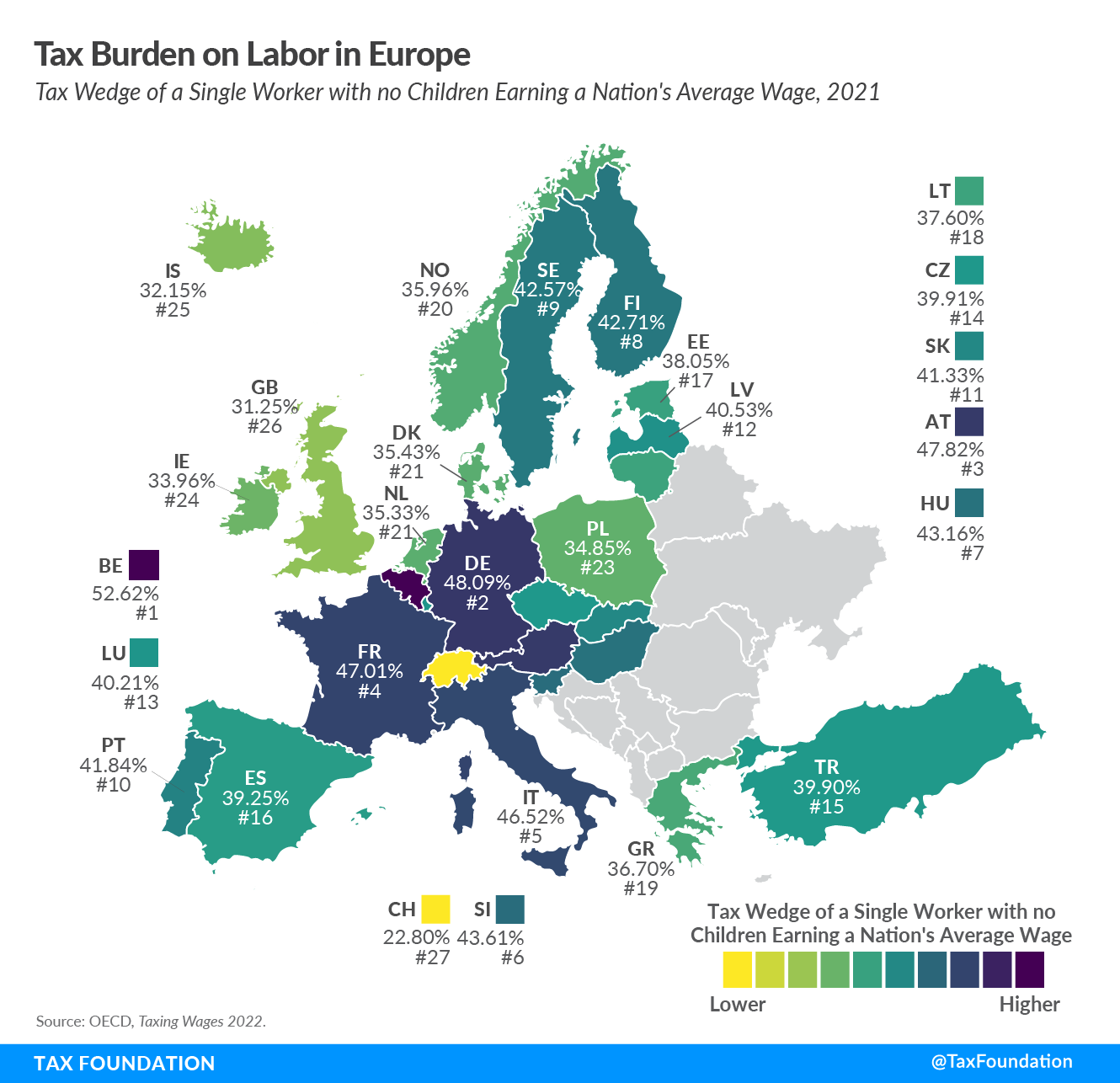
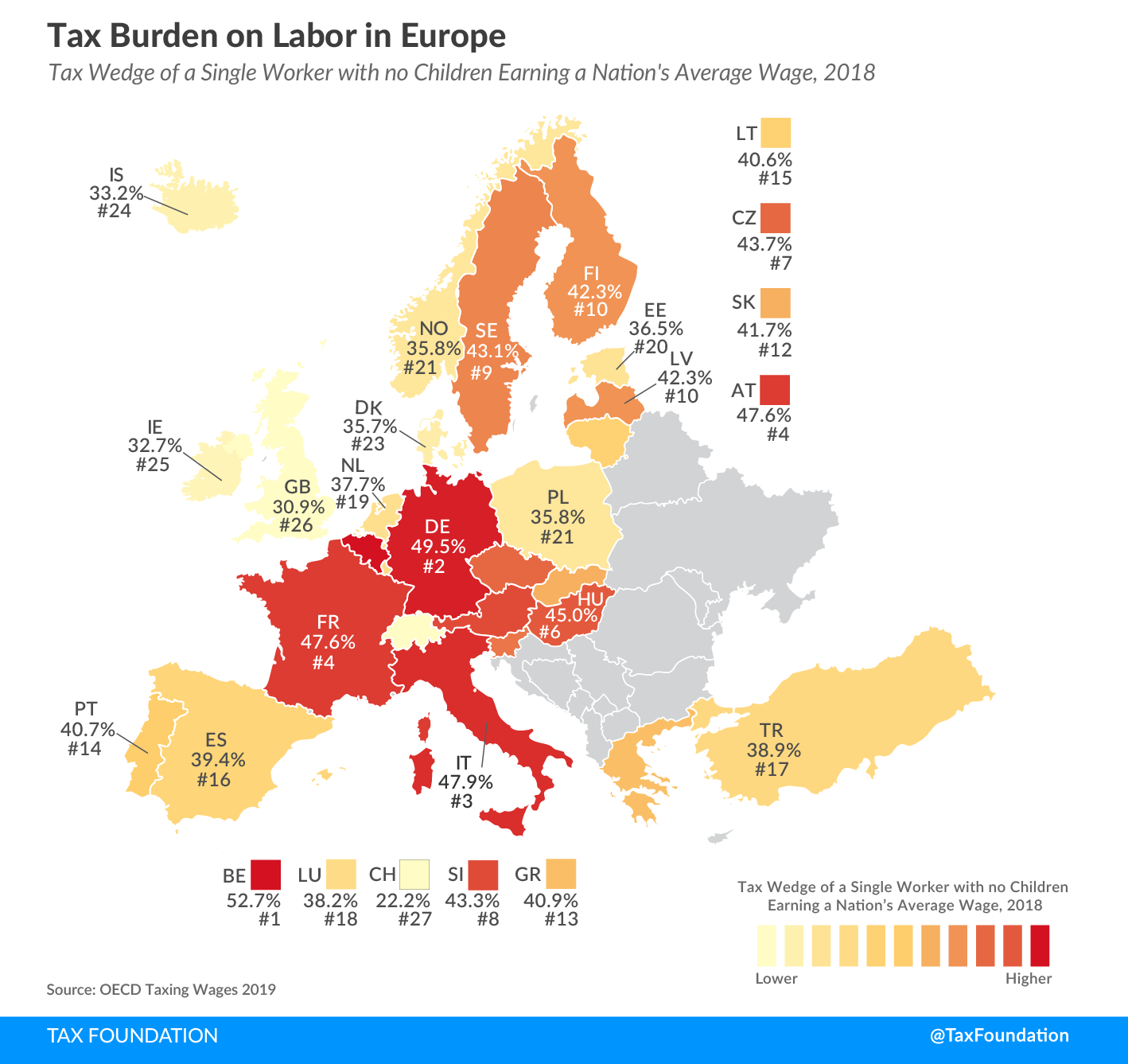
Belgium has the highest tax burden on labor at 50.8 percent (also the highest of all OECD countries), followed by Germany and Slovenia at 46.6 percent and 46.2 percent, respectively.
Cyprus had the lowest tax burden at 26.4 percent, followed by Malta and the United Kingdom (both at 29.2 percent).
To make the taxation of labor more efficient, policymakers should understand their country’s tax wedge and how the tax burden on labor funds government services. This will be particularly important as policymakers explore ways to encourage robust economic growth.
Changes to Income Tax Systems Directly Impact the Tax Burden on Labor
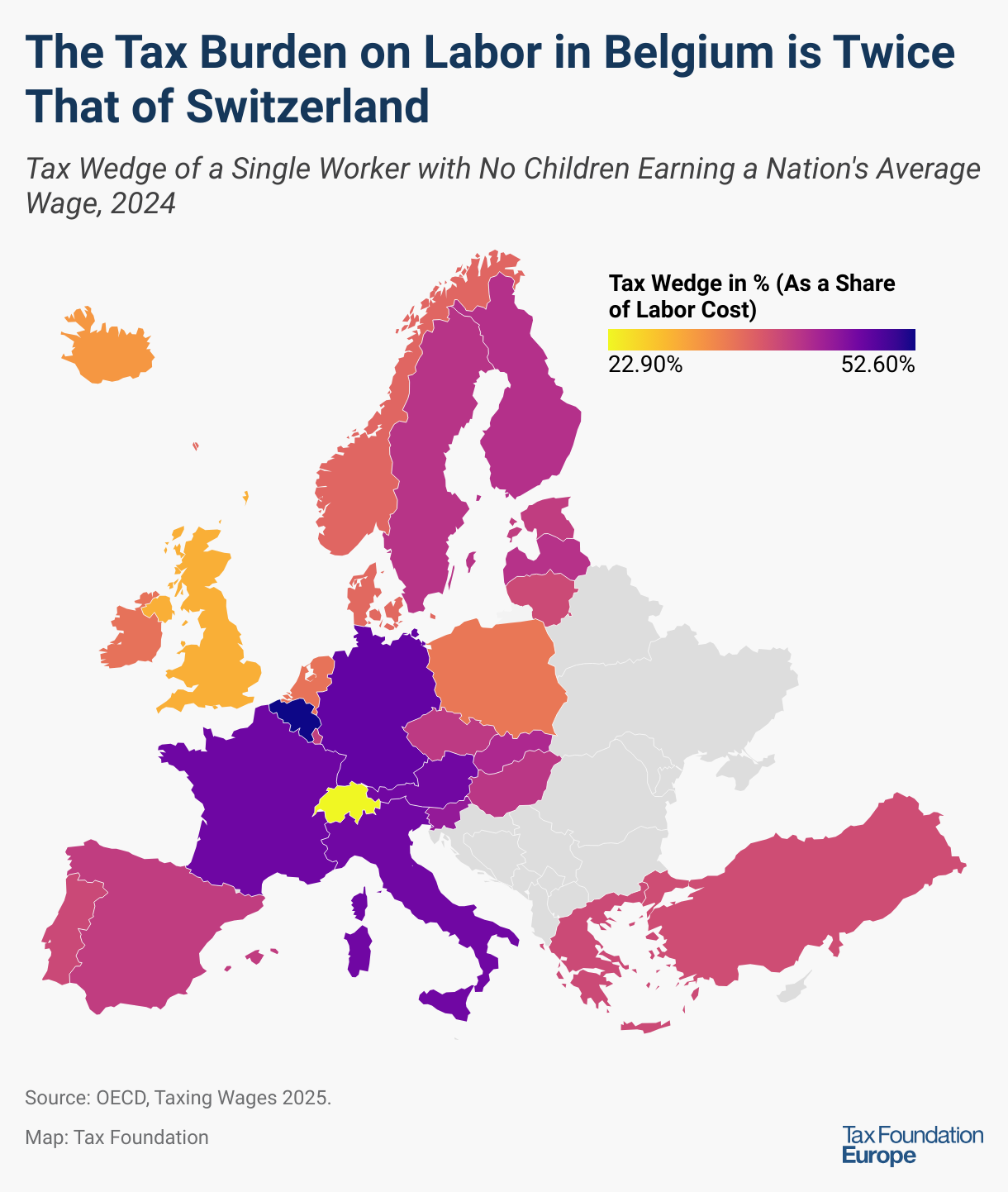
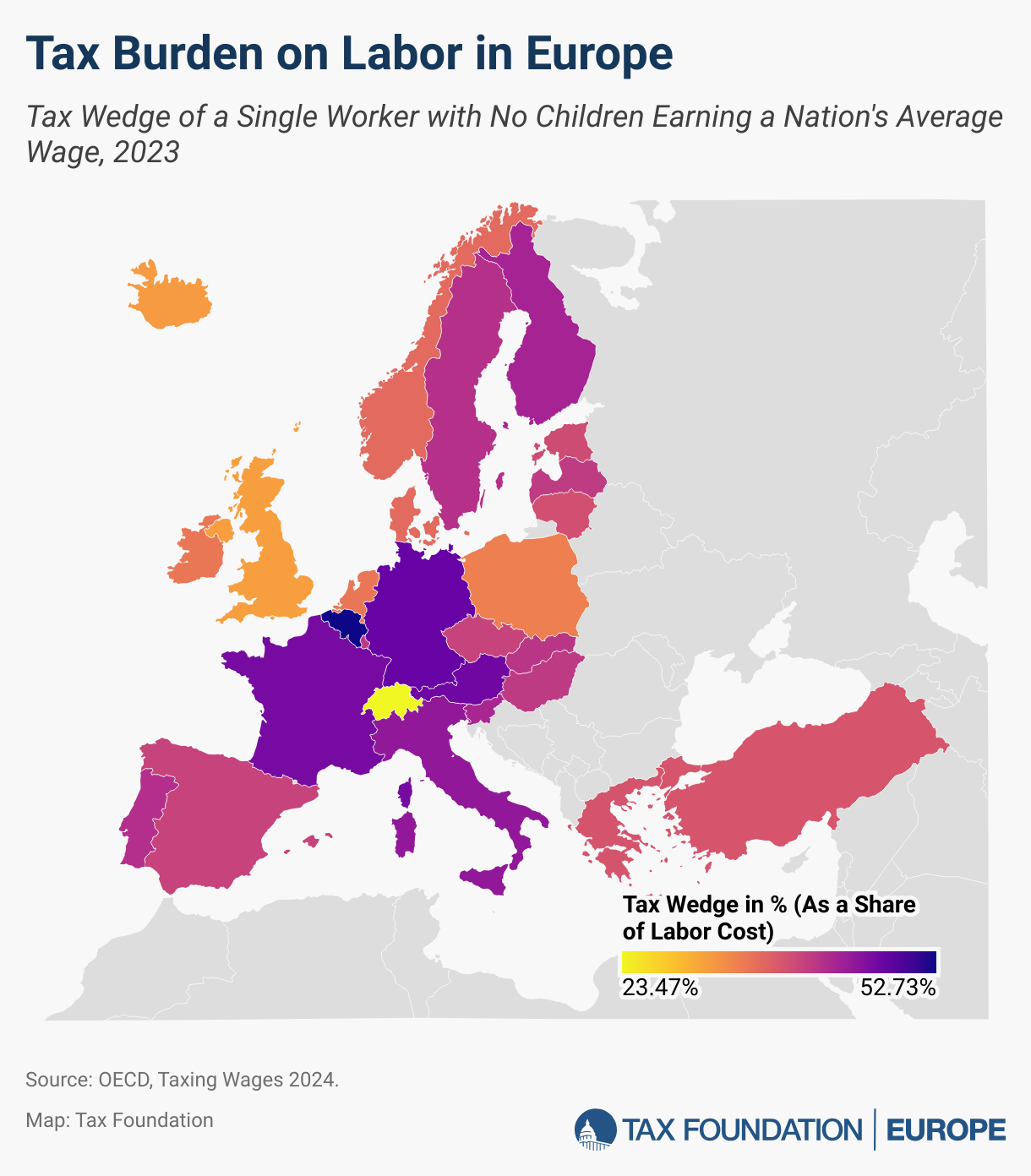
Some individual countries have made substantial changes to their income and payroll taxes in the last two decades. According to OECD data, Hungary, the OECD country with one of the highest tax burdens on labor in 2000 at 54.7 percent, has had the most notable decrease in its tax wedge, to 41.2 percent in 2024. This is partially due to the introduction of a flat taxAn income tax is referred to as a “flat tax” when all taxable income is subject to the same tax rate, regardless of income level or assets. on income, which lowered the income tax burden relative to total labor costs. Additionally, Hungary reduced its payroll taxes relative to total labor costs. Lithuania and Sweden have also lowered their tax burdens on labor substantially, with a reduction between 6.4 and 8.7 percentage points each.
Across the EU and the UK, the average tax burden on labor decreased by 0.06 percentage points between 2024 and 2025.

Overall, between 2024 and 2025, 16 European countries increased their tax burden on labor, while 9 countries reduced it. Several countries in Europe do not adjust the income tax to either inflationInflation is when the general price of goods and services increases across the economy, reducing the purchasing power of a currency and the value of certain assets. The same paycheck covers less goods, services, and bills. It is sometimes referred to as a “hidden tax,” as it leaves taxpayers less well-off due to higher costs and “bracket creep,” while increasing the government’s spendin or aggregate wages, which can lead to bracket creepBracket creep occurs when inflation, or real income growth, pushes taxpayers into higher income tax brackets. Bracket creep results in an increase in income taxes without an increase in real income. Many tax provisions—both at the federal and state levels—are adjusted for inflation. Over time, bracket creep can increase how much income tax people owe as their income grows, either due to inflat, unintentionally pushing workers into higher tax bracketsA tax bracket is the range of incomes taxed at given rates, which typically differ depending on filing status. In a progressive individual or corporate income tax system, rates rise as income increases. There are seven federal individual income tax brackets; the federal corporate income tax system is flat..
During this period, the tax burden increased the most in the UK and Estonia by 1.9 percentage points and 1.6 percentage points, respectively, and decreased the most in Greece, by 3.8 percentage points, followed by Malta (1.8 percentage points) and Latvia (1.7 percentage points).
The UK increased its tax burden on labor by raising the rate of employer national insurance contributions while reducing the secondary threshold. Estonia raised its flat personal income tax rate from 20 to 22 percent.
The fall in Greece’s tax burden on labor is largely driven by a rent subsidy for low- and middle-income households and minor cuts to health insurance contribution rates. Malta raised its lower income tax thresholds for 2025. Latvia reduced its tax burden on labor by simplifying its income tax schedule, abolishing the middle-income tax rate, and moving to a fixed tax-free allowance that does not phase out with income.
Stay informed on the tax policies impacting you.
Subscribe to our free newsletter to get the latest tax data, news and analysis.
SubscribeAbout the Authors

Alex Mengden is an Economist at the Tax Foundation, where he focuses on international tax issues and tax policy in Europe. He holds a BA in philosophy and economics from the University of Bayreuth and an MSc in economics from the Ludwig Maximilian University of Munich.

Michael Christl
Research Fellow, Tax Foundation Europe
Michael Christl is a Research Fellow at the Tax Foundation and Associate Professor of Economics at Universidad Loyola Andalucía in Seville, Spain. He has held several research and policy roles at the European Commission, including at the Joint Research Centre (JRC) and the Directorate-General for Economic and Financial Affairs (DG ECFIN), where he worked on fiscal policy topics across EU member states. He also has experience from think tanks and consulting in Austria, including Agenda Austria and Macro-Consult.
Previous Versions
-
Tax Burden on Labor in Europe, 2024
4 min read -
Tax Burden on Labor in Europe, 2023
4 min read -
Tax Burden on Labor in Europe, 2022
4 min read -
Tax Burden on Labor in Europe, 2019
2 min read