Skip to content

Digital Taxation

Our experts are providing leading analysis of proposals to tax revenues from digital activities around the world. As several European countries and even U.S. states continue to work towards implementing digital services tax (DSTs) policies, the uncertainty for the firms affected by these taxes will continue to rise. The posts below review the evidence that has been gathered on the impact of digital services tax (DSTs) policies, including our responses to OECD Public Consultation Documents.

All Related Articles

UN digital tax negotiations with European countries

What Europe’s UN Tax Turn Means for Multinationals

Europe’s turn toward the UN is ultimately not a sign that governments are ready to resolve fundamental disputes over taxing rights. If anything, international cooperation on the goal that matters most—fair treatment of cross-border trade—is crumbling.

Illinois Social Media Tax, Illinois 2026 State Budget

Illinois’ New Social Media Tax Is a Shambles

Illinois plans to impose a complicated, legally fraught new social media tax based on a few pages of confused, contradictory, and almost laughably incomplete legislative text embedded in the new budget.

10 min read
Europe Tax Reform

Without Reform, the EU Cannot Afford New Taxes

Currently, the European Commission has plans to generate more tax revenue to fund the forthcoming MFF, the long-term budget running from 2028 to 2034. But the truth is, without serious reform, the EU isn’t ready for new taxation.

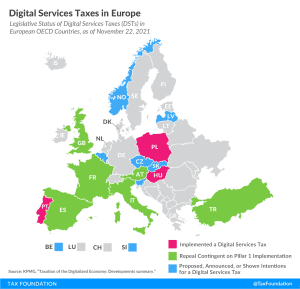
Digital Services Taxes in Europe, 2026

Digital Services Taxes in Europe, 2026

Currently, about half of all European OECD countries have either announced, proposed, or implemented a digital services tax. Because these taxes mainly impact US companies and are thus perceived as discriminatory, the US responded with retaliatory tariff threats.

5 min read
Poland digital services tax, DST

Poland Considering a Second Harmful Digital Tax

Poland is proposing to broaden and raise its digital services tax (DST) from 1.5 percent to 3 percent. Because DSTs tax revenues, not profits, a company with a 10 percent profit margin would face a 30 percent effective tax rate on digital services provided in Poland.

6 min read
International Tax Policy, European Geoeconomics

Lessons From European Geoeconomics & The Future Of International Tax Policy

European policymakers would be wise to refocus tax and trade policies on what is good for Europe rather than trying to change policies in countries beyond European borders. Meanwhile, the Trump administration would be wise to recognize that the transatlantic relationship is a geoeconomic asset that can be mutually beneficial.

Best Global Tax Ranking Improvements | 2025 International Tax Competitiveness Index

Movers and Shakers in the International Tax Competitiveness Index

For the past 12 years, the International Tax Competitiveness Index has examined which countries have truly embraced tax competitiveness and which ones have lagged behind. Our experts examine how country rankings have changed over time and identify the largest movers and shakers.

5 min read
Spain tax policy

Spain’s Tax Missteps Undermine Competitiveness

Spain’s central government could learn some valuable lessons from its regional governments and other European countries about sound tax policy.

7 min read
digitalization of the economy, international tax treaty system, OECD digital economy

Sound Tax Policy Can Withstand Creative Destruction

Creative destruction—coined by famed economist Joseph Schumpeter—is the idea that new innovations disrupt and “destroy” existing economic structures as they create better and more efficient products and processes.

4 min read
EU digital services taxes testimony tax foundation European Union EU flag

Testimony: Digital Services Taxes in the European Union

Since digital services taxes deliver limited revenue, shift the burden to European consumers, and risk provoking trade disputes, it’s time for policymakers to rethink their approach.