Pillar Two Implementation in Europe, 2026
22 of the 27 EU Member States have implemented both the income inclusion rule and the qualified domestic minimum top-up tax in 2026.
4 min read
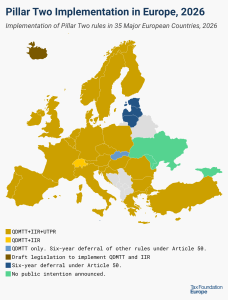
22 of the 27 EU Member States have implemented both the income inclusion rule and the qualified domestic minimum top-up tax in 2026.
4 min read
Under Spain’s current Social Democratic government, the country has fallen from 27th to 35th (out of 38 OECD countries) in the International Tax Competitiveness Index.
8 min read
While there are many factors that affect a country’s economic performance, taxes play an important role. A well-structured tax code is easy for taxpayers to comply with and can promote economic development while raising sufficient revenue for a government’s priorities.
72 min read
The 2026 Regional Tax Competitiveness Index for Spain highlights a growing divergence between regions that have embraced tax reform and those whose tax systems have remained largely unchanged.
7 min read
The federal government’s debt burden and interest on the debt are near record levels and headed higher, raising legitimate concerns about an eventual debt crisis. Given the increasingly dysfunctional budget process, the most viable option on the table to stave off such a crisis is a statutory bipartisan fiscal commission with buy-in from leaders of both parties.
6 min read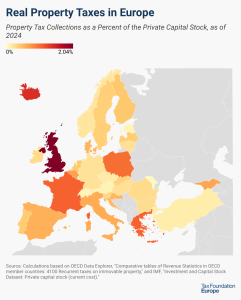
High property taxes levied not only on land but also on buildings and structures can discourage investment in infrastructure, which businesses would have to pay additional tax on.
3 min read
The European Union’s revised Tobacco Excise Directive (TED) is the latest proposal from Brussels that raises questions about the role that the EU plays in relation to the Member States.
7 min read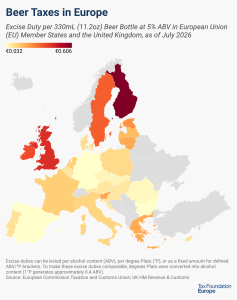
With much of the continent celebrating Oktoberfest, it is a great time to examine beer taxes across Europe. Hefty beer taxes increase the price consumers pay for their libations.
5 min read
While economic levers like sanctions and tariffs have long been recognized as geoeconomic tools, tax policies have rarely been considered a part of this toolkit.
36 min read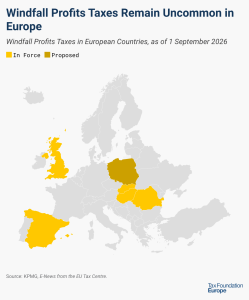
As energy prices have declined, European countries have switched the focus of their windfall profits taxes—a one-time tax levied on a company or industry when economic conditions result in large, unexpected profits—from energy providers to the banking and financial sector.
7 min read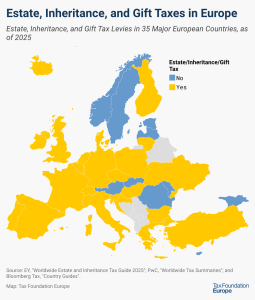
Twenty-four out of the 35 European countries covered in this map currently levy estate, inheritance, or gift taxes.
4 min read
The new public country-by-country reporting regimes adopted by the EU and Australia, and changes from the Financial Accounting Standards Board for financial accounts, are meant to promote transparency by multinational enterprises but have ubiquitous structural differences.
10 min read
In June, the Dominican Republic rushed through a package of tax legislation in seven days. International examples demonstrate that consultation, transparency, and clarity are key factors for successful tax reform.
5 min read
If Canada doesn’t make these provisions permanent, it will drop to 12th place in the capital cost recovery ranking once provisions expire in 2034.
5 min read
Poland taxes its individual business owners through alternative regimes and a series of thresholds, several of them sharp notches that imply significant tax costs for businesses crossing them.
11 min read
Though they are often framed as affecting only the richest households, the economic effects of wealth taxes extend much further by reducing capital formation, discouraging entrepreneurship, curtailing wage and employment growth, and ultimately weakening the overall economy.
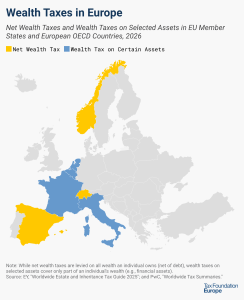
Wealth taxes not only collect little revenue and create legal uncertainty, but an OECD report argues that they can also disincentivize entrepreneurship, harming innovation and long-term growth.
5 min read
The EU Tax Omnibus proposal would create an EU-wide minimum standard for full expensing, but it confines that standard to qualifying tangible assets used in research and development (R&D) rather than to broader asset classes.
16 min read
Rather than adopt temporary policies that phase out and expire, policymakers should focus their efforts on long-term reforms to support investment.
7 min read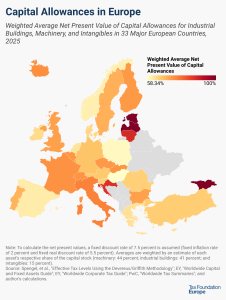
Although sometimes overlooked in discussions about corporate taxation, capital allowances play an important role in a country’s corporate tax base and can impact investment decisions—with far-reaching economic consequences.
6 min read