





Europe Doesn’t Need New EU Taxes. Policymakers Should Fix the Existing System
4 min readBy:Every seven years, EU Member States debate Brussels’ long-term budget: how much to spend and who will pay. At this year’s Multiannual Financial Framework (MFF) negotiations, which will cover the bloc’s collective expenses from 2028 through 2034, European Council President António Costa has been calling for additional revenue sources and to finalize discussions by year’s end.
As policymakers gather in Brussels this Thursday to satisfy this ambitious deadline, the question they must answer is how to raise these funds. While Costa aims to avoid burdening Member States with the bill, the money must come from somewhere. In reality, if the revenue collection policies are not designed accordingly, the taxA tax is a mandatory payment or charge collected by local, state, and national governments from individuals or businesses to cover the costs of general government services, goods, and activities. burden will be passed on to EU taxpayers and businesses—whether it’s collected by Member States or Brussels.
But policymakers can choose to collect this revenue efficiently. To do this, the EU should set three goals for this debate.
No New EU Taxes Without Structural Reforms
In recent weeks, Costa has taken the Corporate Own Resource for Europe (CORE) plan off the table. This is welcome news. The CORE would have charged businesses a fixed tax based on their revenues instead of their profits. A company struggling to make money would pay a heavier share of what they earn while a highly successful business would have a low tax bill. This is not how tax policy should work.
And yet, after removing the CORE, Costa has reintroduced the concept of a 3 percent digital services tax (DST) on revenues of companies with more than €50 million in annual revenue within the EU and €750 million in global revenue. Recent Tax Foundation Europe modeling of similar policies and proposals in the United Kingdom and Belgium demonstrate that the economic costs are larger than the revenues raised by such taxes.
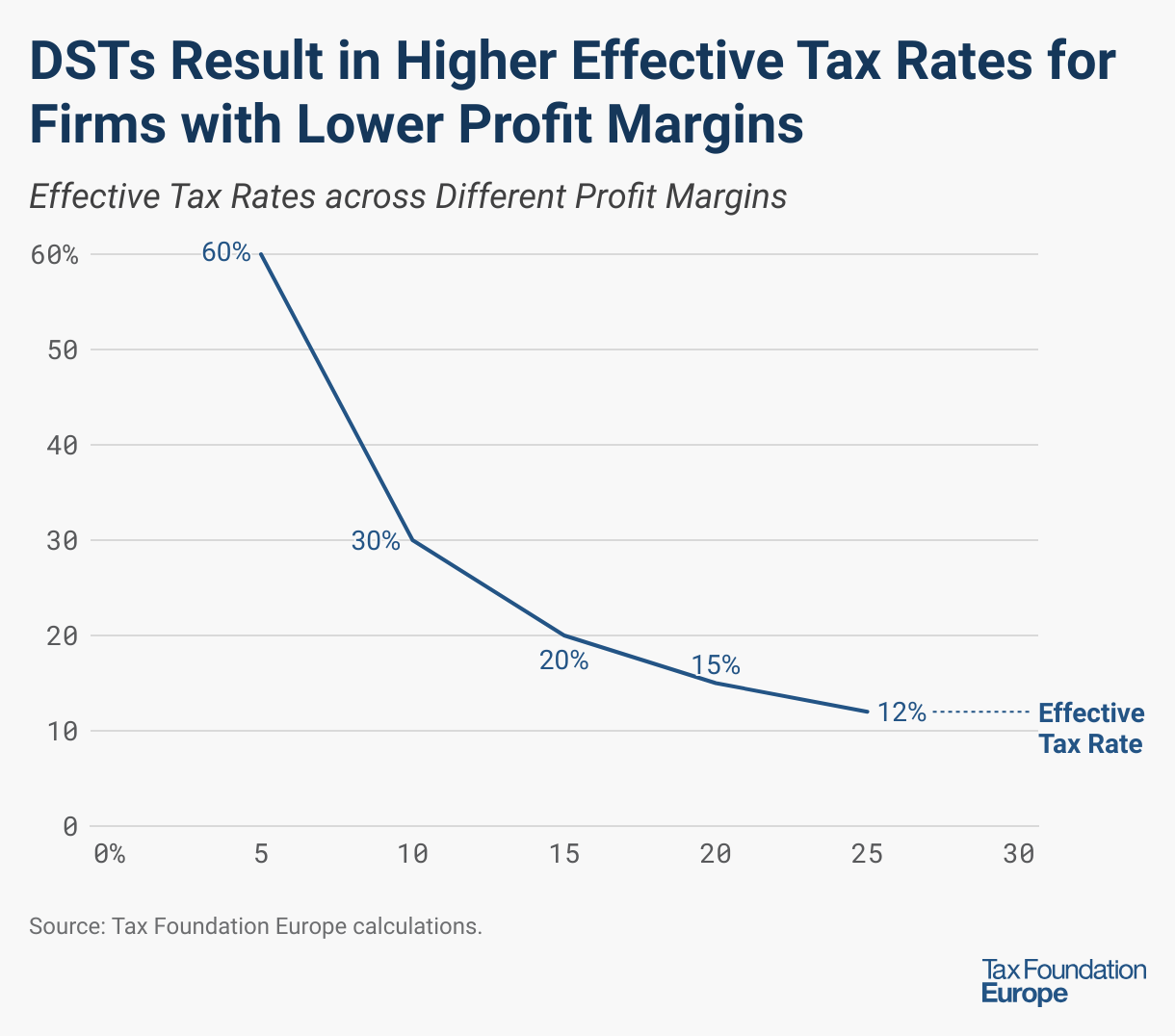
And, as with any tax that applies to revenue rather than profits, higher profit margins mean lower effective tax rates. As my colleague Cristina Enache described in her testimony to the European Parliament’s Budget Committee in July:
“…a company with €100 in revenue and €15 in profit faces a 3 percent DST (€3 in tax), which translates into a 20 percent tax on profits. If the profit margin is lower, the effective tax rate rises dramatically—up to 60 percent or more.”
This is also not how tax policy should work.
Or consider the Carbon Border Adjustment Mechanism (CBAM), which is a charge on the carbon content of imports. This, too, is a flawed approach. By not offering rebates for exporters, it increases costs for EU producers who compete abroad. Even though we are in early days of implementation, CBAM has already drawn widespread international criticism from the US and BRICS nations.
Both proposals are complicated and raise costs in the EU market. A better approach would be to reform the effective tools that are already in place.
Fix the Existing Levers
Today, much of the EU budget is funded by two sources: contributions based on each Member State’s gross national income (GNI), and their value-added tax (VAT). Together, they finance more than 80 percent of it. Crucially, both are dependent on how well Member States run their domestic tax policies. This makes VAT policy particularly important for national revenues.
Fortunately for Costa and policymakers seeking new revenue, the old VAT system has plenty to fix.
Member States fail to collect roughly EUR 128 billion under existing rules, which is often called “the compliance gap.” They also give up EUR 742 billion through exemptions and special rates in VAT rules, or “the policy gap.” By comparison, the new revenue being sought in the EU budget is only roughly EUR 60 billion.
Closing the compliance and policy gaps—collecting what is already owed while trimming exemptions and special rules—and adjusting how the EU budget raises funds from VAT would be far easier than building something new.
Focus on Economic Growth and Tax Simplicity
Tax policy shouldn’t only focus, though, on revenue. When designing the MFF, Costa and Member States should ask each policy to pass a simple test: will this make Europe more or less competitive? The International Monetary Fund’s (IMF) recent World Economic Outlook shows that governments have options to raise additional revenue while minimizing economic costs, ideally through broad-based consumption taxes, well-designed income taxes, and policies built with tax administration in mind.
Relying on revenues from policies like DST or CBAM makes that task harder. But by focusing on simplicity, Member States can refine their own policies rather than worrying about special new levies out of Brussels. Brussels should continue to identify how Member States could patch up their VAT systems that are currently leaving money on the table.
Policymakers calling for higher EU spending need to make their case. And if they make it, the path forward should run through well-designed policies. Improving existing systems at the Member State level should be step one. If Costa instead adds more complexity and tax hikes into the fold, the EU will end up with an inefficient system run from the top while serious problems with national tax systems persist, putting a further drag on the economy.
If we don’t start here, policymakers might waste precious time designing policies that will be more effective at preventing EU growth than raising revenue.
Stay informed on the tax policies impacting you.
Subscribe to our free newsletter to get the latest tax data, news and analysis.
SubscribeAbout the Author

Daniel Bunn is President and CEO of the Tax Foundation. Daniel has been with the organization since 2018 and, prior to becoming President, successfully built its Center for Global Tax Policy, expanding the Tax Foundation’s reach and impact around the world. Prior to joining the Tax Foundation, Daniel worked in the United States Senate at the Joint Economic Committee.