





The 2007-2008 financial crisis triggered a global debate on whether—and, if so, how— taxation can be used to stabilize the financial sector and generate revenue to partially cover the costs associated with financial crises. The issue has returned to the spotlight since 2023, as banks have benefited from higher interest rates and governments have sought new sources of revenue in the wake of the 2022-23 inflationInflation is when the general price of goods and services increases across the economy, reducing the purchasing power of a currency and the value of certain assets. The same paycheck covers less goods, services, and bills. It is sometimes referred to as a “hidden tax,” as it leaves taxpayers less well-off due to higher costs and “bracket creep,” while increasing the government’s spendin shock.
Following the financial crisis and the more recent inflation surge, policymakers and international organizations have explored several approaches:
- Financial stability contributions (levied on financial institutions’ liabilities and/or assets)
- Financial activities taxes (levied either on financial institutions’ profits or remunerations); despite extensive debate following the global financial crisis, few countries have implemented them
- Financial transaction taxes (levied on trade in financial instruments such as stocks, bonds, derivatives, and currencies)
- Windfall taxes (levied on excess profits), introduced in response to the rise in interest rates used to combat the 2022-23 inflation surge
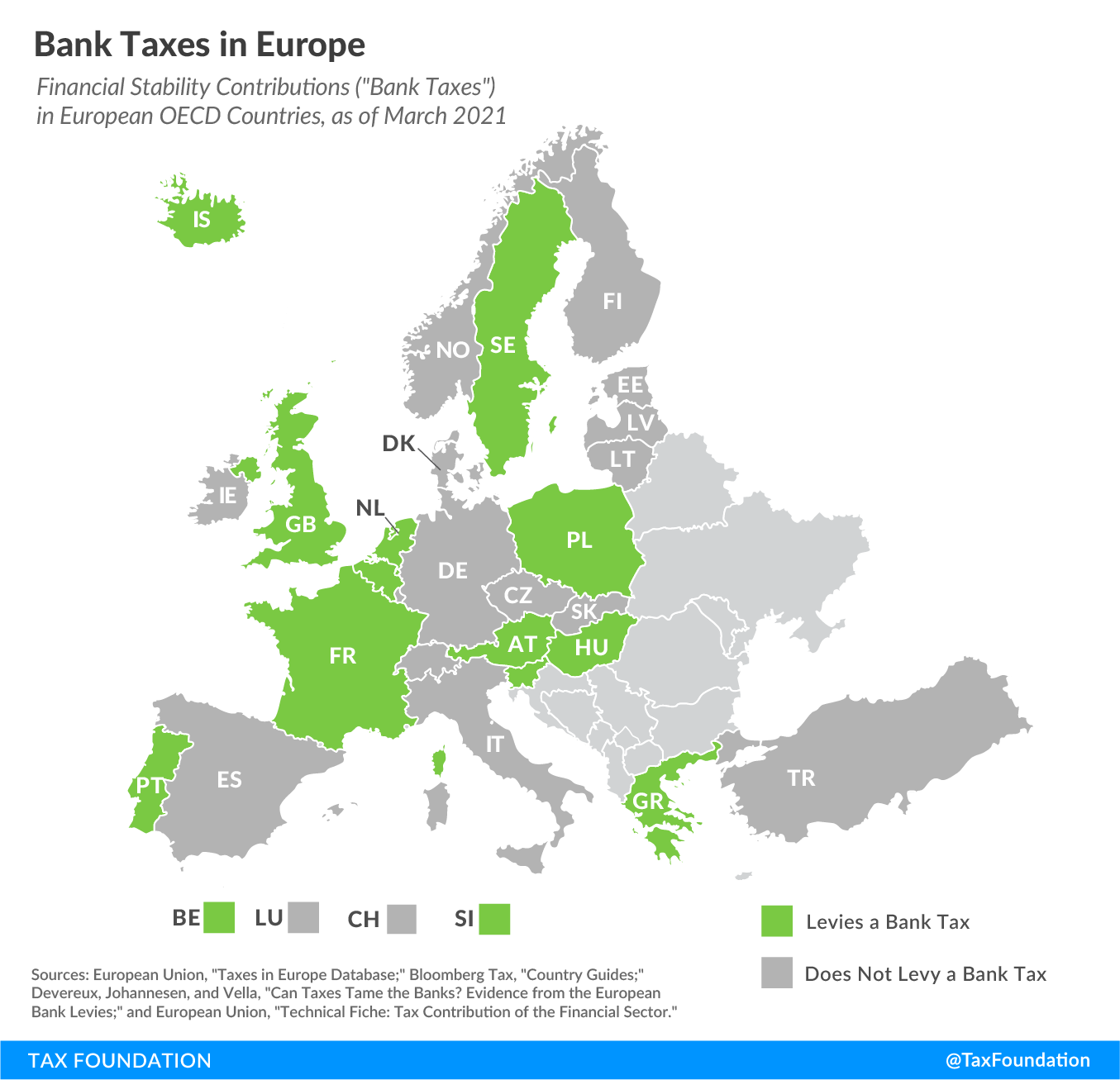
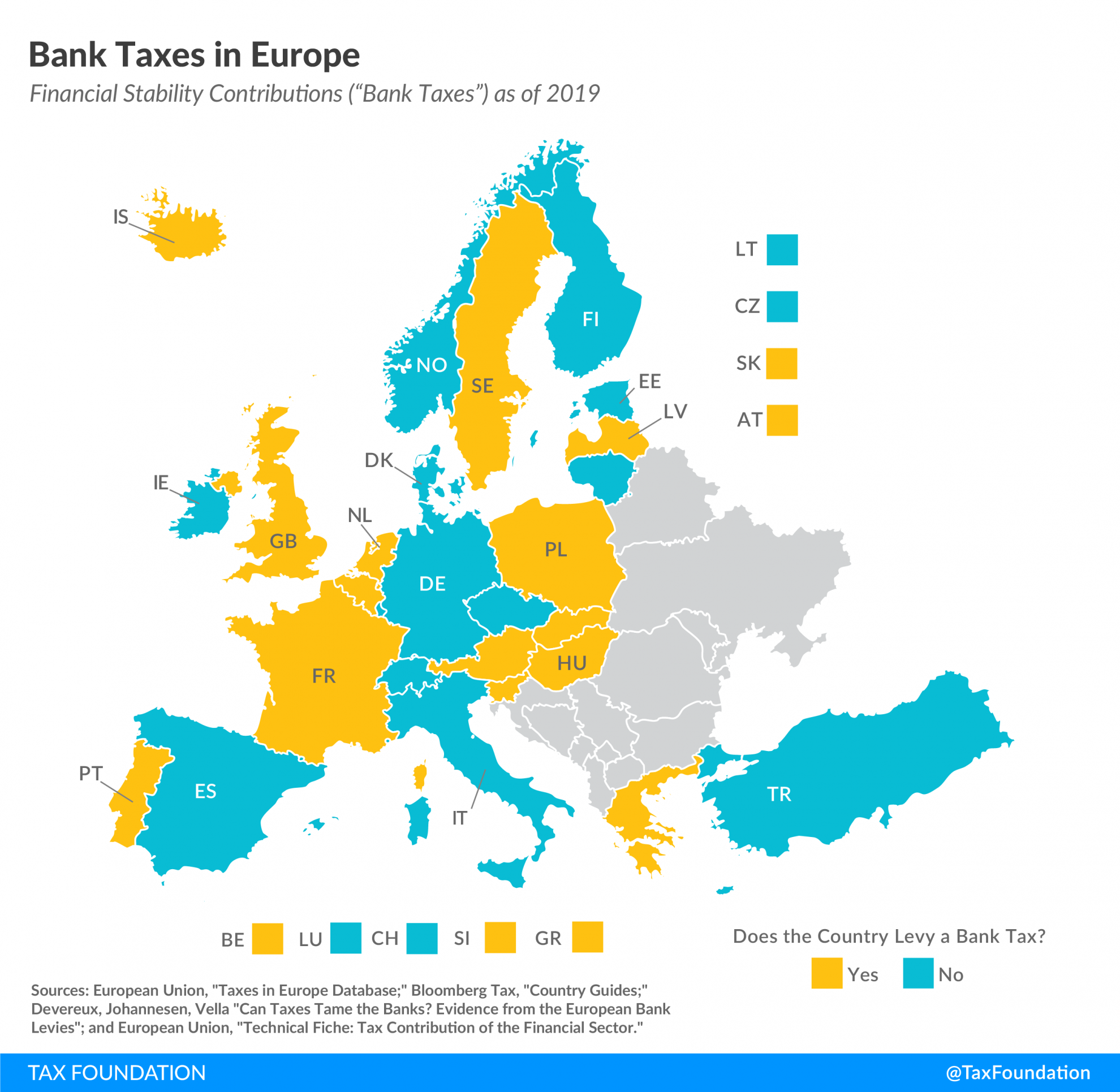
Today’s map shows which European countries implemented financial stability contributions (FSCs), commonly referred to as “bank taxes.”
Austria, Belgium, Cyprus, France, Greece, Hungary, Iceland, the Netherlands, Poland, Portugal, Slovenia, Sweden, and the United Kingdom all levy bank taxes. Almost all of these countries implemented the levy following the 2007-2008 financial crisis, with Greece (1975) the only exception.
Most countries levy their bank taxA tax is a mandatory payment or charge collected by local, state, and national governments from individuals or businesses to cover the costs of general government services, goods, and activities. on a measure of liabilities or a measure of assets. However, some countries decided on a different tax baseThe tax base is the total amount of income, property, assets, consumption, transactions, or other economic activity subject to taxation by a tax authority. A narrow tax base is non-neutral and inefficient. A broad tax base reduces tax administration costs and allows more revenue to be raised at lower rates.. For example, France taxes the minimum amount of capital necessary to comply with the regulatory requirements.
2026 Data
2021
2019

Expand or Collapse Table
Financial Stability Contributions (“Bank Taxes”) in European Countries, as of November 2026
| Country | Tax Rate | Tax Base | Year of Implementation |
|---|---|---|---|
| Austria (AT) | 0.083% - 0.102% | Total liabilities net of equity and insured deposits | 2011 |
| Belgium (BE) | 0.15205% - 0.20204% | Various tax bases depending on size of institution, risk, and destination of tax payments | 2012 |
| Cyprus (CY) | 0.15% | Total liabilities net of equity | 2011 |
| France (FR) | 0.0505% | Minimum regulatory capital requirement | 2011 |
| Greece (GR) | 0.12% – 0.60% | Value of the credit portfolio | 1975 |
| Hungary (HU) | 0.15% – 0.21% | Total assets net of interbank loans | 2010 |
| Iceland (IS) | 0.145% | Total debt | 2011 |
| Netherlands (NL) | 0.0319% – 0.0638% | Total liabilities net of equity and insured deposits | 2012 |
| Poland (PL) | 0.44% | Total value of assets | 2016 |
| Portugal (PT) | 0.01% – 0.13% | ||
| Various tax bases | 2011 | ||
| Slovenia (SI) | 0.20% | Total assets | 2011 |
| Sweden (SE) | 0.07% | Total liabilities net of equity and insured deposits | 2015 |
| United Kingdom (GB) | 0.05% – 0.10% | Total liabilities net of insured deposits | 2011 |
Source: Atanas Pekanov, and Margit Schratzenstaller, “The taxation of the EU’s financial sector,” European Parliament, 2025; PwC, “Worldwide Tax Summaries,” 2026, https://taxsummaries.pwc.com/.
Notable Recent and Upcoming Changes:
- Austria temporarily increased the rates from 0.033 percent and 0.041 percent
to 0.083 percent and 0.102 percent, respectively, for 2025 and 2026.
- Belgium will increase the applicable rates from 0.15205 percent and 0.20204 percent in 2026 to 0.19286 percent and 0.2562 percent, respectively, for 2027.
- France cut the tax rate from 0.0642 percent to 0.0505 percent for the 2026-2028 period.
- In September 2026, Iceland's 2027 budget bill proposed raising the rate to 254 percent to generate an estimated €43.86 million (ISK 6 billion) in additional revenue.
- In 2027, Poland will reduce the tax rate for certain financial institutions, including banks, branches of foreign banks, branches of credit institutions, and credit unions, from 0.44 percent to 0.395 percent for the 2027 fiscal year and to 0.3516 percent thereafter.
- In Sweden, the tax rate was increased from 0.06 percent to 0.07 percent, effective January 2026.
While bank taxes raise relatively little revenue, they can reduce the sector’s capacity to support lending, investment, and economic activity. Over time, they may also reduce the amount of available capital, limiting banks’ ability to absorb losses and respond to unforeseen financial crises.
Stay informed on the tax policies impacting you.
Subscribe to our free newsletter to get the latest tax data, news and analysis.
SubscribeAbout the Author

Cristina Enache writes on the economics of tax policy and is the author of the Spanish Regional Tax Competitiveness Index. She was formerly the Director of Research at Civismo, an economic research organization based in Spain. She also served as head of research at Institución Futuro, a regional think tank based in Navarra in northern Spain. She is also currently Secretary-General at the World Taxpayers Associations and General Manager of the Spanish Taxpayers Union, which she joined in 2016.