





Key Findings:
- Poland lets individual business owners choose between three income taxA tax is a mandatory payment or charge collected by local, state, and national governments from individuals or businesses to cover the costs of general government services, goods, and activities. regimes: a progressive personal income tax, a 19 percent flat taxAn income tax is referred to as a “flat tax” when all taxable income is subject to the same tax rate, regardless of income level or assets., and a turnover-based tax on gross revenue. Entrepreneurs can often opt for whichever regime lowers their bill.
- Under each of the regimes, entrepreneurs face tax cliffs that raise the tax on the entire base at once when crossing, not only on the amount above the line. The mandatory value-added tax (VAT) registration threshold and the lump-sum health contribution steps are the sharpest.
- Administrative data shows that firms cluster just below these thresholds. The effect is strongest at the VAT threshold and at the health contribution step, and it appears across all three regimes.
- This bunching shows that the thresholds change firms’ behavior to gain tax-advantaged status. Whether owners cap real activity, split into several entities, or adapt their revenue reporting practices, each response carries an economic cost.
- Poland should smooth the health and social contribution notches into a continuous schedule and lower its VAT registration threshold to the European average or below, while simplifying the VAT base rather than raising the threshold further.
Introduction
A well-structured tax system taxes similar economic activity in similar ways and avoids arbitrary lines, where a small change in circumstances produces a large change in tax. Poland’s treatment of individual business owners falls short on both counts. Sole proprietors and partners can choose between three separate income tax regimes, and their liability, health and social contributions, and value-added tax (VAT) obligations turn on a series of thresholds. At several of these thresholds, business owners’ tax liabilities make a sudden jump instead of rising gradually.
Economists distinguish between two kinds of thresholds. At a kink, a higher marginal rate applies only to income above the line, as with an ordinary income tax bracket. At a notch, or tax cliff, crossing the line applies the higher charge to the entire base at once. Because a notch penalizes crossing the threshold so heavily, it gives taxpayers a strong reason to stop just short of it. The result is bunching: a cluster of firms reporting revenue or income just below the threshold, and a gap just above.
This paper documents bunching among Poland’s individual business owners using administrative data from the Ministry of Finance. We map the thresholds these businesses face, distinguishing notches from kinks and revenue-based lines from income-based ones to then show where firms cluster and how the pattern differs across regimes.
Poland’s sharpest tax cliffs, the VAT registration threshold and the lump-sum health contribution steps, are also the most visible bunching locations, and both are in need of reform or abolition.
Tax Cliffs for Individual Business Owners in Poland
Polish tax law contains several thresholds that affect individual business owners, including in the income tax schedule, the health and social contributions, and VAT.
Three Business Income Tax Regimes
Individual business owners can choose between three forms of income taxation.[1] The default is the progressive personal income tax (PIT). Income up to PLN 30,000 (about EUR 7,000) is exempt, income up to PLN 120,000 (about EUR 27,900) is taxed at 12 percent, and income above that is taxed at 32 percent. Progressive filers can also file jointly with a spouse or as a single parent and can claim a wide range of deductions and credits.
Individual entrepreneurs may instead elect a flat PIT of 19 percent, which offers no tax-free allowance and fewer reliefs. To stop workers from relabeling employment as a business, the flat regime bars providing services to a current or former employer. It sets no income thresholds of its own.
The third option is a turnover-based tax on gross revenue, with no deduction for costs. Rates run from 2 to 17 percent depending on the activity, and eligibility is limited to specified sectors and legal forms and capped at EUR 2 million in revenue.
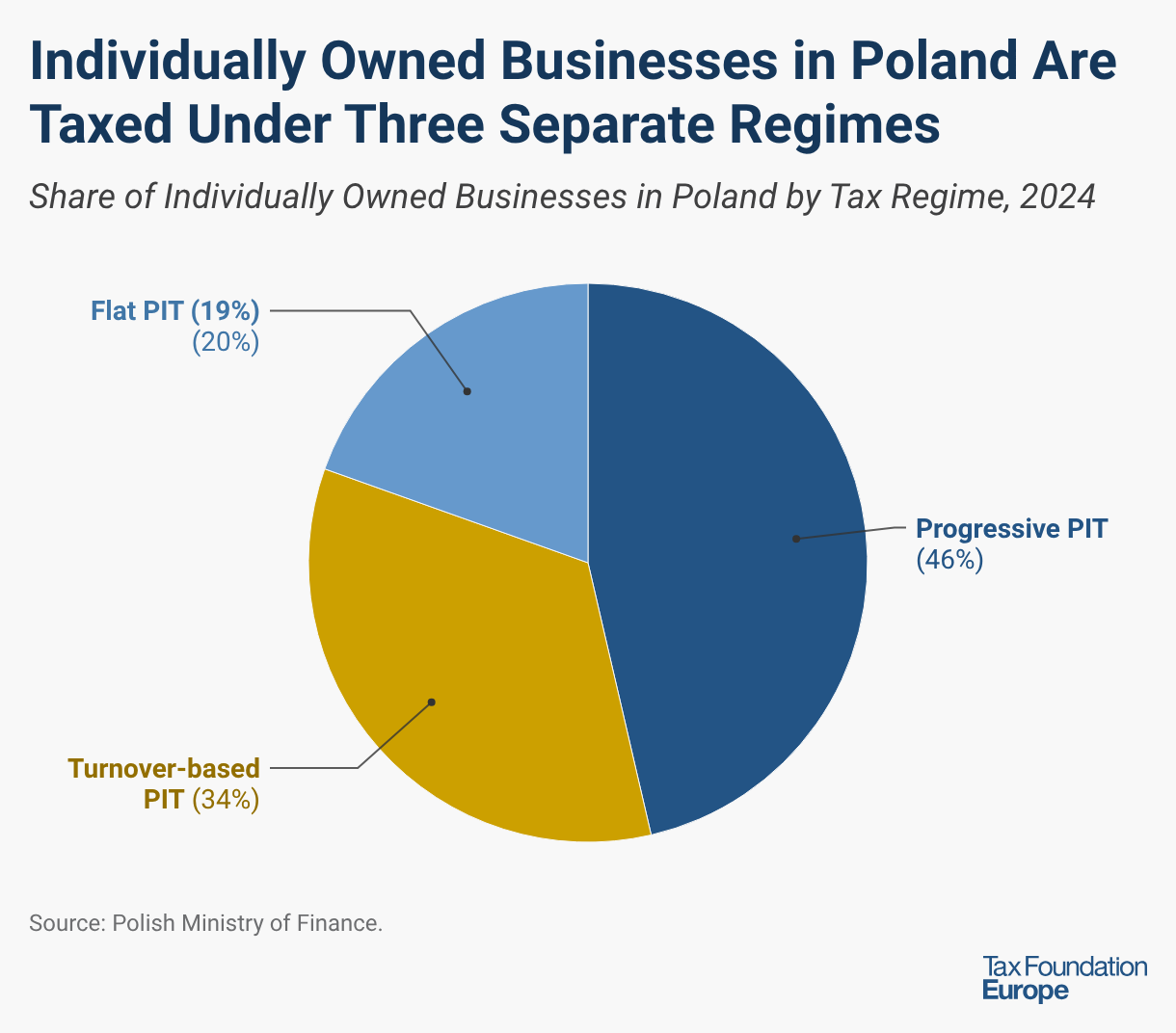
Of the 2.67 million businesses taxed at the personal rather than the entity level, 46 percent use the progressive scale, about one-third use the turnover-based regime, and the remaining 20 percent use the flat PIT. Overwhelmingly, these are very small firms. A quarter report annual revenue below PLN 60,000 (EUR 14,000), far below the average Polish wage. About half report revenue below PLN 160,000 (EUR 37,200), representing less than 2 percent of the revenue cap for micro‑enterprises defined in the Entrepreneurs Law.[2] Overall, micro-firms account for over 95 percent of all enterprises operating in Poland.[3]
Health and Social Contributions
On top of income tax, the self‑employed are also subject to mandatory health and social contributions, which can constitute a significant burden on their business income, depending on the selected tax regime.
Under progressive PIT, the health insurance contribution is 9 percent of income; under flat PIT, it is 4.9 percent of income. Under the turnover-based regime, however, it is a fixed amount that steps up with revenue rather than a percentage of it (Table 1).
Table 1. Health Tax Schedule Under the Turnover-Based Regime
| Revenue | Health Tax Liability (Monthly) | Increase in Health Tax Cost upon Crossing the Threshold |
|---|---|---|
| Up to PLN 60,000 (EUR 14,000) | PLN 500 (EUR 120) | - |
| From PLN 60,000 to 300,000 (EUR 69,800) | PLN 830 (EUR 190) | 67% |
| Above PLN 300,000 (EUR 69,800) | PLN 1,495 (EUR 350) | 80% |
Those steps are tax cliffs: crossing PLN 60,000 or PLN 300,000 in revenue raises the annual contribution by nearly PLN 4,000 (EUR 930) and PLN 8,000 (EUR 1,860), respectively, applied to total annual revenue rather than to the revenue above the threshold.
Table 2. Preferential Social Security Contribution Schedule for Individual Business Owners (“Mały ZUS Plus”)
Source: “Mały ZUS Plus,” Information and service portal for entrepreneurs, https://biznes.gov.pl/pl/portal/00284; authors’ calculations.
Prior-Year Revenue Prior-Year Income Preferential SSC (Monthly) Increase in SSC Cost upon Crossing the Revenue Threshold
Up to PLN 120,000 (EUR 27,900) PLN 20,000 (EUR 4,650) PLN 460 (EUR 110) 290%
Up to PLN 120,000 (EUR 27,900) PLN 50,000 (EUR 11,630) PLN 660 (EUR 155) 170%
Up to PLN 120,000 (EUR 27,900) PLN 100,000 (EUR 23,260) PLN 1,320 (EUR 310) 35%
A separate social security contribution (SSC) threshold applies to the smallest firms across all tax regimes (Table 2). Individual business owners can pay reduced social contributions under the Mały ZUS Plus scheme if their prior-year revenue does not exceed PLN 120,000 (EUR 27,900). Under this regime, companies pay monthly SSC ranging from PLN 450 to PLN 1,780, depending on their level of income in the previous year. The PLN 1,780 amount corresponds to the standard monthly social security contribution rate that is applicable if a firm is no longer eligible for the Mały ZUS Plus. Thus, the revenue threshold for relief creates a separate tax cliff, and crossing it comes with a cost reaching as much as 290 percent for businesses with the lowest income level (Table 2).
Value-Added Tax
Regardless of income tax regime, a business must register for VAT and charge it once revenue passes a threshold, set at PLN 200,000 through 2025 and rising to PLN 240,000 in 2026 (about EUR 46,510 and EUR 55,810, respectively). Below the threshold, a firm may stay exempt, charging no VAT but remaining unable to reclaim VAT on its inputs, or register voluntarily.
Adjusted for purchasing power, Poland’s threshold is the eighth highest among 32 European countries and two-thirds above the European average.[4] The standard VAT rate is 23 percent, with reduced rates of 8 and 5 percent.
The Thresholds at a Glance
Table 3 sets out the different tax cliffs together. Two features matter for what follows. First, most of the binding thresholds are notches rather than kinks, so the incentive to stop short of them is strong. Second, they sit on different bases: the VAT and health contribution thresholds and the Mały ZUS Plus ceiling are revenue-based, while the PIT rate change is income-based.
Table 3. Tax Thresholds Facing Poland’s Individual Business Owners
| Threshold (PLN) | Applies To | Base | Type | What Changes at the Line |
|---|---|---|---|---|
| 120,000 | Progressive PIT filers | Income | Kink | Marginal rate rises from 12% to 32% |
| 120,000 | All regimes (smallest firms eligible) | Prior-year income | Notch | Reduced social contributions (Mały ZUS Plus) |
| 200,000 (240,000 from 2026) | All regimes | Revenue | Notch | VAT registration and filing become mandatory |
| 60,000 and 300,000 | Turnover-based regime | Revenue | Notch | Fixed health contribution steps up by PLN 4,000 and 8,000, respectively |
Evidence of Bunching Behavior
We use administrative data from the Ministry of Finance covering individual business owners in 2024. The data report the number of businesses by annual revenue, separately for each regime.
Individual business owners sort across regimes by size. Lower-revenue firms are concentrated in the progressive regime, which offers the most allowances and a lower tax rate at low incomes, while higher-revenue firms are spread more evenly and lean toward the flatter regimes. This sorting indicates a cost of running parallel systems: business owners channel time and effort into choosing and qualifying for the lowest-tax option with negative effects on tax revenue.
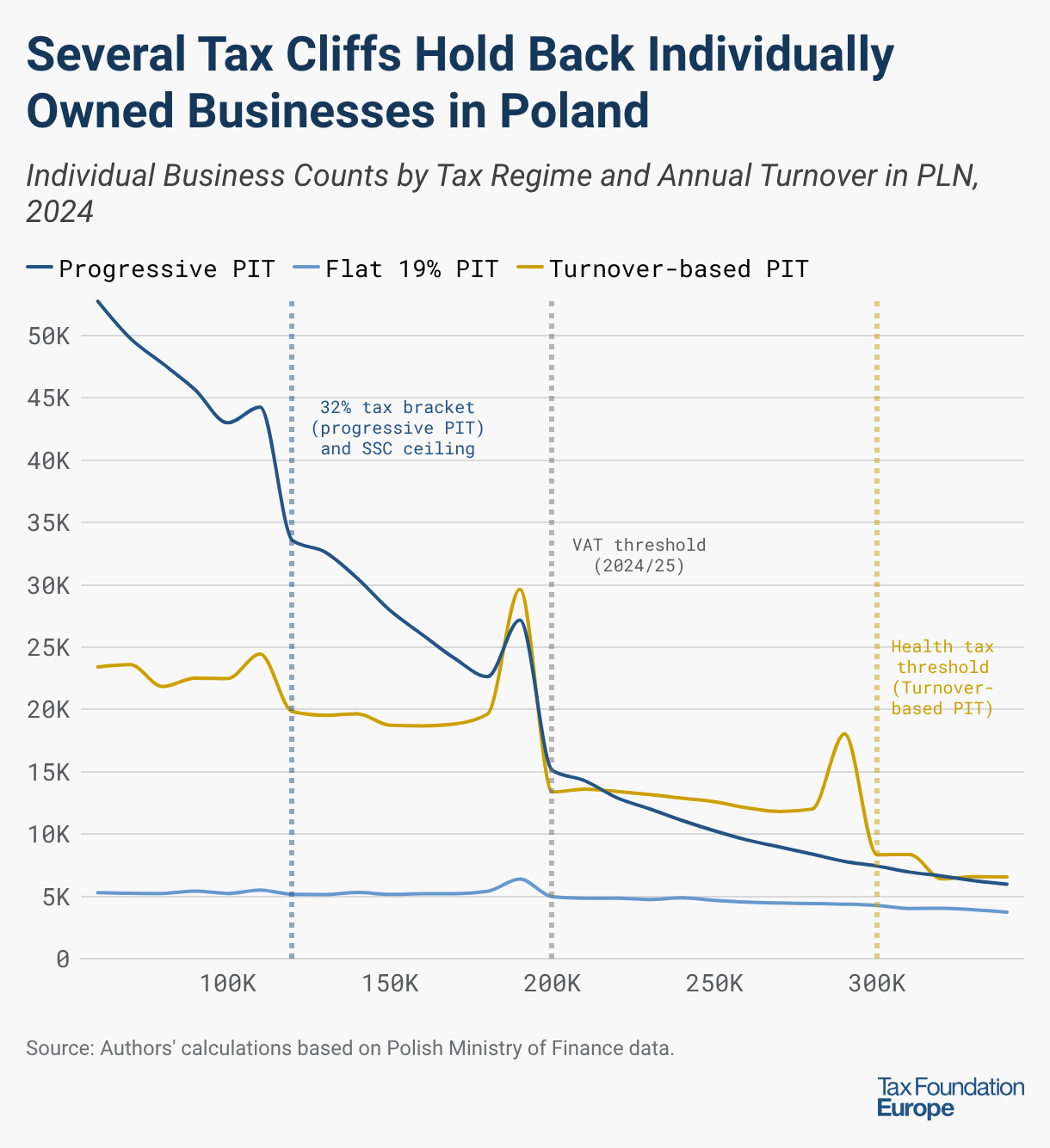
The thresholds produce clear spikes in the firm distribution. The strongest and most general is at the VAT threshold. Firms under all three regimes pile up just below PLN 200,000 and thin out above it. Because the VAT threshold does not depend on the income tax regime, its imprint appears everywhere, which is strong evidence that individual business owners hold reported revenue down to stay out of the VAT system.
The lump-sum regime shows a second sharp spike at the PLN 300,000 health contribution step, where the fixed charge jumps by nearly 80 percent, or PLN 8,000. Firms taxed on gross revenue evidently manage that revenue to stay below the threshold.
Around PLN 120,000, firms subject to the progressive and flat regimes cluster too. Two thresholds coincide at this figure: the Mały ZUS Plus revenue ceiling, below which individual business owners in every regime may qualify for reduced social security contributions, and the 12 to 32 percent PIT rate kink, which reaches only progressive filers. The two rest on different bases. The social contribution ceiling is based on revenue, the axis of the chart, so it can produce a sharp spike. In turn, the PIT rate change is defined on income, which for most firms is smaller than revenue and varies with costs, so the same kink maps to a range of revenue levels rather than a single point. A kink also gives a weaker reason to bunch than a notch, since it raises the rate only on marginal taxable incomeTaxable income is the amount of income subject to tax, after deductions and exemptions. Taxable income differs from—and is less than—gross income. . Both forces predict that the income tax kink will show up as a softer, more diffuse cluster than the revenue notches.
The Costs of Tax Cliffs
Bunching below a tax cliff is a behavioral response, and it carries two kinds of cost. The first is economic: to stay below the line, a firm either holds down real output or spends resources on avoidance, such as retiming income, restructuring its accounts, or underreporting. The second is fiscal, since the same maneuvers lower the tax the firm pays.
Across many countries, Brockmeyer et al. find firms splitting into smaller units, underreporting sales, and staying partly informal to avoid VAT registration, with the effect largest where tax administration is weak, so that the threshold hardens into a border between the formal and informal economy.[5] Liu et al. find that firms slow their growth before they even reach the line. Responses like these lower productivity and hold firms below efficient scale.[6] Although part of the clustering response is reporting and timing rather than a real cut in activity, these responses can still carry economic costs because retiming, fragmenting, and underreporting divert effort from production while eroding the tax baseThe tax base is the total amount of income, property, assets, consumption, transactions, or other economic activity subject to taxation by a tax authority. A narrow tax base is non-neutral and inefficient. A broad tax base reduces tax administration costs and allows more revenue to be raised at lower rates..[7]
Whether these costs are worth bearing depends on what the threshold buys in return.
The VAT threshold is an exemption threshold, and excluding a firm from the VAT system eliminates its compliance costs of filing returns and keeping fuller records while alleviating tax authorities of VAT administration. Policymakers therefore must weigh the fiscal and economic cost of exempting a firm from the VAT system against the lower compliance and administrative costs of having fewer firms in the system. Since the smallest firms yield little revenue while costing about as much to administer as larger ones, there is a justification to retain a moderate but positive threshold.[8]
Firms with negative VAT liabilities often voluntarily register for VAT despite the paperwork to obtain tax refunds, revealing how much they are willing to pay in compliance costs to obtain a VAT refund. Importantly, the liability for crossing the threshold rises in proportion to its value, because all previously untaxed value added becomes taxable at once.
Policymakers should therefore consider moving the threshold down to the European or OECD average or below. A better way to cut compliance costs for small businesses would be to simplify the VAT itself, by cutting back reduced rates and exemptions, not to raise the registration threshold further.
The health contribution steps and the Mały ZUS Plus ceiling on social security contribution rebates are a different case. They shift the charge from one positive level to another without changing any administrative obligations of taxpayers or tax authorities, so the tax notch buys no administrative saving to offset its economic and fiscal cost. A better approach would be to collapse the stepwise schedule into a flat rate, or at least smooth the steps into a continuous schedule for the progressive system.
The same logic reaches beyond individual owners. Small companies in Poland face a sharp tax cliff of their own, where crossing EUR 2 million in revenue lifts the corporate income taxA corporate income tax (CIT) is levied by federal and state governments on business profits. Many companies are not subject to the CIT because they are taxed as pass-through businesses, with income reportable under the individual income tax. rate from 9 percent to 19 percent on all income and more than doubles their corporate tax liability. We should expect the same type of bunching behavior and associated economic and fiscal costs in that case.
Conclusion
Poland taxes its individual business owners through alternative regimes and a series of thresholds, several of them sharp notches that imply significant tax costs for businesses crossing them. Owners respond to those thresholds as economic theory predicts, clustering just below the VAT line, the health contribution step, and the ceiling for the social-contribution rebate. The bunching behavior implies real costs, whether firms achieve it by curbing activity, fragmenting into multiple entities, or underreporting, even though the size of those costs awaits estimation. Collapsing the health and social security tax notches into flat rates and lowering the VAT threshold while simplifying its base would remove the sharpest of the harmful incentives that now reward staying small.
Stay informed on the tax policies impacting you.
Subscribe to our free newsletter to get the latest tax data, news and analysis.
SubscribeAppendix
Table A1. Tax Regimes Applicable to Individual Business Owners in Poland
| Key Features | Progressive PIT | Flat-Rate PIT (19%) | Turnover Tax |
|---|---|---|---|
| Type of Taxation (Default or Optional) | Default – applies unless the entrepreneur chooses another form | Optional – applies upon the entrepreneur’s request, provided statutory conditions are met | Optional – applies upon the entrepreneur’s request, provided statutory conditions are met |
| Restrictions on Eligibility | None | Providing services to one's former or current employter | Providing services to one's former or current employer Revenue limit: EUR 2,000,000; only sectors listed in the statute; only sole proprietors and civil-law partnerships |
| Tax Base | Income (revenue minus costs) | Income (revenue minus costs) | Revenue (costs are not deductible) |
| Tax Rate | Progressive tax scale: - Tax-free allowance of PLN 30,000 - 12% on income up to PLN 120,000 - 32% above PLN 120,000 | Flat rate of 19% | Rate depends on the type of activity: - 2% - 3% - 5.5% - 8.5% - 10% - 12% and 12.5% - 14% - 15% - 17% |
References
[1] Excluding the so-called tax card, which is currently being phased out and remains in effect solely as an acquired right for businesses that opted for this form of taxation before 2022.
[2] Entrepreneurs’ Law (Prawo Przedsiębiorcơw), Act of 6 March 2018 (Journal of Laws of 2025, item 1480).
[3] Statistics Poland (GUS), “Non-Financial Enterprises by Kind and Place of Economic Activity in 2024,” 2025, https://stat.gov.pl/en/topics/economic-activities-finances/activity-of-enterprises-activity-of-companies/non-financial-enterprises-by-kind-and-place-of-economic-activity-in-2024,24,6.html.
[4] Alex Mengden and Julius Graack, “VAT Exemption Thresholds in Europe, 2026,” Tax Foundation, Jun. 15, 2026, https://taxfoundation.org/data/all/eu/vat-registration-exemption-thresholds-europe/.
[5] Anne Brockmeyer, Giulia Mascagni, Vedanth Nair, Mazhar Waseem, and Miguel Almunia, “Does the Value-Added Tax Add Value? Lessons Using Administrative Data from a Diverse Set of Countries,” Journal of Economic Perspectives 38:1 (2024): 107–32, https://pubs.aeaweb.org/doi/pdfplus/10.1257/jep.38.1.107.
[6] Li Liu, Ben Lockwood, and Eddy H.F. Tam, “Small Firm Growth and the VAT Threshold Evidence for the UK,” International Monetary Fund, Working Paper No. 2024/033, 2024, https://doi.org/10.5089/9798400267260.001.
[7] Henrik Jacobsen Kleven, “Bunching,” Annual Review of Economics 8 (2016): 435–64, https://eml.berkeley.edu/~saez/course/kleven_annualreview.pdf.
[8] Michael Keen and Jack Mintz, “The optimal threshold for a value-added tax,” Journal of Public Economics 88:3–4 (2004): 559-576, https://doi.org/10.1016/S0047-2727(02)00165-2.
Share this articleAbout the Authors

Anna Leszczyłowska
Research Fellow, Tax Foundation Europe
Anna Leszczyłowska is a Research Fellow with Tax Foundation Europe.

Alex Mengden is an Economist at the Tax Foundation, where he focuses on international tax issues and tax policy in Europe. He holds a BA in philosophy and economics from the University of Bayreuth and an MSc in economics from the Ludwig Maximilian University of Munich.