





In recent years, countries have debated significant changes to international tax rules affecting multinational companies. In October 2021, after negotiations at the Organisation for Economic Co-Operation and Development (OECD), more than 130 member jurisdictions agreed to an outline for new taxA tax is a mandatory payment or charge collected by local, state, and national governments from individuals or businesses to cover the costs of general government services, goods, and activities. rules. Pillar Two introduces the global minimum tax with an effective tax rate of 15 percent (increasing tax revenues by an estimated $220 billion globally).
Pillar Two includes three main rules that establish the global minimum tax: The first is a qualified domestic minimum top-up tax (QDMTT), which countries could use to claim the first right to tax profits currently being taxed below the minimum effective rate of 15 percent. The second is an income inclusion rule (IIR), which determines when the foreign income of a company should be included in the taxable incomeTaxable income is the amount of income subject to tax, after deductions and exemptions. Taxable income differs from—and is less than—gross income. of the parent company. When a company’s effective tax rate falls below 15 percent, additional taxes would be owed in its home jurisdiction.
The third rule in Pillar Two is the undertaxed profits rule (UTPR), which allows a country to increase taxes on a company if another related entity in a different jurisdiction was being taxed below the 15 percent effective rate. If multiple countries apply a similar top-up tax, the taxable profit would be divided based on the location of tangible assets and employees.
Together, the domestic minimum tax, income inclusion rule, and undertaxed profits rule create a minimum tax both on companies investing abroad and foreign companies investing domestically. They are all tied to the minimum effective rate of at least 15 percent and would apply to each jurisdiction in which a company operates.
The EU Directive on Pillar Two obliges Member States with more than 12 in-scope multinational groups to implement the IIR starting 31 December 2023, and the UTPR starting 31 December 2024. Member States with no more than 12 in-scope multinational groups can elect to defer implementing both rules for six years under Article 50 of the Directive.
2025 Data
2024
Expand or Collapse Table
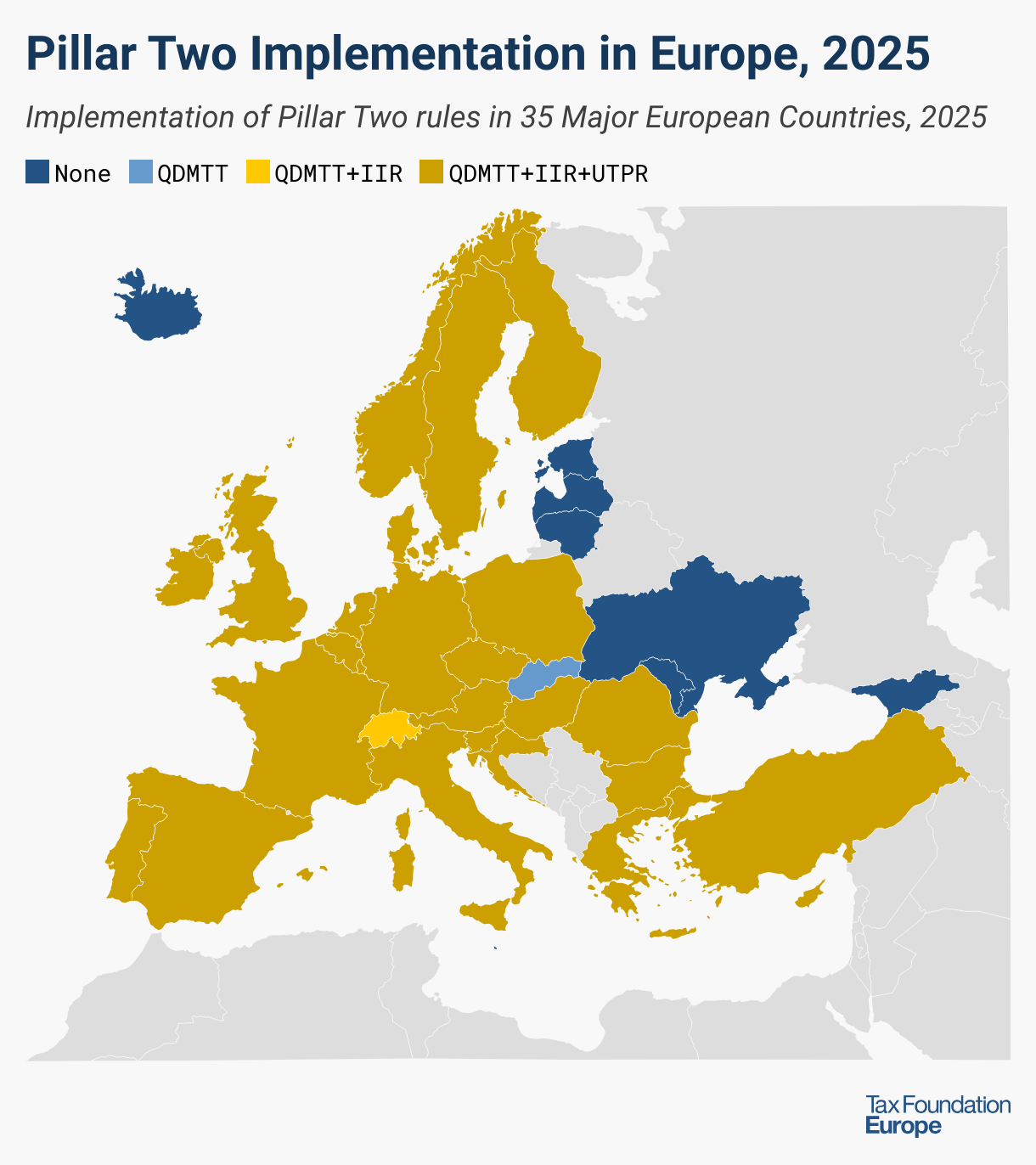
Pillar Two Implementation in Europe, 2025
Implementation of Pillar Two rules in 35 Major European Countries, 2025
| Territory | Joined the Pillar Two Statement | IIR | UTPR | (Q)DMTT | Details |
|---|---|---|---|---|---|
| Austria | Yes | Yes | Yes | Yes | QDMTT+IIR+UTPR |
| Belgium | Yes | Yes | Yes | Yes | QDMTT+IIR+UTPR |
| Bulgaria | Yes | Yes | Yes | Yes | QDMTT+IIR+UTPR |
| Croatia | Yes | Yes | Yes | Yes | QDMTT+IIR+UTPR |
| Cyprus | Yes | Yes | Yes | Yes | QDMTT+IIR+UTPR |
| Czech Republic | Yes | Yes | Yes | Yes | QDMTT+IIR+UTPR |
| Denmark | Yes | Yes | Yes | Yes | QDMTT+IIR+UTPR |
| Estonia | Yes | No | No | No | Six-year deferral under Article 50. |
| Finland | Yes | Yes | Yes | Yes | QDMTT+IIR+UTPR |
| France | Yes | Yes | Yes | Yes | QDMTT+IIR+UTPR |
| Georgia | Yes | No | No | No | No public intention announced. |
| Germany | Yes | Yes | Yes | Yes | QDMTT+IIR+UTPR |
| Greece | Yes | Yes | Yes | Yes | QDMTT+IIR+UTPR |
| Hungary | Yes | Yes | Yes | Yes | QDMTT+IIR+UTPR |
| Iceland | Yes | No | No | No | Draft legislation to implement QDMTT and IIR from 2026. |
| Ireland | Yes | Yes | Yes | Yes | QDMTT+IIR+UTPR |
| Italy | Yes | Yes | Yes | Yes | QDMTT+IIR+UTPR |
| Latvia | Yes | No | No | No | Six-year deferral under Article 50. |
| Lithuania | Yes | No | No | No | Six-year deferral under Article 50. |
| Luxembourg | Yes | Yes | Yes | Yes | QDMTT+IIR+UTPR |
| Malta | Yes | No | No | No | Six-year deferral under Article 50. |
| Moldova | No | No | No | No | No public intention announced. |
| Netherlands | Yes | Yes | Yes | Yes | QDMTT+IIR+UTPR |
| Norway | Yes | Yes | Yes | Yes | QDMTT+IIR+UTPR |
| Poland | Yes | Yes | Yes | Yes | Deferral of all rules until 2025. |
| Portugal | Yes | Yes | Yes | Yes | QDMTT+IIR+UTPR |
| Romania | Yes | Yes | Yes | Yes | QDMTT+IIR+UTPR |
| Slovakia | Yes | No | No | Yes | Selective implementation of QDMTT. Six-year deferral of other rules under Article 50. |
| Slovenia | Yes | Yes | Yes | Yes | QDMTT+IIR+UTPR |
| Spain | Yes | Yes | Yes | Yes | QDMTT+IIR+UTPR |
| Sweden | Yes | Yes | Yes | Yes | QDMTT+IIR+UTPR |
| Switzerland | Yes | Yes | No | Yes | QDMTT+IIR |
| Turkey | Yes | Yes | Yes | Yes | QDMTT+IIR+UTPR |
| Ukraine | Yes | No | No | No | No public intention announced. |
| United Kingdom | Yes | Yes | Yes | Yes | QDMTT+IIR+UTPR |

Expand or Collapse Table
Pillar Two Implementation in Europe, 2024
Implementation of Pillar Two rules in 35 Major European Countries, 2024
| Country | Joined the Pillar Two Statement | Income Inclusion Rule (IIR), | Undertaxed Profits Rule (UTPR) | Qualified Domestic Minimum Top-up Tax (QDMTT) | Details |
|---|---|---|---|---|---|
| Austria | Yes | Yes | No | Yes | QDMTT+IIR |
| Belgium | Yes | Yes | No | Yes | QDMTT+IIR |
| Bulgaria | Yes | Yes | No | Yes | QDMTT+IIR |
| Croatia | Yes | Yes | No | Yes | QDMTT+IIR |
| Cyprus | No | No | No | No | Draft law provides for IIR implementation in 2024 but is not yet enacted. |
| Czech Republic | Yes | Yes | No | Yes | QDMTT+IIR |
| Denmark | Yes | Yes | No | Yes | QDMTT+IIR |
| Estonia | Yes | No | No | No | Six-year deferral under Article 50. |
| Finland | Yes | Yes | No | Yes | QDMTT+IIR |
| France | Yes | Yes | No | Yes | QDMTT+IIR |
| Georgia | Yes | No | No | No | No public intention announced. |
| Germany | Yes | Yes | No | Yes | QDMTT+IIR |
| Greece | Yes | Yes | No | Yes | QDMTT+IIR |
| Hungary | Yes | Yes | No | Yes | QDMTT+IIR |
| Iceland | Yes | No | No | No | Public consultation to implement QDMTT and IIR from 2025. |
| Ireland | Yes | Yes | No | Yes | QDMTT+IIR |
| Italy | Yes | Yes | No | Yes | QDMTT+IIR |
| Latvia | Yes | No | No | No | Six-year deferral under Article 50. |
| Lithuania | Yes | No | No | No | Six-year deferral under Article 50. |
| Luxembourg | Yes | Yes | No | Yes | QDMTT+IIR |
| Malta | Yes | No | No | No | Six-year deferral under Article 50. |
| Moldova | No | No | No | No | No public intention announced. |
| Netherlands | Yes | Yes | No | Yes | QDMTT+IIR |
| Norway | Yes | Yes | No | Yes | QDMTT+IIR |
| Poland | Yes | No | No | No | Deferral of all rules until 2025. |
| Portugal | Yes | No | No | No | Draft law provides for QDMTT and IIR implementation in 2024 but is not yet enacted. |
| Romania | Yes | Yes | No | Yes | QDMTT+IIR |
| Slovakia | Yes | No | No | Yes | Selective implementation of QDMTT. Six-year deferral of other rules under Article 50. |
| Slovenia | Yes | Yes | No | Yes | QDMTT+IIR |
| Spain | Yes | No | No | No | Draft law provides for QDMTT and IIR implementation in 2024 but is not yet enacted. |
| Sweden | Yes | Yes | No | Yes | QDMTT+IIR |
| Switzerland | Yes | No | No | Yes | QDMTT |
| Turkey | Yes | Yes | No | Yes | QDMTT+IIR |
| Ukraine | Yes | No | No | No | No public intention announced. |
| United Kingdom | Yes | Yes | No | Yes | QDMTT and IIR implemented. No commencement date for UTPR set so far. |
Data compiled by Alex Mengden
Twenty-two of the 27 Member States of the European Union have implemented the QDMTT, the IIR, and the UTPR in 2025, while five have not.
Five EU Member States can opt for a six-year deferral of Pillar Two implementation, and all of them have done so, with Estonia, Latvia, Lithuania, and Malta deferring all rules until 2029, while Slovakia selectively implemented only a domestic top-up tax in 2024.
Four EU Member States—Cyprus, Poland, Portugal, and Spain—have implemented Pillar Two rules with delay, despite obligations under the EU Directive. In these countries, the rules apply retroactively for 2024.
Among eight major European countries outside of the European Union, only Norway, Turkey, and the United Kingdom have implemented a QDMTT, an IIR, and a UTPR by 2025. Switzerland implemented a QDMTT in 2024 and an IIR in 2025, but has not set forward any plans to implement a UTPR. Iceland is undergoing public consultation to implement a QDMTT and an IIR in 2026, with no statements regarding a UTPR. Georgia, Moldova, and Ukraine, the latest candidates for EU accession, have not publicly announced intentions to implement any Pillar Two rules.
In contrast to many European countries, the US has chosen not to implement changes in line with the global tax deal. In June 2025, the G7 announced a political agreement on a global minimum tax “side-by-side” solution that would exclude US-parented groups from Pillar Two’s IIR and UTPR.
Recent changes to US international tax rules in the One Big Beautiful Bill Act—net CFC-tested income, or NCTI (formerly GILTI)—produce an outcome similar to Pillar Two, despite the rules themselves being distinct. NCTI acts as a minimum tax of between 12.6 percent and 14 percent on all foreign income of US companies, using a blended formula instead of country-by-country. Due to less generous foreign tax crediting, the removal of the substance exclusion, lack of loss carryovers, and interest deductibility rules, the US system may be more stringent than Pillar Two.
Since extraterritorial taxation measures like the IIR and UTPR can risk tax and trade disputes, European countries that negotiate free trade agreements on their own, rather than as part of a larger trading bloc, face stronger incentives to avoid measures that could provoke retaliation.
Stay informed on the tax policies impacting you.
Subscribe to our free newsletter to get the latest tax data, news and analysis.
SubscribeAbout the Author

Alex Mengden is an Economist at the Tax Foundation, where he focuses on international tax issues and tax policy in Europe. He holds a BA in philosophy and economics from the University of Bayreuth and an MSc in economics from the Ludwig Maximilian University of Munich.