Gas Taxes by State, 2026
California levies the highest tax on gasoline at 73.6 cents per gallon (cpg), followed by Illinois at 70.4 cpg and Indiana at 63.1 cpg.
10 min read
California levies the highest tax on gasoline at 73.6 cents per gallon (cpg), followed by Illinois at 70.4 cpg and Indiana at 63.1 cpg.
10 min read
Privacy concerns are a primary driver of opposition to vehicle miles traveled (VMT) tax systems, but VMT taxes do not need to invade drivers’ privacy to efficiently fund the roads.
6 min read
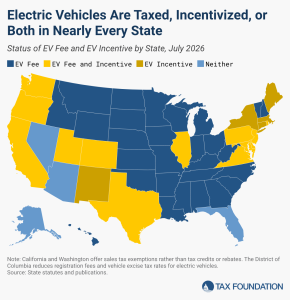
As the market share of electric vehicles (EVs) on the road grows, the gas tax’s ability to fund road projects and decrease traffic congestion erodes. Both federal and state real tax revenue per vehicle mile traveled has been on a steady decline for decades, creating a fiscal gap for road expenditures even as the demand for road infrastructure improvements has grown.
6 min read
Poland is currently moving forward with legislation aimed at introducing a windfall profits tax. In doing so, it is following a broader European trend of renewed interest in such taxes in response to rising fuel prices triggered by the conflict in the Middle East.
6 min read
British taxation on the American colonies was a major catalyst for the American Revolution, but most of the tax revolts leading up to the war were in response to one tax type: excise taxes.
4 min read
Military action around the Strait of Hormuz has increased global oil prices. In response, policymakers around the world have put forward proposals targeting oil and gas producers who are seeing profits increase in the short run from the spike in prices.
5 min read
In response to surging gas prices, President Trump and several lawmakers have proposed suspending the federal gas tax via a gas tax holiday. Gas tax holidays have appeal across the political aisle, but suspending the federal gas tax is a uniquely ill-suited policy for addressing rising prices.
3 min read
Tax collections vary widely by state, making per capita collections figures—a measure of collections per person—especially useful, as they allow comparisons across differences in tax rates and bases, economic capacities, and policy decisions that impact the size and scope of government.
5 min read
Gas tax prices are soaring across the country, and lawmakers are naturally looking for ways to alleviate the pain at the pump. While gas tax holidays—which temporarily suspend fuel taxes to artificially lower the price of gas—are a politically welcomed intervention, taxpayers shouldn’t be so quick to celebrate.
Facts & Figures serves as a one-stop state tax data resource that compares all 50 states on over 40 measures of tax rates, collections, burdens, and more.
2 min read
The amount of revenue states raise through roadway-related revenues varies significantly across the US. Only two states raise enough revenue to fully cover their highway spending.
5 min read
Fuel taxes continue to be a central policy consideration for European countries amid geopolitical conflicts, increased emphasis on environmental policy, and economic conditions experienced by average consumers.
6 min read
Forty-three states will ring in 2026 with notable tax changes. Eight states will see reduced individual income tax rates in the new year while four states will see reduced corporate income tax rates.
30 min read
Examples from other countries and US states show that well-designed user fees can fund transportation infrastructure effectively.
19 min read
Spain’s central government could learn some valuable lessons from its regional governments and other European countries about sound tax policy.
7 min read
Excise taxes are regressive, and other alternatives are frequently available to incentivize behavior change.
6 min read
The State Tax Competitiveness Index enables policymakers, taxpayers, and business leaders to gauge how their states’ tax systems compare. While there are many ways to show how much state governments collect in taxes, the Index evaluates how well states structure their tax systems and provides a road map for improvement.
122 min read
Sean Bray interviewed Dr. Sérgio Vasques, Professor of Tax Law at the Catholic University of Lisbon and former Portuguese Secretary of State for Tax Affairs, about the future of the EU tax mix.
7 min read
Summer has arrived, and states are beginning to implement policy changes that were enacted during this year’s legislative session (or that have delayed effective dates or are being phased in over time).
28 min read
The House reconciliation bill includes numerous changes to the tax code: good, bad, and ugly. However, the new corporate alternative minimum tax, or CAMT, goes largely untouched.
4 min read