New IRS data for taxA tax is a mandatory payment or charge collected by local, state, and national governments from individuals or businesses to cover the costs of general government services, goods, and activities. year 2025 shows how tax refunds and taxes owed at filing time changed under the new tax breaks enacted as part of the One Big Beautiful Bill Act (OBBBA).
The OBBBA changed several provisions of the individual income taxAn individual income tax (or personal income tax) is levied on the wages, salaries, investments, or other forms of income an individual or household earns. The U.S. imposes a progressive income tax where rates increase with income. The Federal Income Tax was established in 1913 with the ratification of the 16th Amendment. Though barely 100 years old, individual income taxes are the largest source code, but some of the largest changes for tax year 2025 were the creation of several deductions: for tip income, overtime, senior citizens, and auto-loan interest paid. The standard deductionThe standard deduction reduces a taxpayer’s taxable income by a set amount determined by the government. Taxpayers who take the standard deduction cannot also itemize their deductions; it serves as an alternative. was larger ($15,750 for single filers and $31,500 for joint), as was the child tax creditA tax credit is a provision that reduces a taxpayer’s final tax bill, dollar-for-dollar. A tax credit differs from deductions and exemptions, which reduce taxable income rather than the taxpayer’s tax bill directly. (up $2,200 per child), and the itemized deductionItemized deductions allow individuals to subtract designated expenses from their taxable income and can be claimed in lieu of the standard deduction. Itemized deductions include those for state and local taxes, charitable contributions, and mortgage interest. An estimated 13.7 percent of filers itemized in 2019, most being high-income taxpayers. for state and local taxes paid (SALT, which was increased from $10,000 to $40,000).
Unfortunately, the data update does not provide any new information on the new OBBBA provisions. While we can analyze how refunds and taxes due at filing time changed across filers, we cannot analyze the uptake or usage of the new provisions themselves.
Taxes Due Down, Tax Refunds Received Up
Most of the tax relief from the new OBBBA changes occurred during the filing season, as taxpayers either owed less to the IRS than they would have paid otherwise, or received larger refunds. We can compare this year’s filing season data, which covers through July 30, 2026, to last year’s filing season data through the same week, to analyze how the filing seasons changed.
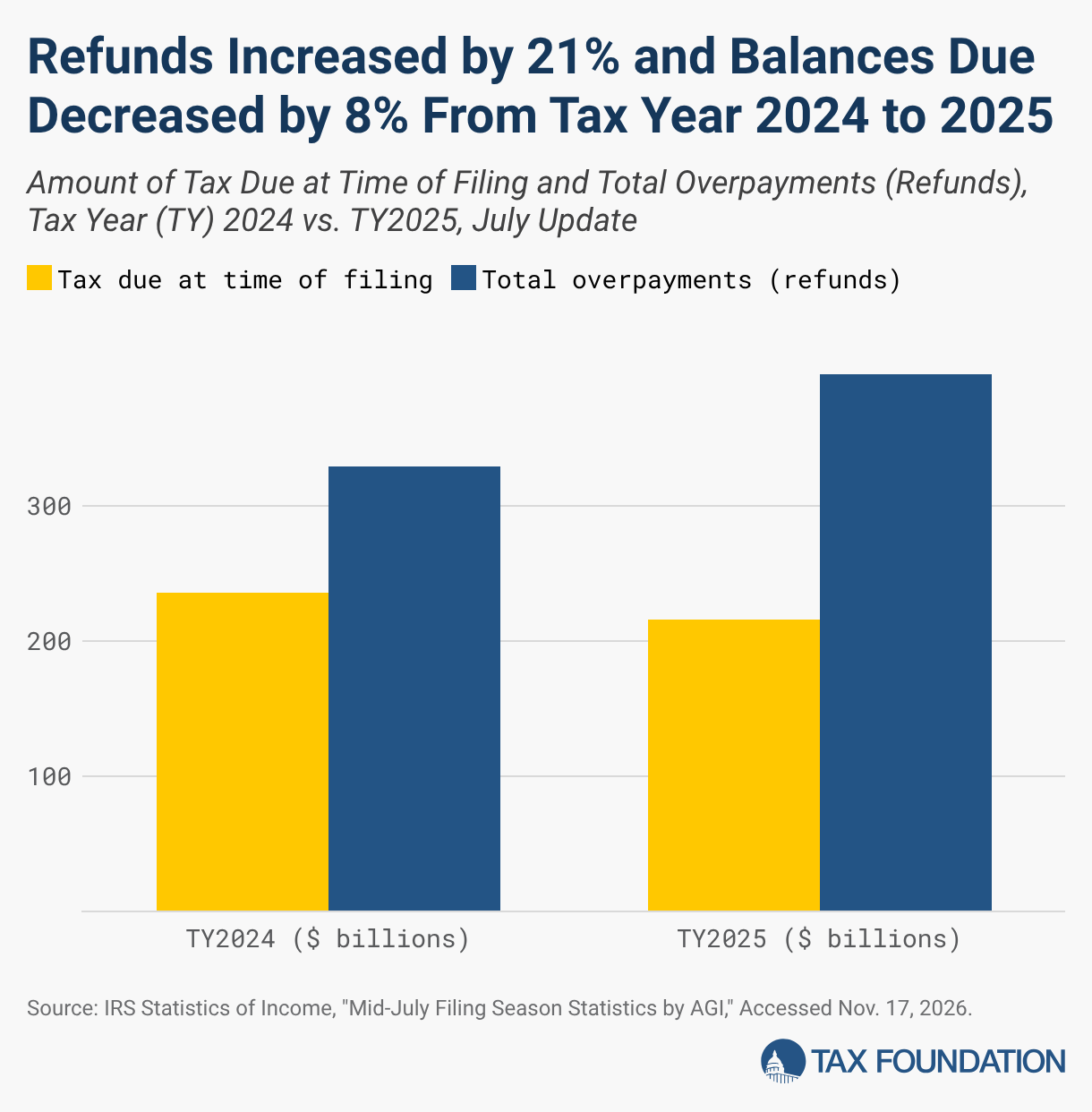
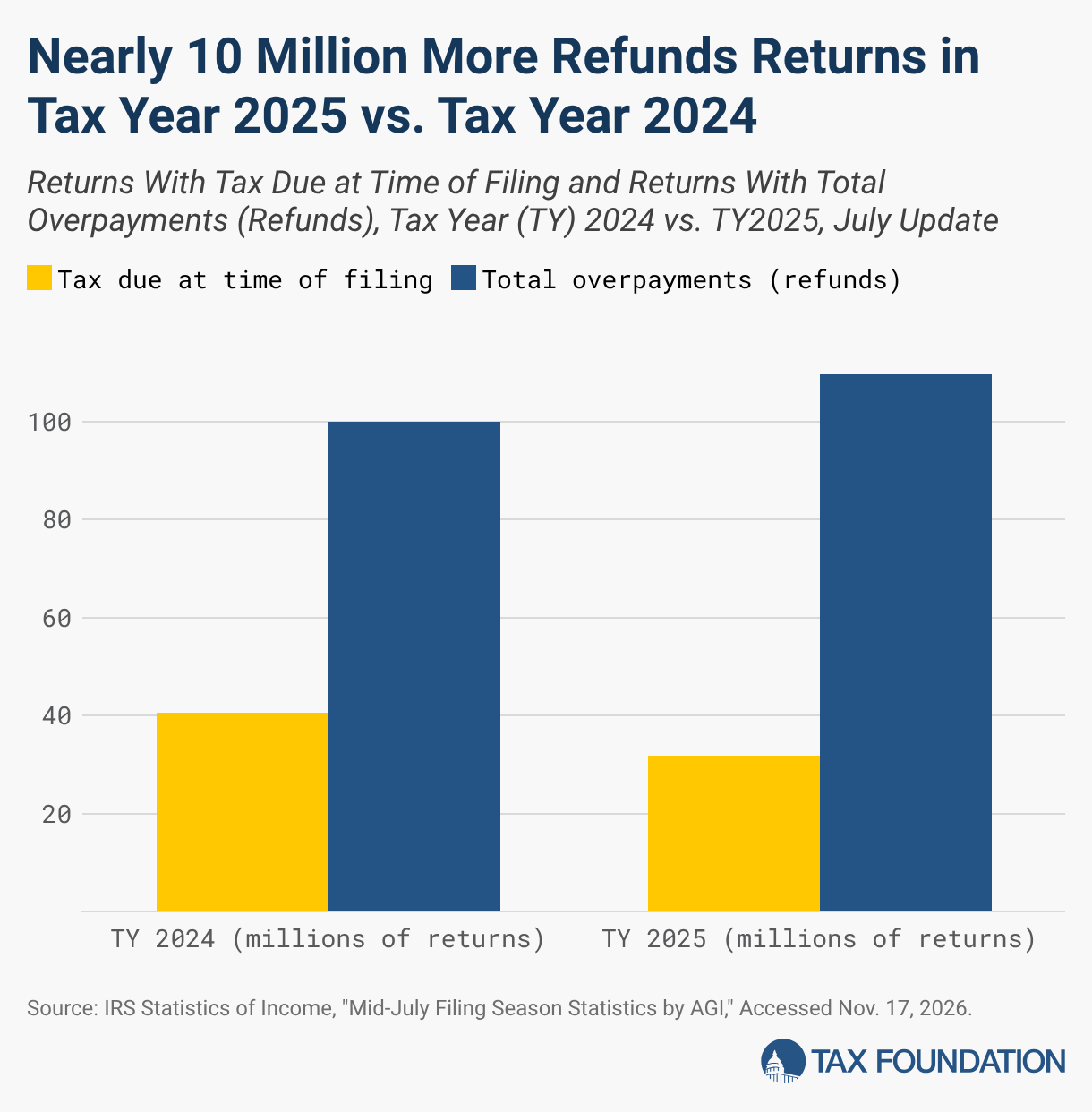
The total amount of tax owed at filing time fell by 8 percent year over year, while the number of taxpayers owing a balance dropped more sharply by 21.3 percent. For tax year 2024, 40.6 million returns paid nearly $236 billion at filing time. For tax year 2025, far fewer returns, 31.9 million, paid a lower $216 billion at filing time.
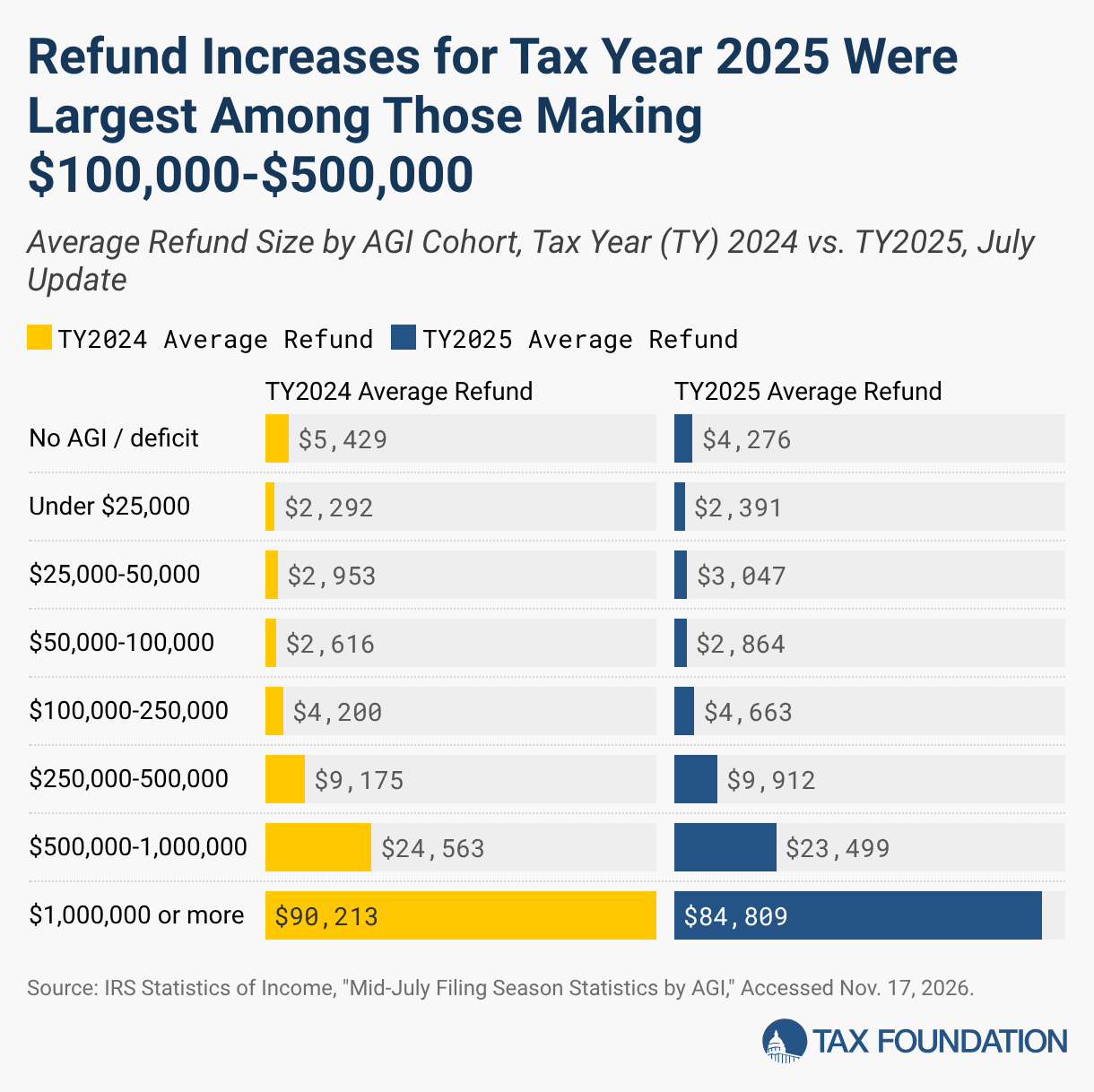
While taxes owed went down, tax refunds went up, growing nearly 21 percent year over year. In tax year 2024, 100 million tax returns received $329 billion back from overpayments, and that rose to 109.6 million tax returns receiving nearly $397 billion back from overpayments for tax year 2025. The average refund size increased by $328 from $3,290 in tax year 2024 to $3,617 in tax year 2025.
The biggest percentage decrease in taxes owed at filing was experienced by filers making between $50,000 to $100,000 (falling 23.1 percent year over year), while the biggest percentage increase in total refunds received was experienced by filers making between $200,000 to $500,000 (rising 54.6 percent year over year).
3.5 Million More Filers Itemized Their Deductions in Tax Year 2025
Last filing season, 132.9 million filers took the standard deduction (90.9 percent) compared to nearly 12.7 million who itemized (8.7 percent). This filing season, more taxpayers itemized. About 130.7 million filers took the standard deduction (88.6 percent) while 16.2 million itemized (11.0 percent).
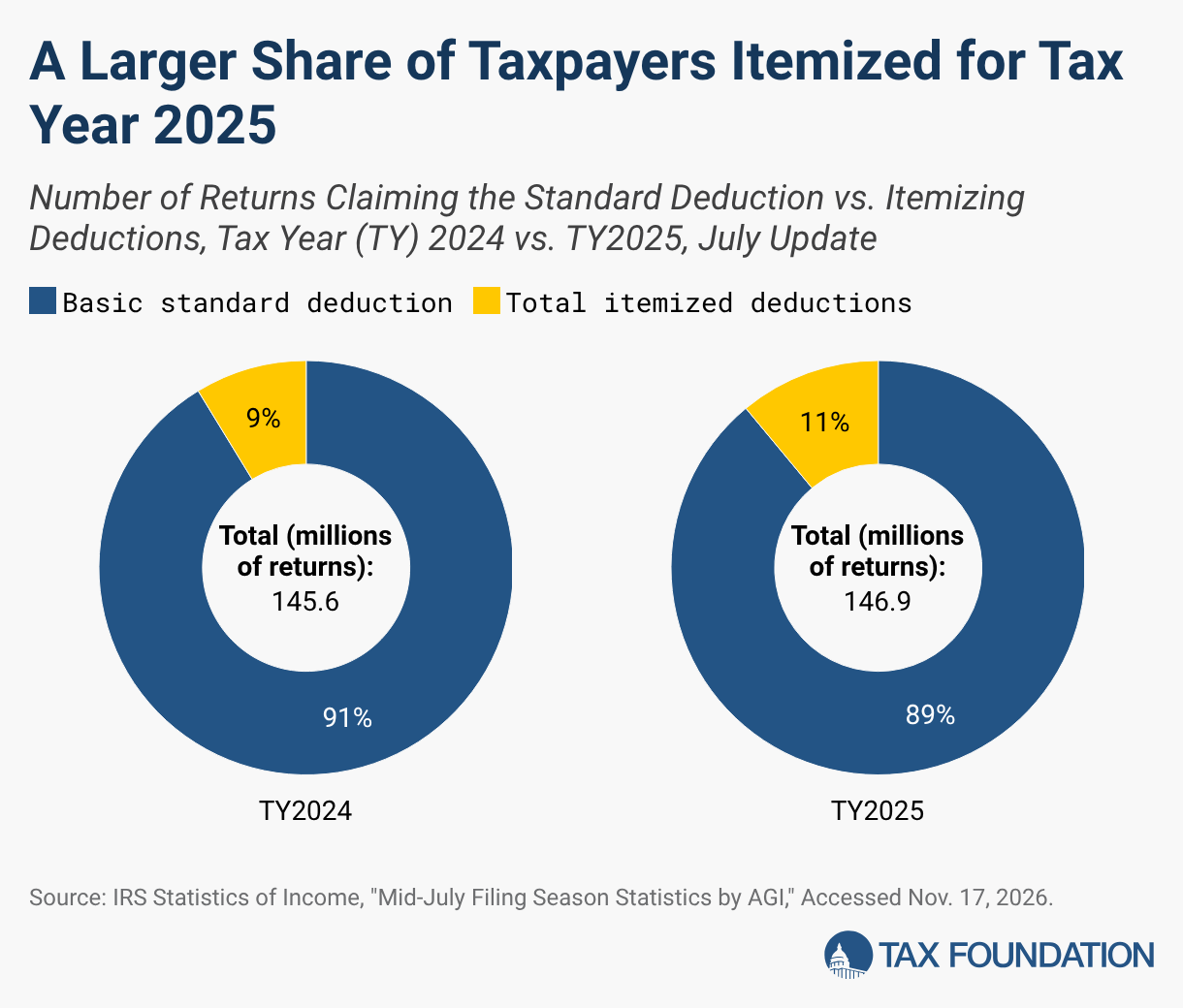
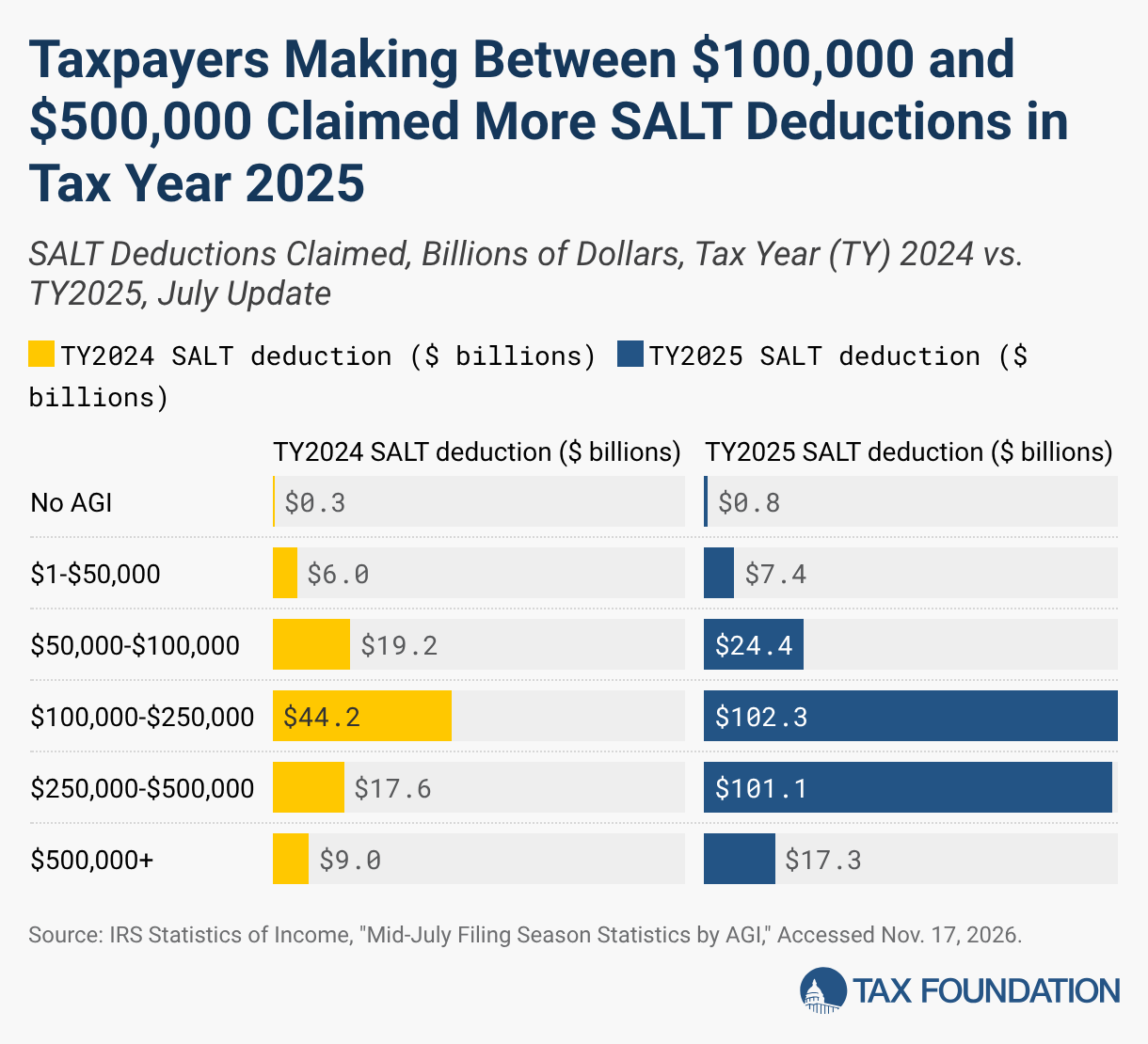
This 27.9-percent increase in itemization is a predictable consequence of one of OBBBA’s biggest individual tax changes for tax year 2025: the increase in the state and local tax (SALT) deductionThe state and local tax (SALT) deduction permits taxpayers who itemize when filing federal taxes to deduct certain taxes paid to state and local governments. The Tax Cuts and Jobs Act (TCJA) capped it at $10,000 per year, consisting of property taxes plus state income or sales taxes, but not both. cap.
Taxpayers claimed $253.3 billion in SALT deductions through mid-July, compared to just $96.3 billion in deductions at the same point for tax year 2024 filings. Taxpayers with adjusted gross incomeFor individuals, gross income is the total of all income received from any source before taxes or deductions. It includes wages, salaries, tips, interest, dividends, capital gains, rental income, alimony, pensions, and other forms of income. For businesses, gross income (or gross profit) is the sum of total receipts or sales minus the cost of goods sold (COGS)—the direct costs of producing goods (AGI) between $200,000 and $500,000 increased SALT claims the most relative to last year. OBBBA increased the SALT cap from $10,000 to $40,000 for tax year 2025, but the higher SALT cap phases out for taxpayers earning more than $500,000.
We Still Have Limited Data on the “No Tax On” Provisions
The IRS data through July 30, 2026, provide no new information on claims for the “no tax on” provisions from OBBBA: the deductions for tips, overtime, auto loan interest, and the enhanced senior deduction.
The Treasury Department published a press release in June 2026 with limited data on how many taxpayers claimed the new deductions and the average deduction size. The IRS filing season data are more granular and allow researchers to examine total deductions claimed by AGI cohort.
Absent a filing season update, policymakers, researchers, and the public may have to wait until annual IRS Statistics of Income (SOI) data are released for tax year 2025 for more data on the “no tax on” provisions. Given IRS data lags, those data may not be published until 2028—the year these temporary provisions are scheduled to expire.
While we know that the OBBBA delivered tax relief for individual taxpayers—as millions fewer taxpayers owed at filing time and refunds were up—we still lack detailed data on how filers utilized the new provisions.
Stay informed on the tax policies impacting you.
Subscribe to our free newsletter to get the latest tax data, news and analysis.
Subscribe