





Excise Taxes Are Most Harmful to the Poor
6 min readBy:Key Points
- Excise taxes are regressive, comprising a larger portion of the budgets of lower-income households than higher-income households.
- Cigarette taxes are the most regressive excise tax, while excise taxes like aviation and motor fuel taxes are less regressive.
- To minimize punishments for the poorest households, policymakers should use more carrots (rewards) and fewer sticks (tax penalties) to incentivize behavior change.
One drawback of excise taxes is that they are almost always regressive. Regressive taxes comprise a larger percentage of the budgets of lower-income households than higher-income households, disproportionately impacting the poor.
Simply because a taxA tax is a mandatory payment or charge collected by local, state, and national governments from individuals or businesses to cover the costs of general government services, goods, and activities. is regressive, however, doesn’t mean it shouldn’t be used. Most consumption taxes are regressive, but they still have a role in a broader tax and transfer system that is almost invariably highly progressive. Consumption doesn’t keep pace with income growth because savings increase as incomes grow. Best practices for tax policy usually include a mix of both progressive and regressive taxes that provide a stable source of revenue but minimize market distortions and the tax burden on the poor. Especially where taxes are regressive, it is worth considering policies that incentivize behavior change through rewards instead of punishments (carrots over sticks).
While excise taxes are regressive, they vary in extent. One way to measure the degree to which an excise taxAn excise tax is a tax imposed on a specific good or activity. Excise taxes are commonly levied on cigarettes, alcoholic beverages, soda, gasoline, insurance premiums, amusement activities, and betting, and typically make up a relatively small and volatile portion of state and local and, to a lesser extent, federal tax collections. is regressive is by comparing its burden on low-income households with its burden on high-income households.
The table below illustrates the income and tax burden of various US federal excise taxes across five quintiles. Wealthier households—those in the top quintile—consume more of almost everything, so they pay an increasing share of the overall tax burden. Consumers in the top income quintile pay 44.6 percent of all motor fuel taxes and more than half of all air travel excise taxes, whereas the lowest income households pay less than 5 percent of the taxes in each of those categories. Wealthier Americans drive and fly more than poor Americans.
The tax burdens for motor fuels and air travel track fairly closely to the overall income distribution as well. The difference in the air travel tax burden between households in the highest income and lowest income quintiles is 48.1 percent. The same difference in highest to lowest quintiles across the income distribution is 48.8 percent. Therefore, air travel excise taxes scale in line with income and are only mildly regressive.
Some Excise Taxes Are More Regressive Than Others
Tax Burden Paid by Income Group and Income Distribution in the United States on Select Federal Excise Taxes, 2023
| Motor Fuel | Air Travel | Alcohol | Tobacco | Income Distribution | |
|---|---|---|---|---|---|
| Lowest Quintile | 4.7% | 4.4% | 3.9% | 16.3% | 3.1% |
| Second Quintile | 10.1% | 6.8% | 8.0% | 18.3% | 8.3% |
| Middle Quintile | 17.2% | 14.0% | 17.4% | 18.0% | 14.1% |
| Fourth Quintile | 22.9% | 21.7% | 23.5% | 19.8% | 22.6% |
| Top Quintile | 44.6% | 52.5% | 46.9% | 27.1% | 51.9% |
| All | 100% | 100% | 100% | 100% | 100% |
The excise tax burden for tobacco looks very different, though. The difference between the tobacco tax burden for the highest and lowest income households is only 8.8 percent. Tobacco taxes are highly regressive, the most regressive taxTaxes can create different burdens on taxpayers of different income levels, measured by comparing taxes paid as a fraction of income. A regressive tax is one that creates a larger burden on lower-income taxpayers than on middle- or higher-income taxpayers. for which we have data.
Across the Organisation for Economic Co-operation and Development (OECD), smokers pay more consumption taxes than non-smokers. This shouldn’t be surprising. Cigarettes are highly taxed, so smokers are likely to pay more in consumption taxes than non-smokers.
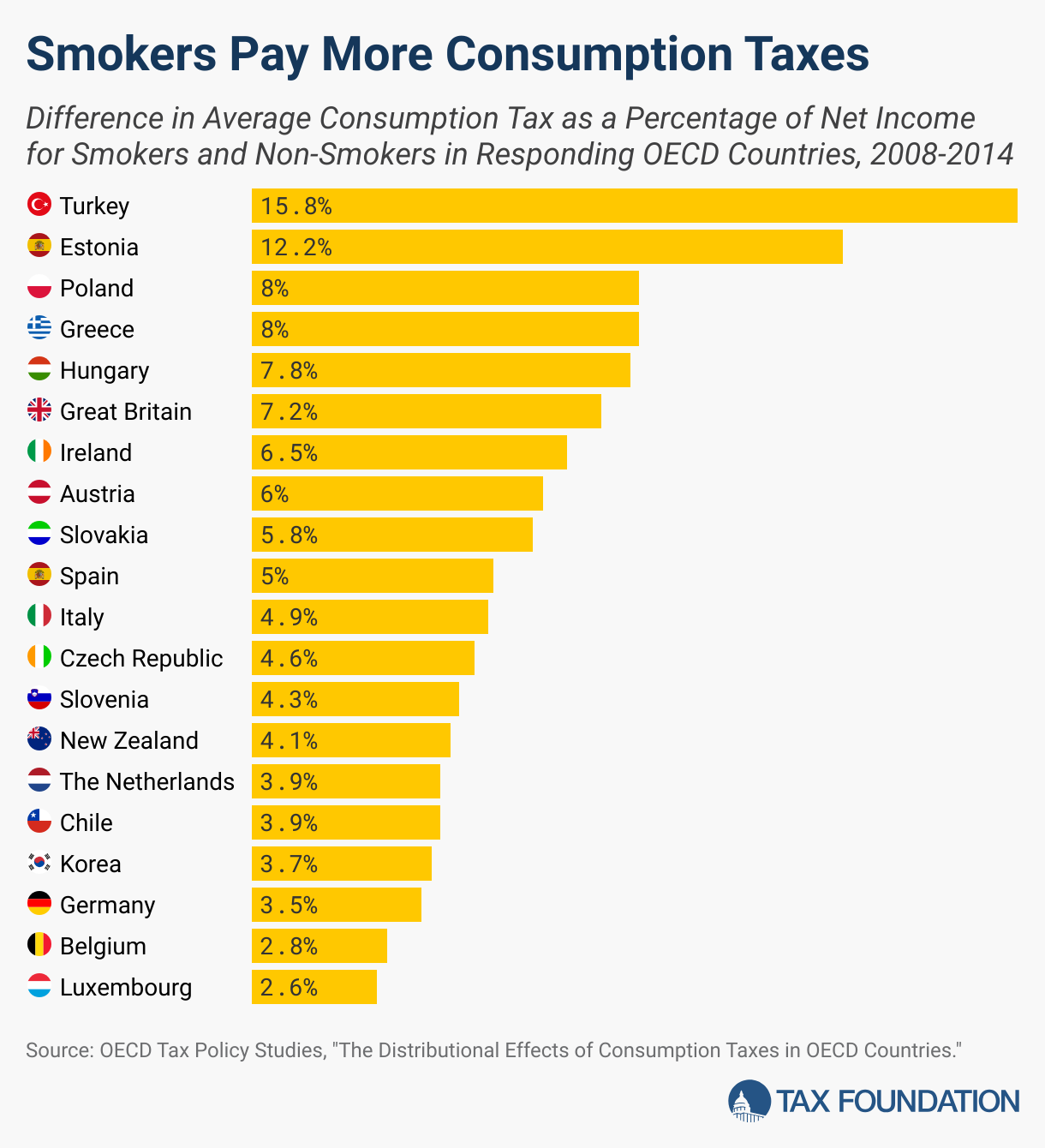
In Luxembourg, smokers pay 9.9 percent of their income in consumption taxes on average, whereas non-smokers pay an average of 7.3 percent, a difference of 2.6 percentage points. In Turkey, on the other hand, smokers pay 27.9 percent of their income in consumption taxes, whereas non-smokers pay 12.1 percent, a difference of 15.8 percentage points.
However, this effect spread across the income distribution tells a more interesting story. In Turkey, the difference in tax burden between smokers and non-smokers in the lowest income decile (the poorest households) is 21.1 percent. That difference is only 5 percent in the highest decile of the income distribution.

In Belgium, the difference in tax as a percentage of disposable income between smokers and non-smokers in the lowest income decile is 2.8 percent. For those in the highest income quintile in Belgium, smokers actually pay fewer consumption taxes than non-smokers.
The academic literature has reached a consensus finding that tobacco taxes are regressive. A WHO systematic review explored three decades of research and found that cigarette taxes were regressive across the globe. These findings are well-established. The newest developments in tobacco policy are the WHO’s attempts to spin tobacco taxes as pro-poor.
According to the WHO’s “Technical Manual on Tobacco Policy and Administration,”
Contrary to the perception of tobacco taxation being regressive, it is a strong pro-poor policy when the broader economic impacts are taken into consideration. The tax burden is not a complete indicator of regressivity, since it does not include the negative health and economic impacts of tobacco-attributable diseases or the positive impacts of behaviour change in response to tax and price increases.
The problem with this line of reasoning is that it selectively chooses some of the benefits of a policy, while ignoring other costs. The definition of a regressive tax is one that takes a larger percentage of income from low-income individuals than from high-income individuals. So, cigarette taxes are regressive. The broader tobacco policy environment can be progressive if its aggregate effects—all the costs involved and the related expenditure policy—have a disproportionately positive impact on lower-income households. But the WHO comes nowhere near this level of analysis. Instead, it argues that because smoking is harmful, and cigarette taxes induce some level of smoking cessation, the increased well-being from those who quit smoking makes cigarette taxes a pro-poor policy.
As part of a broad policy analysis, yes, health improvements from smoking cessation caused by tax increases would be a benefit. However, few people actually quit smoking following cigarette tax increases, and that number decreases as cigarette taxes increase.
But to look at the entirety of the cumulative effects of cigarette tax policy, we’d need data on many other outcomes. Because most smokers keep smoking after a cigarette tax increase, total expenditures on cigarettes increase. This makes smokers—disproportionately represented among lower-income households—poorer.
What do households cut from their budget to pay for higher cigarette taxes? This is difficult to answer because of the variety of possible options, but a recent study found that a $1 increase in cigarette taxes causes a 2.1 percent decline in human capital-related expenditures, such as health and education. They estimate that nearly 70 percent of the increase in cigarette spending following a tax hike is offset by reductions in human capital expenditures, while the remaining 30 percent comes from reductions in other day-to-day consumption. “[T]he majority of the adjustment to higher cigarette prices comes from reallocation away from investments that may support long-term health and socioeconomic outcomes—potentially undermining the very human capital channels through which cigarette taxes are often presumed to operate.”
Higher tax rates also incentivize smuggling and illicit trade. Estimates range widely by country, but a one euro increase in cigarette taxes translates to 29 to 95 percent more cigarette smuggling. Cigarette smuggling is particularly lucrative for illicit operators. All black market activity creates revenue for those who wish to operate outside legal boundaries. These activities are very, very anti-poor.
Smuggling and household substitution are only two of the myriad effects caused by cigarette tax policy. Estimating all the effects may be realistically infeasible, but only incorporating a single benefit, such as improved health from smokers who quit, yields misleading results.
Excise taxes make life more difficult for the taxed, in part because they are now poorer. Taxing poor households to try to make them healthier and wealthier is often a counterproductive policy because the tax penalties often leave poor households in worse condition.
Instead of trying to force behavior change through sticks (tax penalties), policymakers trying to induce behavior change should explore more carrots (rewards). Sweden and the UK have incorporated tobacco harm reduction into their excise framework, incentivizing smokers to switch to less harmful products. These kinds of incentives can drive better outcomes without exacerbating inequality. Sweden has the lowest smoking rate in Europe and became the first country to reach the WHO’s “smoke free” status with a population daily smoking rate of 5 percent or less.
Excise taxes are regressive, and other alternatives are frequently available to incentivize behavior change. Ultimately, excise taxes should be evaluated not just by their intent or isolated benefits, but by their full impact across the income distribution. Policymakers must weigh the trade-offs carefully, ensuring that revenue generation does not come at the expense of the most vulnerable.
Subscribe to our free newsletter to get the latest tax data, news and analysis.Stay informed on the tax policies impacting you.
About the Author

Adam Hoffer is the Director of Excise Tax Policy at the Tax Foundation. Dr. Hoffer earned his PhD in Economics from West Virginia University and his undergraduate degree from Washington & Jefferson College.