Whether a sommelier or a casual enjoyer, wine drinkers may not be aware of just how much they are paying in taxes to uncork their drink of choice.
Wine has maintained a steady market share among alcoholic beverages since 2000 and continues to generate significant value for consumers and the broader economy. In addition to standard business taxes, the wine industry is burdened with specific excise taxes: the total amount of consumption taxes paid for wine in 2025 is estimated to be $7.2 billion.
States often taxA tax is a mandatory payment or charge collected by local, state, and national governments from individuals or businesses to cover the costs of general government services, goods, and activities. wine at a higher rate than beer but a lower rate than distilled spirits because wine’s alcohol content is usually between the other beverage types. After adjusting for alcohol content, however, most states still levy higher taxes on wine, though some favor wine and tax beer at more than double the rate. Policymakers should modernize this arcane categorical system by taxing directly according to actual alcohol content, making the system simpler and more neutral.
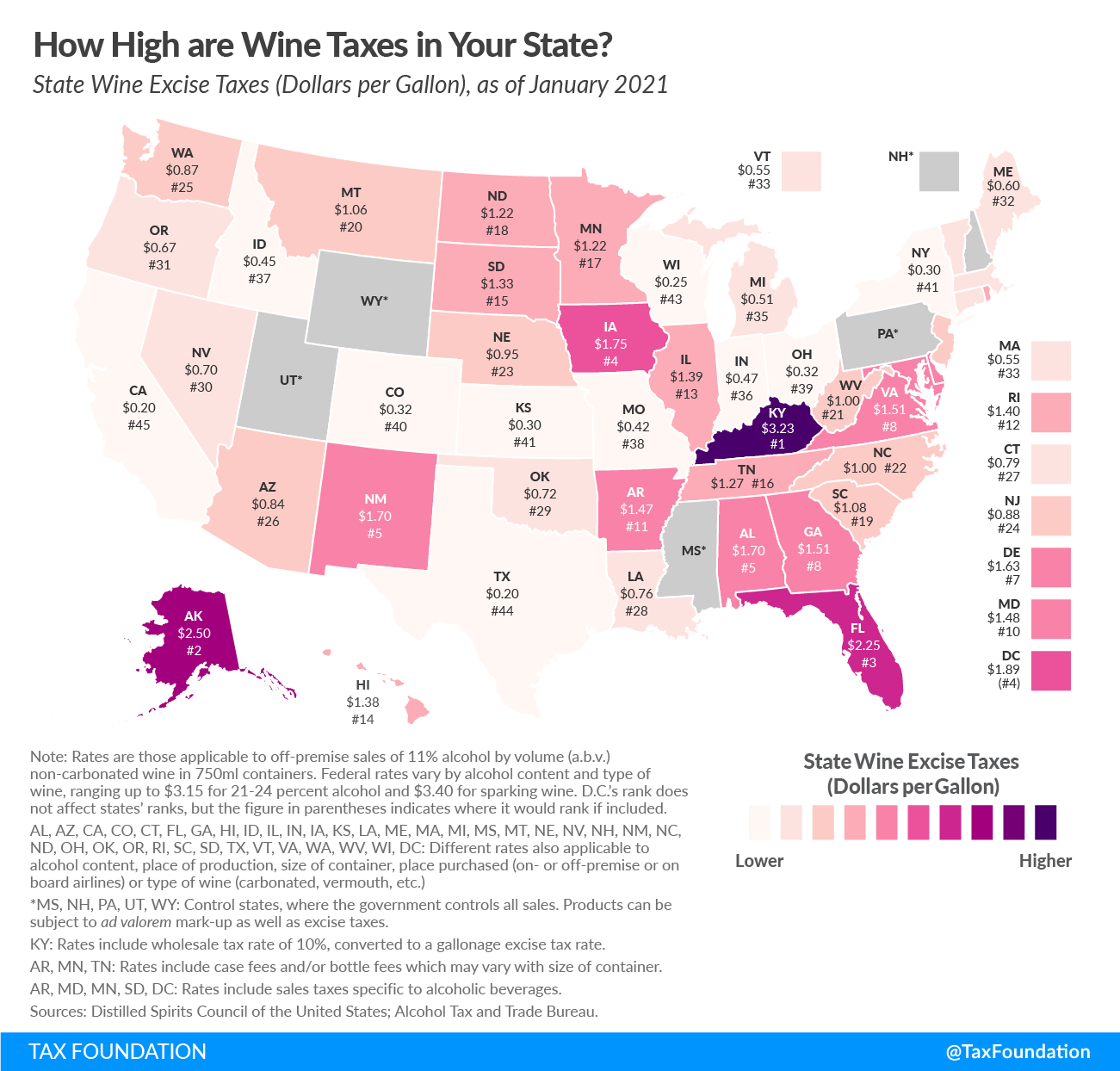
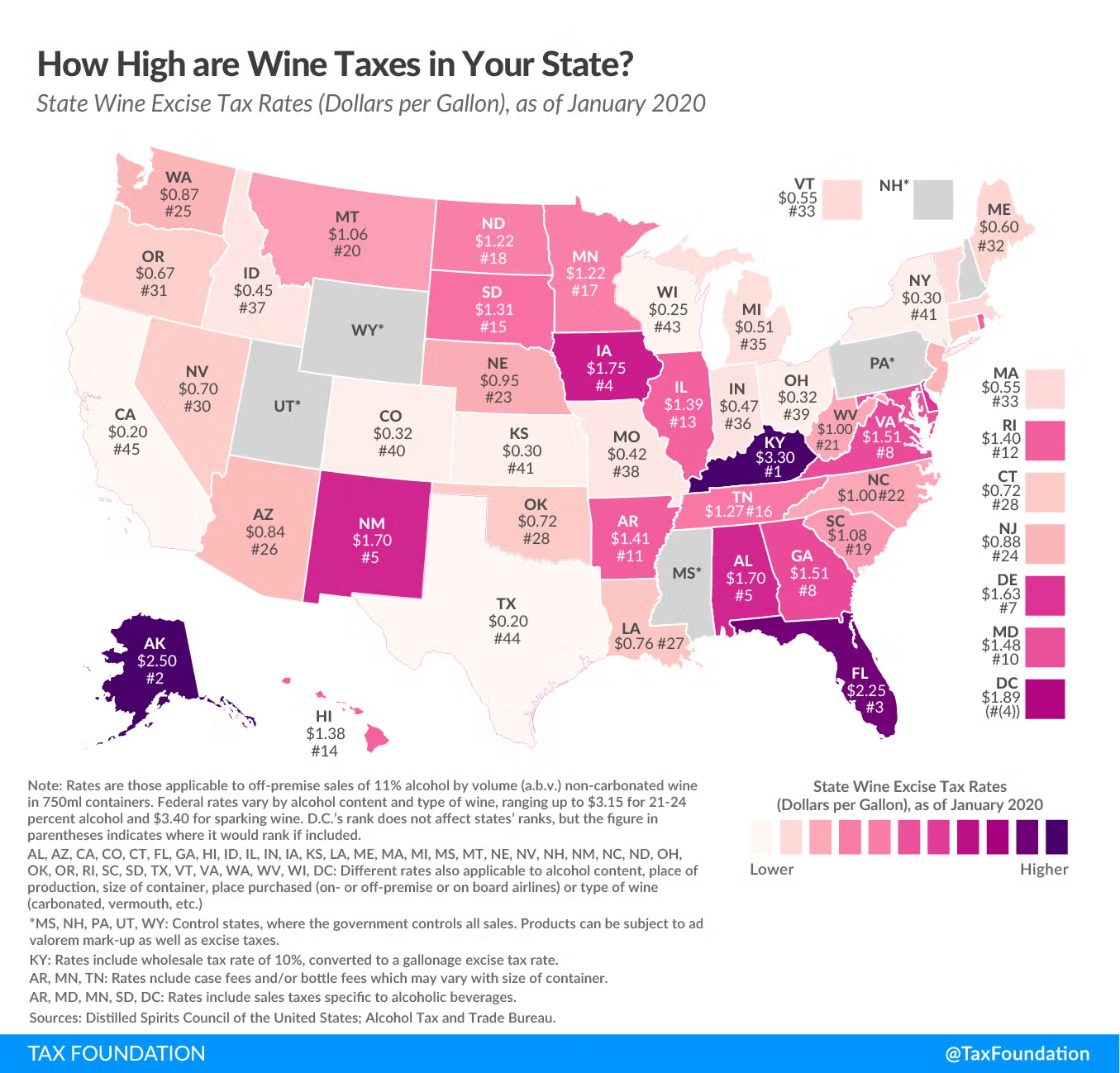
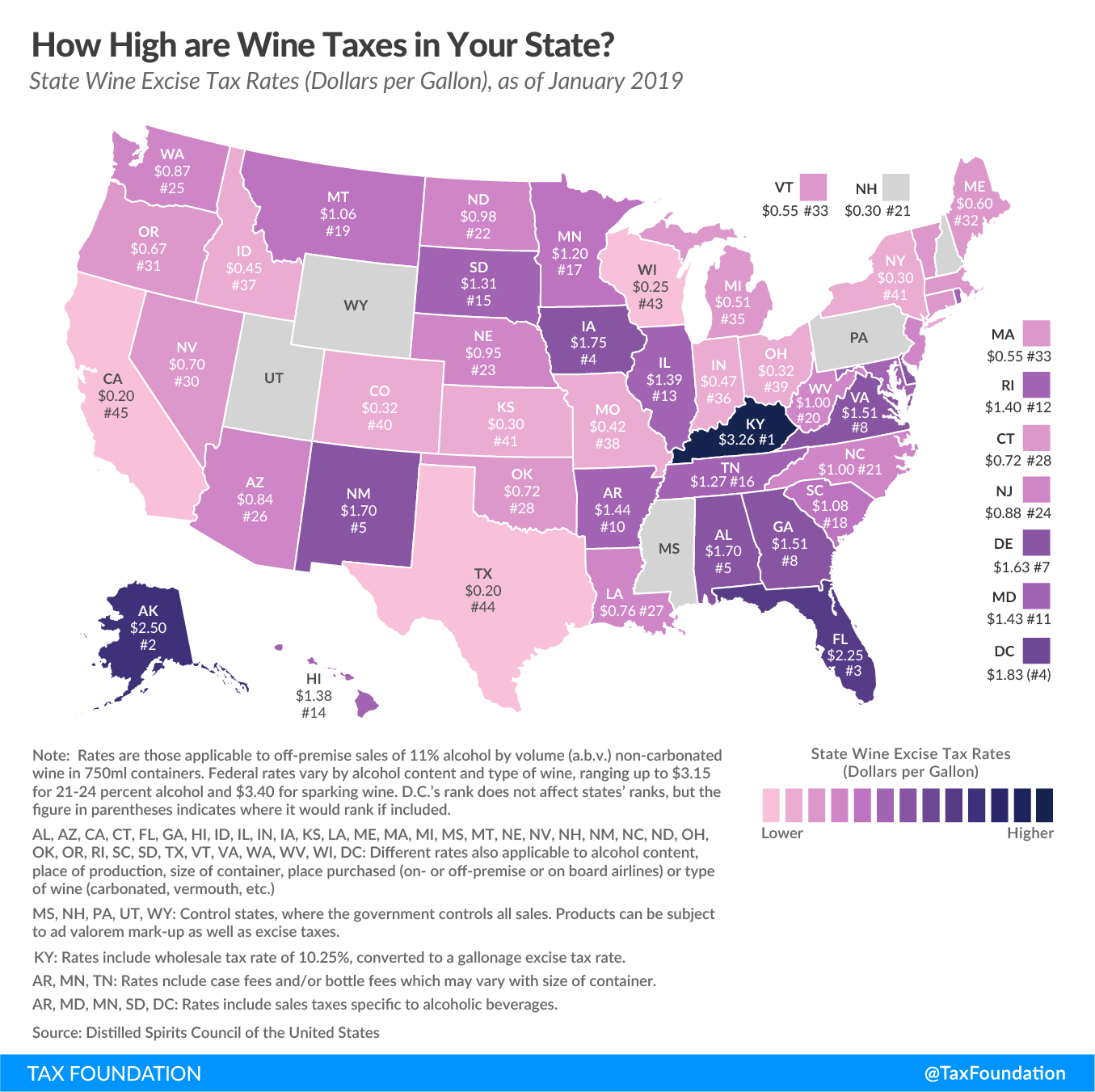
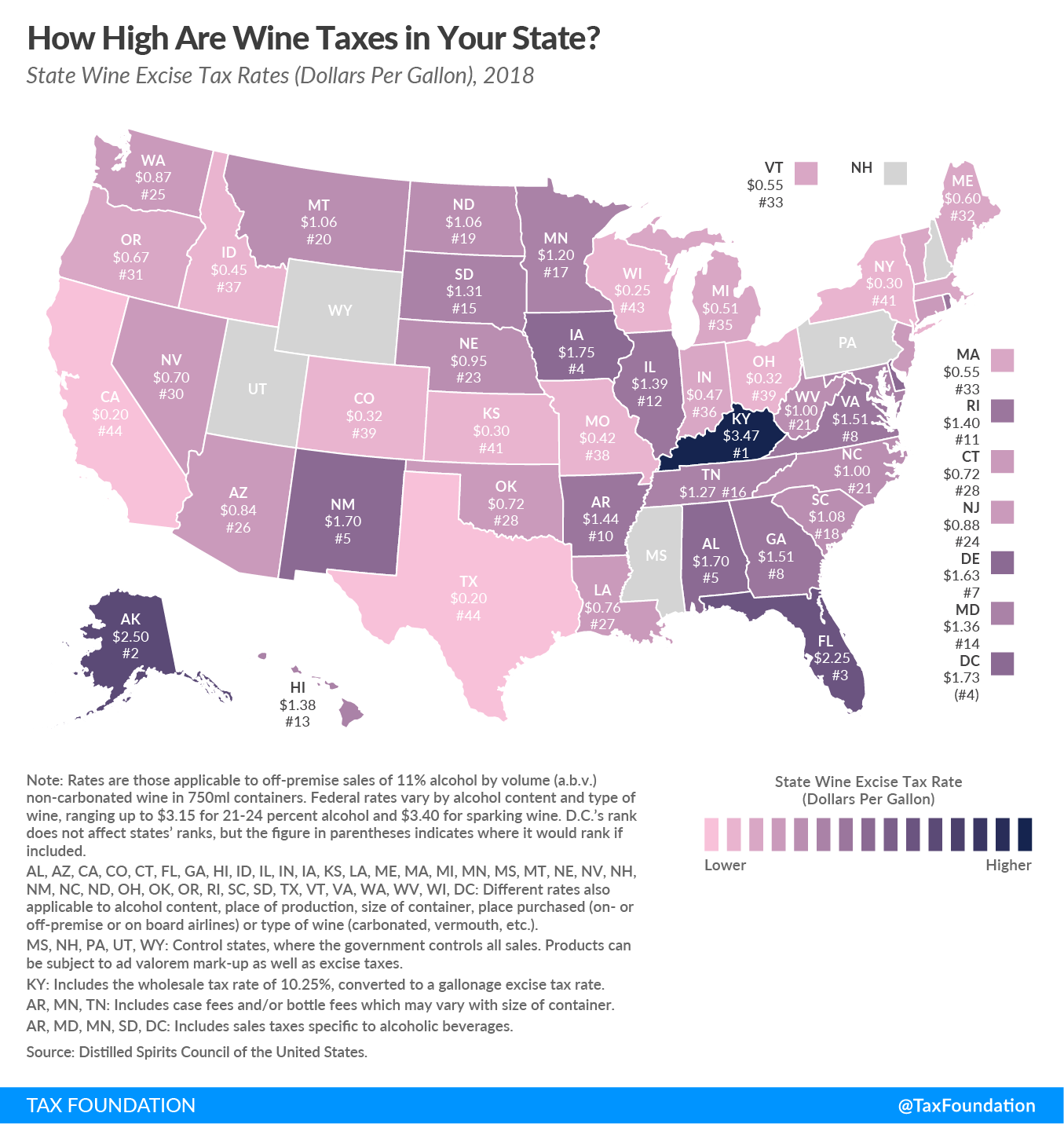
The highest tax burden on wine is levied in Kentucky at $3.82 per gallon. The state’s 10 percent wholesale tax places it well above the next highest tax states, Alaska ($2.50 per gallon), Florida ($2.25 per gallon), and Iowa ($1.75 per gallon). The state with the lowest tax burden is California—home to the prominent viticultural area Napa Valley —at $0.20 per gallon. The states with the next lowest taxes are Texas ($0.204 per gallon), Wisconsin ($0.25 per gallon), and Kansas and New York (both at $0.30 per gallon).

Wine Taxes by State, 2026
State Wine Excise Tax Rates in Dollars per Gallon, as of January 2026
| State | Wine Tax Rate per Gallon | Rank |
|---|---|---|
| Alabama (b) | $1.70 | 6 |
| Alaska | $2.50 | 2 |
| Arizona (b) | $0.84 | 26 |
| Arkansas (c, d) | $1.50 | 11 |
| California (b) | $0.20 | 45 |
| Colorado (b) | $0.32 | 39 |
| Connecticut (b) | $0.79 | 27 |
| Delaware | $1.63 | 8 |
| Florida (b) | $2.25 | 3 |
| Georgia (b) | $1.51 | 9 |
| Hawaii (b) | $1.38 | 15 |
| Idaho (b) | $0.45 | 37 |
| Illinois (b) | $1.39 | 14 |
| Indiana (b) | $0.47 | 36 |
| Iowa (b) | $1.75 | 4 |
| Kansas (b) | $0.30 | 41 |
| Kentucky (e) | $3.82 | 1 |
| Louisiana (b) | $0.76 | 28 |
| Maine (b) | $0.60 | 32 |
| Maryland (d) | $1.64 | 7 |
| Massachusetts (b) | $0.55 | 33 |
| Michigan (b) | $0.51 | 35 |
| Minnesota (c, d) | $1.25 | 17 |
| Mississippi (a) | ||
| Missouri | $0.42 | 38 |
| Montana (b) | $1.06 | 20 |
| Nebraska (b) | $0.95 | 23 |
| Nevada (b) | $0.70 | 30 |
| New Hampshire (a) | ||
| New Jersey | $0.88 | 24 |
| New Mexico (b) | $1.70 | 5 |
| New York | $0.30 | 41 |
| North Carolina (b) | $1.00 | 22 |
| North Dakota (b) | $1.17 | 18 |
| Ohio (b) | $0.32 | 39 |
| Oklahoma (b) | $0.72 | 29 |
| Oregon (b) | $0.67 | 31 |
| Pennsylvania (a) | ||
| Rhode Island (b) | $1.40 | 13 |
| South Carolina (b) | $1.08 | 19 |
| South Dakota (b, d) | $1.44 | 12 |
| Tennessee (c) | $1.27 | 16 |
| Texas (b) | $0.20 | 44 |
| Utah (a) | ||
| Vermont (b) | $0.55 | 33 |
| Virginia (b) | $1.51 | 10 |
| Washington (b) | $0.87 | 25 |
| West Virginia (b) | $1.00 | 21 |
| Wisconsin (b) | $0.25 | 43 |
| Wyoming (a) | ||
| District of Columbia (b, d) | $2.07 | 4 |
(b) Different rates also applicable according to alcohol content, place of production, size of container, place purchased (on- or off-premises or onboard airlines) or type of wine (carbonated, vermouth, etc.).
(c) Includes case fees and/or bottle fees which may vary with size of container.
(d) Includes sales taxes specific to alcoholic beverages.
(e) Includes the wholesale tax rate of 10%, converted into a gallonage excise tax rate.
Rates are those applicable to off-premises sales of 11% alcohol by volume (ABV) non-carbonated wine in 750mL containers which have been imported from outside the state.
Source: Distilled Spirits Council of the United States; state statutes.
Data compiled by Jacob Macumber-Rosin, Adam Hoffer
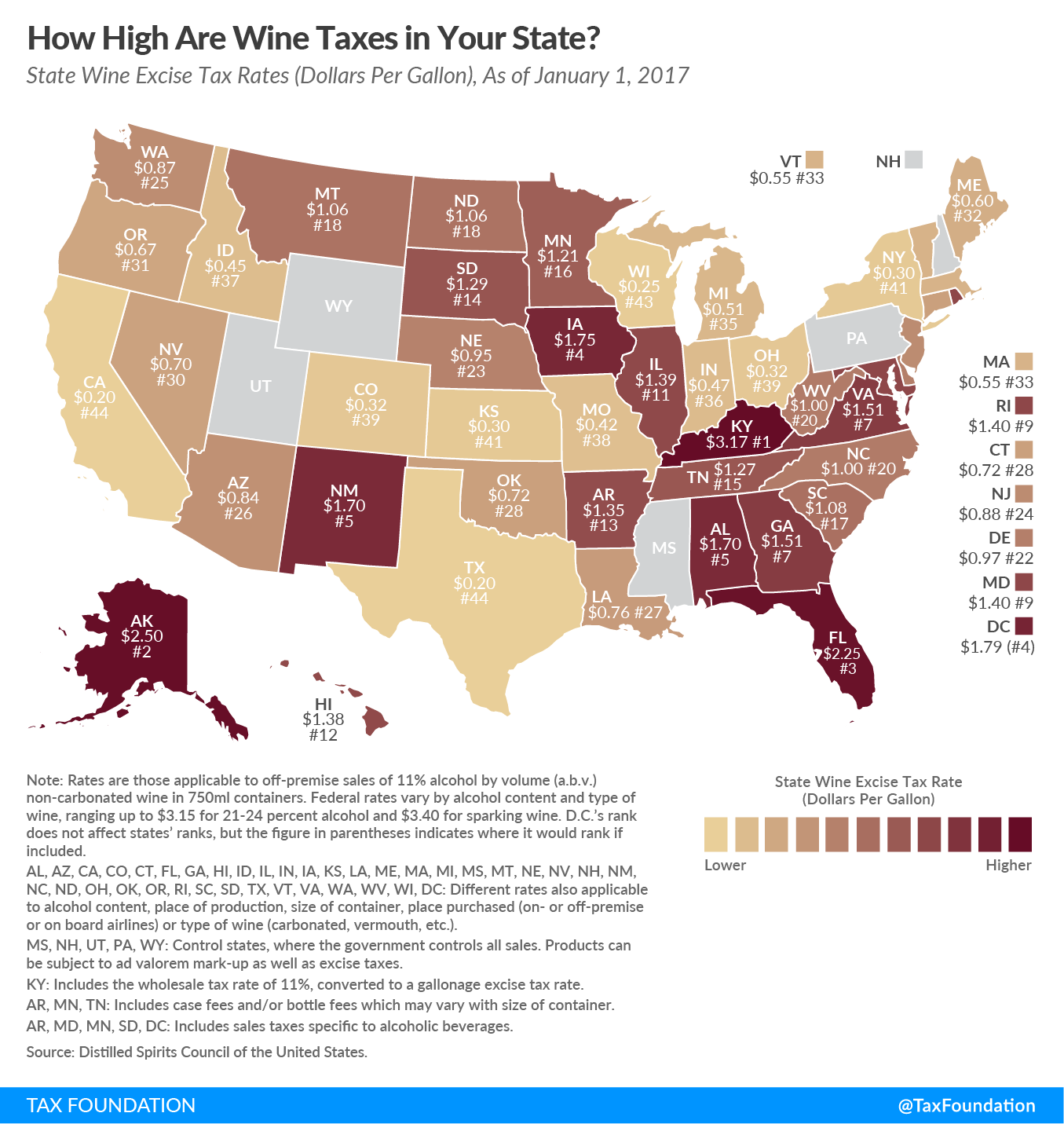
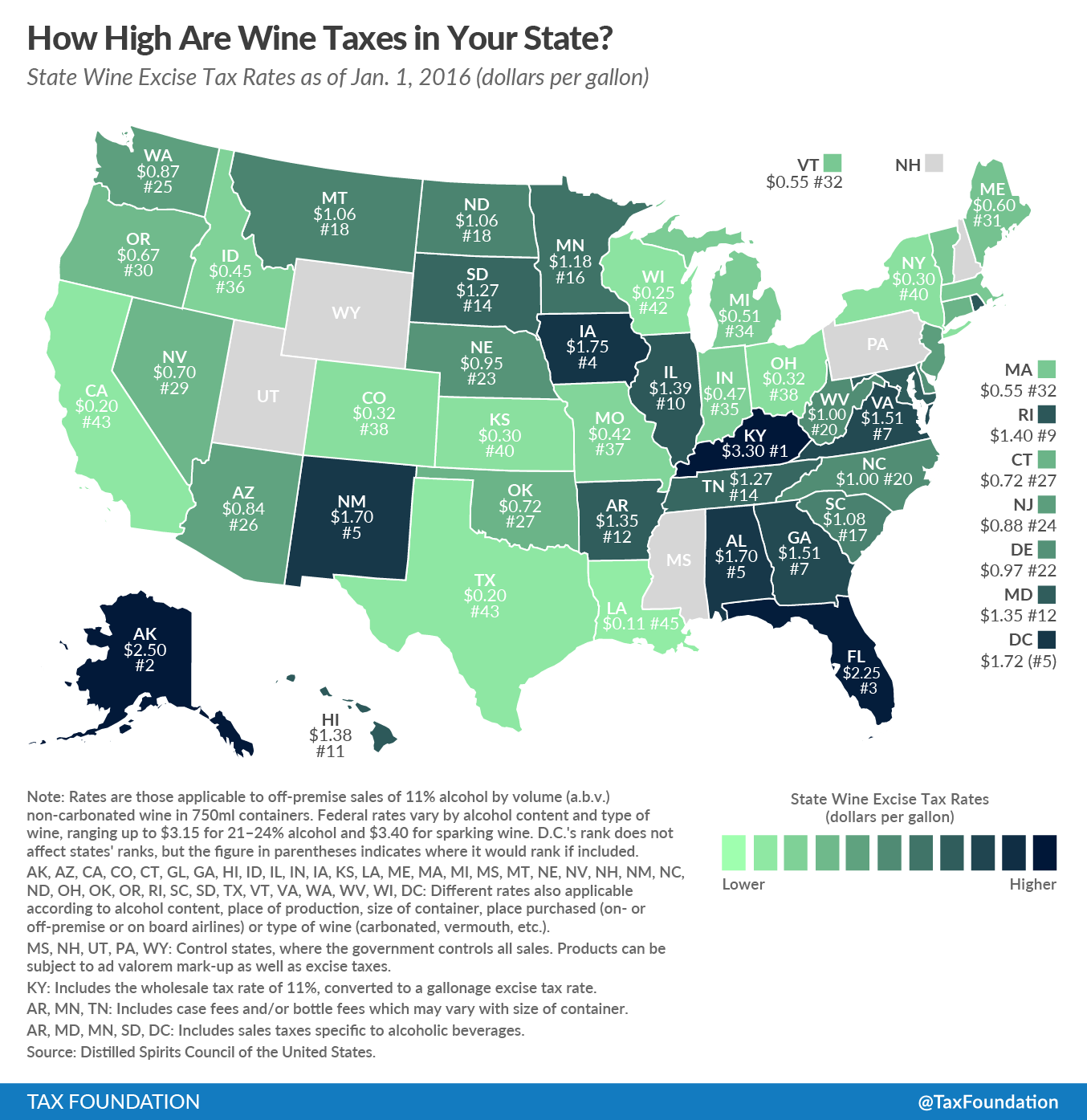
Notable Recent Changes
Tax Changes Since 2021
- The effective per gallon excise taxAn excise tax is a tax imposed on a specific good or activity. Excise taxes are commonly levied on cigarettes, alcoholic beverages, soda, gasoline, insurance premiums, amusement activities, and betting, and typically make up a relatively small and volatile portion of state and local and, to a lesser extent, federal tax collections. in Kentucky increased from $3.23 to $3.82, driven by higher prices yielding a greater burden from the state’s 10 percent ad valorem
- DC’s effective rate increased from $1.89 to $2.07 per gallon as the alcohol-specific sales taxA sales tax is levied on retail sales of goods and services and, ideally, should apply to all final consumption with few exemptions. Many governments exempt goods like groceries; base broadening, such as including groceries, could keep rates lower. A sales tax should exempt business-to-business transactions which, when taxed, cause tax pyramiding. is levied on generally higher prices.
- Similarly, Maryland, South Dakota, Minnesota, and Arkansas all have had their effective per gallon excise tax rate increased slightly, as higher prices result in a greater tax burden from the states’ alcohol-specific sales taxes.
- The effective per gallon excise tax in North Dakota decreased from $1.22 to $1.17.
Volume-based ad quantum taxes are the most common levy on wine, but many states impose additional layers of taxes and fees that may vary by wine type, alcohol content, place of production, place of purchase, or container size. To make tax burdens comparable across states, sales are assumed to be for off-premises sales of 11 percent ABV non-carbonated wine in 750 mL containers imported from out of state.
Wine in every state bears an additional burden from a federal excise tax. This tax, too, varies by wine type and alcohol content, and there are tax credits available that reduce the rate applied to the first 30,000, 130,000, and 750,000 wine gallons domestically produced. The tax rate for 11 percent still wine is $1.07 per wine gallon.
Most states use a licensing system to regulate the sale of alcoholic beverages, but five states have seized a government monopoly for themselves. In these states—Mississippi, New Hampshire, Pennsylvania, Utah, and Wyoming—pricing data is unavailable to estimate the effective per gallon excise tax rate those states levy with artificial price increases in addition to any applicable excise taxes.
Statutorily, Mississippi levies a $0.35 per gallon excise tax, and an additional 3 percent markup on sales of alcoholic beverages is dedicated to the Mental Health Programs Fund. The New Hampshire Liquor Commission seems proud to serve customers with low effective taxes. It reports an average wine tax of $0.046 per gallon and overall net margins of 16.5 percent. Pennsylvania’s Liquor Control Board was granted broad authority to manipulate prices in 2016, and the markup varies by product, but its net margins are reported as 5.3 percent, and liquors are subject to an additional 18 percent tax. Utah mandates a minimum markup of 88.5 percent for wine. Wyoming statutes levy a $0.28 per gallon excise tax, and the Liquor Division’s price calculator indicates a 17.6 percent markup.
Excise taxes in seven states—Colorado, Idaho, Iowa, Missouri, Ohio, Oregon, and Washington—include funds dedicated to a Wine Commission, Wine Industry Development Fund, Agriculture Business Development Fund, or similar entity meant to oversee the development and promotion of vineyards, wines, and other alcohol or agricultural businesses and products. These states tax the broad market to raise funds to subsidize their domestic industry.
While wine’s overall market share among alcoholic beverages has been relatively steady, policymakers should remain mindful that excise taxes are ill-suited to raise general revenues. Unadjusted ad quantum taxes inevitably lose real value to currency debasement, and ad valorem tax revenues are subject to significant fluctuations when consumer behavior shifts or tariffs suppress industries.
Additionally, the categorical structure of alcohol taxes often struggles to incorporate innovative new products in the industry. Wine taxes are no different, as the increasingly popular ready-to-drink wine cocktails don’t fit neatly into existing rigid statutory definitions without drastic over-taxation. A better option would be to discard categorical definitions and instead impose a direct taxA direct tax is levied on individuals and organizations and is not expected to be passed on to another payer (unlike indirect taxes such as sales and excise taxes), though economic incidence can still fall upon others. Often with a direct tax, such as the individual income tax, tax rates increase as the taxpayer’s ability to pay, or financial resources, increases, resulting in what is called a p according to the actual alcohol content, regardless of form. This modernization would make alcohol taxes simpler and more neutral.
Stay informed on the tax policies impacting you.
Subscribe to our free newsletter to get the latest tax data, news and analysis.
Subscribe