Alabama Tax Tribunal Says Out-of-State Workers Owe Income Taxes
If Alabama continues on its current path, its treatment of remote workers would be even more aggressive than that of New York—a shaky legal foundation.
6 min read

Janelle Fritts is a Senior Policy Analyst with the Tax Foundation’s Center for State Tax Policy. She is the lead researcher on the annual State Tax Competitiveness Index and serves as a resource to policymakers in their efforts to modernize and improve the structures of their state tax codes. Her work has been cited in The New York Times, the Associated Press, Bloomberg, and numerous state media outlets across the country.
Janelle has been with the Tax Foundation since 2019, with a brief hiatus to teach high school literature, logic, and rhetoric. Before joining the state team, she interned at the Mackinac Center for Public Policy, the Reason Foundation, and the Illinois Policy Institute. She graduated from Dordt University (Sioux Center, Iowa) with a bachelor’s degree in English with a writing emphasis and a minor in Chemistry.
Born and raised in Midland, Michigan, Janelle now lives in Reston, Virginia. In her free time, she enjoys baking, thrifting, and spending time with her husband and infant daughter.

If Alabama continues on its current path, its treatment of remote workers would be even more aggressive than that of New York—a shaky legal foundation.
6 min read
As housing prices are rapidly increasing, and property tax bills along with them, the property tax has come into the spotlight in many states. The design of a state’s property tax system can affect how attractive that state is to businesses and residents.
9 min read
Facts & Figures serves as a one-stop state tax data resource that compares all 50 states on over 40 measures of tax rates, collections, burdens, and more.
2 min read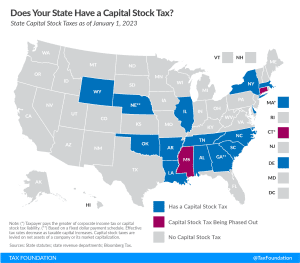
States can better position themselves for success by moving away from economically-damaging taxes like the capital stock tax.
4 min read
The changes put forth in a new package of bills would represent significant pro-growth change for Oklahoma that would set the state up for success in an increasingly competitive tax landscape.
7 min read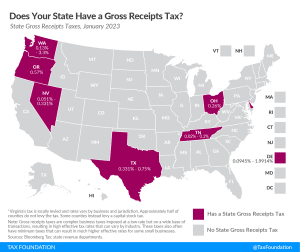
Gross receipts taxes impose costs on consumers, workers, and shareholders alike. Shifting from these economically damaging taxes can thus be a part of states’ plans for improving their tax codes in an increasingly competitive tax landscape.
4 min read
With other states upping their game to attract ever-more-mobile people and businesses, lawmakers and the governor are not content to leave Tennessee’s business taxes in their current, uncompetitive form.
7 min read
Most states avoid municipal income taxes for good reason. These taxes are more volatile and less economically competitive than other forms of taxation available to local governments, and add substantial complexity for governments and taxpayers alike.
23 min read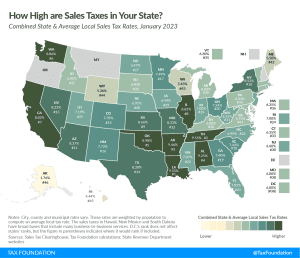
While many factors influence business location and investment decisions, sales taxes are something within policymakers’ control that can have immediate impacts.
11 min read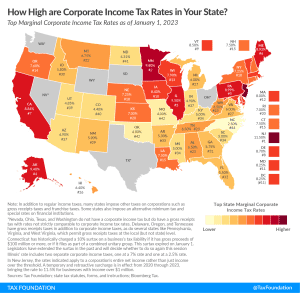
New Jersey levies the highest top statutory corporate tax rate at 11.5 percent, followed by Minnesota (9.8 percent) and Illinois (9.50 percent). Alaska and Pennsylvania levy top statutory corporate tax rates of 9.40 percent and 8.99 percent, respectively.
6 min read
By shifting to a flat income tax, Georgia has already made an important commitment to tax competitiveness. Although the state’s top rate threshold is already very low, a true single-rate income tax will help protect taxpayers from inflation-related tax increases and provide a buffer against rising tax rates in the future. To combine responsible rate reductions with these benefits, Georgia should create tax triggers that empower the state to keep pace with its competition.
3 min read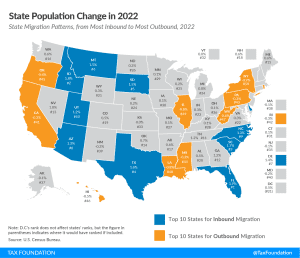
The pandemic has accelerated changes to the way we live and work, making it far easier for people to move—and they have. As states work to maintain their competitive advantage, they should pay attention to where people are moving, and try to understand why.
5 min read
Most of the 2023 state tax changes represent net tax reductions, the result of an unprecedented wave of rate reductions and other tax cuts in the past two years as states respond to burgeoning revenues, greater tax competition in an era of enhanced mobility, and the impact of high inflation on residents.
20 min read
The logic that has prevailed for local sales taxes should apply equally to other taxes that localities impose on multijurisdictional businesses, including local tourism taxes. The evidence is clear that central administration of local taxes reduces compliance costs without sacrificing local revenue.
15 min read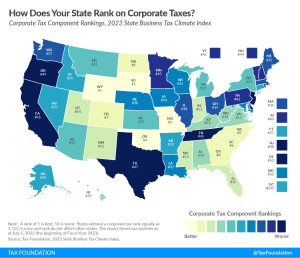
All corporate income taxes fall on capital investment, but the structure should not make matters worse, and policymakers should take care not to distort investment decisions through the use of targeted incentives for select firms or activities instead of a lower rate for all businesses.
2 min read
While there are many ways to show how much is collected in taxes by state governments, our Index is designed to show how well states structure their tax systems by focusing on the how more than the how much in recognition of the fact that there are better and worse ways to raise revenue.
129 min read
From income tax changes to cannabis legalization and taxation, here’s what voters decided on Election Day.
6 min read
When Coloradans go to the polls this November, they will be given the opportunity to permanently lower their income taxes—or to increase those tax burdens.
4 min read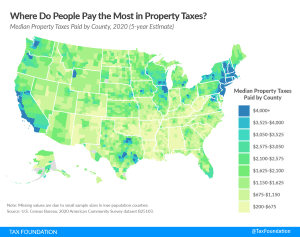
Property taxes are the primary tool for financing local government and generating state-level revenue in some states as well.
5 min read
As Missouri legislators head into a special session, they should consider making a pro-growth change that the state is already so close to achieving: creating a flat income tax.
4 min read