Facts and Figures 2021: How Does Your State Compare?
Our updated 2021 edition of Facts & Figures serves as a one-stop state tax data resource that compares all 50 states on over 40 measures of tax rates, collections, burdens, and more.
1 min read

Janelle Fritts is a Senior Policy Analyst with the Tax Foundation’s Center for State Tax Policy. She is the lead researcher on the annual State Tax Competitiveness Index and serves as a resource to policymakers in their efforts to modernize and improve the structures of their state tax codes. Her work has been cited in The New York Times, the Associated Press, Bloomberg, and numerous state media outlets across the country.
Janelle has been with the Tax Foundation since 2019, with a brief hiatus to teach high school literature, logic, and rhetoric. Before joining the state team, she interned at the Mackinac Center for Public Policy, the Reason Foundation, and the Illinois Policy Institute. She graduated from Dordt University (Sioux Center, Iowa) with a bachelor’s degree in English with a writing emphasis and a minor in Chemistry.
Born and raised in Midland, Michigan, Janelle now lives in Reston, Virginia. In her free time, she enjoys baking, thrifting, and spending time with her husband and infant daughter.
Our updated 2021 edition of Facts & Figures serves as a one-stop state tax data resource that compares all 50 states on over 40 measures of tax rates, collections, burdens, and more.
1 min read
A year ago, it seemed possible that New Hampshire was headed toward a triggered tax increase. Instead, lawmakers may trim business tax rates and begin the phaseout of the state’s tax on interest and dividend income, which would take away the asterisk and make New Hampshire the ninth state to forgo an individual income tax altogether.
4 min read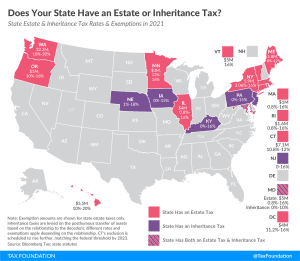
In addition to the federal estate tax, with a top rate of 40 percent, some states levy an additional estate or inheritance tax. Twelve states and Washington, D.C. impose estate taxes and six impose inheritance taxes. Maryland is the only state to impose both. Most states have been moving away from estate or inheritance taxes or have raised their exemption levels, as estate taxes without the federal exemption hurt a state’s competitiveness.
3 min read
Learn more about the recent Alabama tax reform measures (House Bill 170), which combines pandemic-era tax policy responses with broader tax policy reforms.
4 min read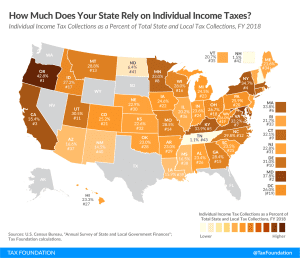
Sources of state revenue have come under closer scrutiny in light of the impact of the coronavirus pandemic, as different tax types have differing volatility and economic impact—although even beyond these unique circumstances, it is important for policymakers to understand the trade-offs associated with different sources of tax revenue.
4 min read
Two states—Florida and Missouri—have held back on online sales taxes thus far following the landmark 2018 Supreme Court case, South Dakota v. Wayfair. Now, lawmakers in both states have filed bills to address the issue this session.
4 min read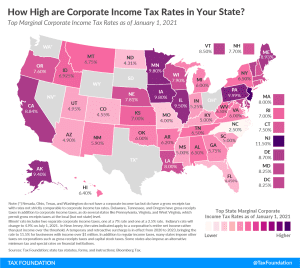
North Carolina’s 2.5 percent corporate tax rate is the lowest in the country, followed by Missouri (4 percent) and North Dakota (4.31 percent). Seven other states impose top rates at or below 5 percent: Florida (4.458 percent), Colorado (4.55 percent), Arizona (4.9 percent), Utah (4.95 percent), and Kentucky, Mississippi, and South Carolina (5 percent).
7 min read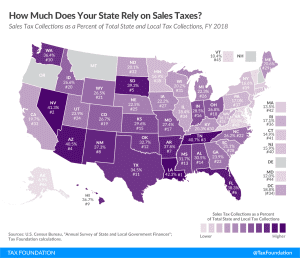
Consumption taxes (like sales taxes) are more economically neutral than taxes on capital and income because they target only current consumption. Consumption taxes are generally more stable than income taxes in economic downturns as well.
3 min read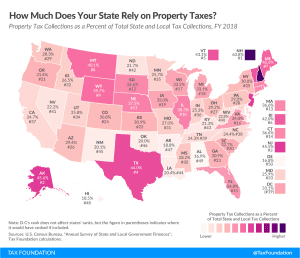
New Hampshire and Alaska rely most heavily on property taxes. Neither have individual income taxes, and in New Hampshire, significant government authority often vested in state government is devolved to the local level, where services are overwhelmingly funded by property taxes.
4 min read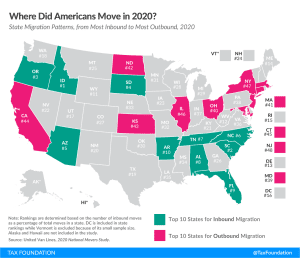
States compete with each other in a variety of ways, including in attracting (and retaining) residents. Sustained periods of inbound migration lead to (and reflect) greater economic output and growth. Prolonged periods of net outbound migration, however, can strain state coffers, contributing to revenue declines as economic activity and tax revenue follow individuals out of state.
4 min read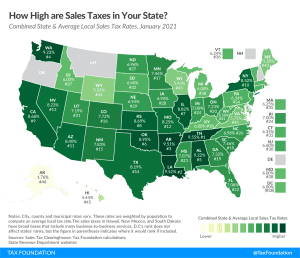
While many factors influence business location and investment decisions, sales taxes are something within lawmakers’ control that can have immediate impacts.
12 min read

Lt. Governor Griffin’s goal to eliminate the income tax is a commendable one that should be considered with cautious optimism, though with the understanding that even a well-designed process may end up putting more weight on an already uncompetitive sales tax. In the meantime, there is plenty of space for incremental improvements in Arkansas’s income tax that will make the state more competitive.
4 min read
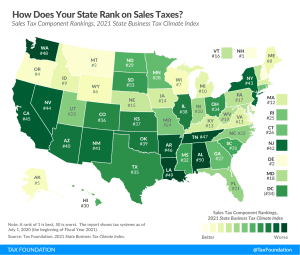
An ideal sales tax applies to a broad base of final consumer goods and services, with few exemptions, and is levied at a low rate. Broad-based, low-rate tax structures minimize tax-induced economic distortions that can occur when people change their purchasing behavior because of tax differences.
3 min read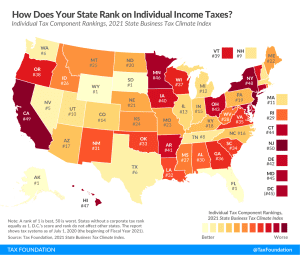

Illinois voters rejected a high graduated rate income tax (“Fair Tax”) while Arizonans embraced a large income tax rate increase for high earners, among the many attention-grabbing results from Tuesday’s elections.
7 min read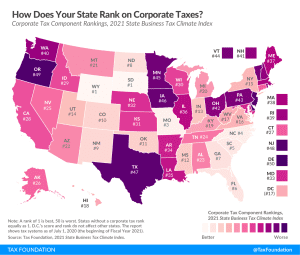
The corporate tax component of our Index measures each state’s principal tax on business activities. Most states levy a corporate income tax on a company’s profits (receipts minus most business expenses, including compensation and the cost of goods sold), while some states levy gross receipts taxes, which allow few or no deductions for a company’s expenses.
2 min read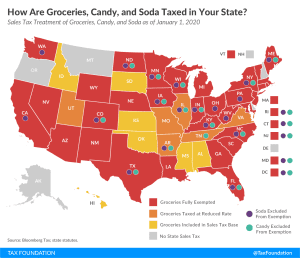
Even in 2020, jack-o’-lanterns and fake skeletons have popped up in neighborhoods as they do every October, although Halloween may look and play out differently this time around.
4 min read