Europe Doesn’t Need New EU Taxes. Policymakers Should Fix the Existing System
Policymakers calling for higher EU spending need to make their case. And if they make it, the path forward should run through well-designed policies.
4 min read

Policymakers calling for higher EU spending need to make their case. And if they make it, the path forward should run through well-designed policies.
4 min read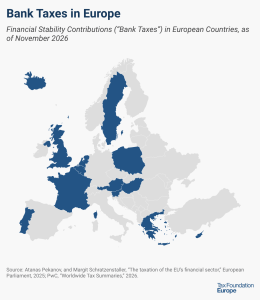
13 European OECD countries have implemented financial stability contributions (FSCs), commonly referred to as “bank taxes.” Explore the 2026 data.
3 min read
Evaluations of digital services taxes in the UK and Belgium show tiny annual revenue collections relative to the total treasury revenue raised by the government. Our dynamic modeling shows digital services taxes reduce both labor and capital supply, lowering investment, GDP, and labor compensation.
15 min read
Tax Foundation Europe’s input to the European Commission’s public consultations on the Tax Omnibus proposal reviews selected issues that have an impact on growth and competitiveness.
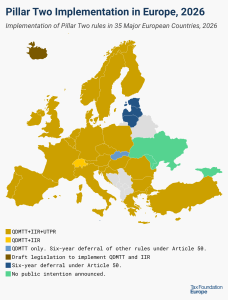
22 of the 27 EU Member States have implemented both the income inclusion rule and the qualified domestic minimum top-up tax in 2026.
4 min read
Under Spain’s current Social Democratic government, the country has fallen from 27th to 35th (out of 38 OECD countries) in the International Tax Competitiveness Index.
8 min read
The 2026 Regional Tax Competitiveness Index for Spain highlights a growing divergence between regions that have embraced tax reform and those whose tax systems have remained largely unchanged.
7 min read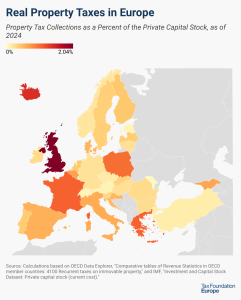
High property taxes levied not only on land but also on buildings and structures can discourage investment in infrastructure, which businesses would have to pay additional tax on.
3 min read
The European Union’s revised Tobacco Excise Directive (TED) is the latest proposal from Brussels that raises questions about the role that the EU plays in relation to the Member States.
7 min read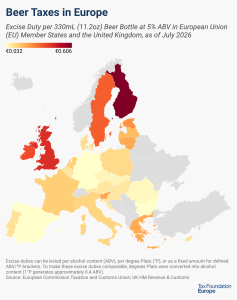
With much of the continent celebrating Oktoberfest, it is a great time to examine beer taxes across Europe. Hefty beer taxes increase the price consumers pay for their libations.
5 min read
While economic levers like sanctions and tariffs have long been recognized as geoeconomic tools, tax policies have rarely been considered a part of this toolkit.
36 min read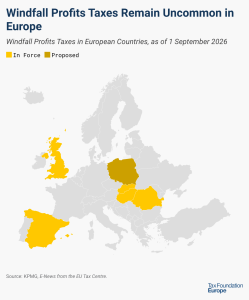
As energy prices have declined, European countries have switched the focus of their windfall profits taxes—a one-time tax levied on a company or industry when economic conditions result in large, unexpected profits—from energy providers to the banking and financial sector.
7 min read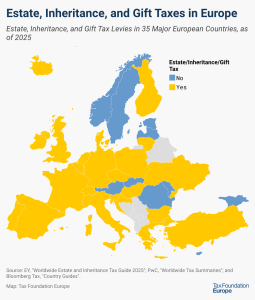
Twenty-four out of the 35 European countries covered in this map currently levy estate, inheritance, or gift taxes.
4 min read
Poland taxes its individual business owners through alternative regimes and a series of thresholds, several of them sharp notches that imply significant tax costs for businesses crossing them.
11 min read
Though they are often framed as affecting only the richest households, the economic effects of wealth taxes extend much further by reducing capital formation, discouraging entrepreneurship, curtailing wage and employment growth, and ultimately weakening the overall economy.
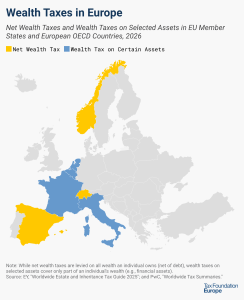
Wealth taxes not only collect little revenue and create legal uncertainty, but an OECD report argues that they can also disincentivize entrepreneurship, harming innovation and long-term growth.
5 min read
The EU Tax Omnibus proposal would create an EU-wide minimum standard for full expensing, but it confines that standard to qualifying tangible assets used in research and development (R&D) rather than to broader asset classes.
16 min read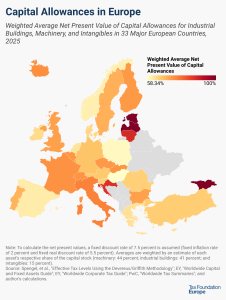
Although sometimes overlooked in discussions about corporate taxation, capital allowances play an important role in a country’s corporate tax base and can impact investment decisions—with far-reaching economic consequences.
6 min read
Retail prices make poor targets for excise tax policy, often reflecting factors that have little to do with the underlying reasons for which an excise tax is levied in the first place. Unfortunately, the World Health Organization (WHO) has a growing preference for using tax share of retail price (tax incidence) as a primary policy target.
6 min read
Because withholding taxes can create double taxation and administrative friction even where foreign tax credits are available, the European Commission’s 2026 Tax Omnibus proposal to eliminate them on dividend, interest, and royalty payments between EU companies regardless of holding percentage would foster stronger cross-border savings and investment.
6 min read