
Illinois Lawmakers Are Attempting to Rush Through a Harmful Tax on Unrealized Gains in 48 Hours
Illinois lawmakers are attempting to rush through a harmful mark-to-market capital gains tax proposal that captures unrealized gains.
7 min readJared Walczak is a Senior Fellow at the Tax Foundation, where he spent five years as Vice President of State Projects, and president of Walczak Policy Consulting.
Jared has written or co-written tax reform guides for more than a dozen states and has served as the principal author of the Tax Foundation’s State Tax Competitiveness Index and Location Matters. He is also a regular on the conference circuit and has testified before legislatures in 35 states. His efforts have been instrumental in securing tax reform in many states, including sweeping reforms in Iowa and Louisiana, along with substantive reforms in Georgia, Idaho, Kentucky, Missouri, North Carolina, Oklahoma, Utah, West Virginia, and Wyoming, among others.
Jared also serves as a member of the faculty of the Institute for Professionals in Taxation, sits on the state tax advisory board of the Institute for State Policy Leaders, and contributes to Tax Notes State magazine. He is the author of the “SALT Road” Substack, a free newsletter on state and local tax policy.
Illinois lawmakers are attempting to rush through a harmful mark-to-market capital gains tax proposal that captures unrealized gains.
7 min read
The past four years have brought significant focus on state income tax reform and relief, and with that, something of a flat tax revolution.
11 min read
With property tax bills on the rise, homeowners are searching for answers—and some even want to abolish the tax altogether. In this episode, we break down why property taxes are increasing, common but flawed solutions, and why the property tax remains an economically efficient revenue source.
Backfilling forgone local property tax revenue through new state taxes is difficult because it dramatically shifts overall tax burdens, undermines local accountability, and cannot easily adjust for changing population mixes.
20 min read
When the Kansas City and Los Angeles squads face off in São Paulo, the players will owe Brazil’s nonresident income tax on the share of income they earned there, while California will lose out on the nonresident income taxes that Chiefs players ordinarily would have remitted in what is nominally a Chargers home game.
5 min read
Congress may have passed the One Big Beautiful Bill Act (OBBBA), but state lawmakers now face big choices. Most states link their tax codes to the federal system, meaning OBBBA’s provisions—good and bad—are about to ripple across state budgets.
For Congress, work on the One Big Beautiful Bill Act is done. But in state capitols, the work has not yet begun. Many of the tax changes in the federal reconciliation act flow through to state tax codes—automatically in some states, and subject to an update in states’ Internal Revenue Code conformity date in others.
39 min read
However states choose to respond to other tax provisions of the One Big Beautiful Bill Act, they should conform to the pro-growth provisions, which represent a marked improvement in the corporate tax code.
12 min read
The One Big Beautiful Bill’s changes to the taxation of international income have surprising implications for state codes, yielding tax increases and a revised tax base that, through quirks of state incorporation, bears very little resemblance to the federal base and almost nothing of its purpose.
10 min read
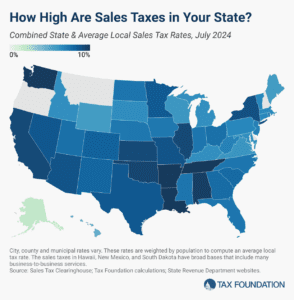
The five states with the highest average combined state and local sales tax rates are Louisiana (10.11 percent), Tennessee (9.61 percent), Arkansas (9.48 percent), Washington (9.47 percent), and Alabama (9.44 percent).
10 min read
The Senate’s version of the OBBB restores the benefit of avoiding the SALT deduction cap with PTETs for all pass-through businesses, while placing new limits on the extent of the workarounds.
6 min read
President’s Trump’s policies would throw high-tax states a life raft as they swim against the tide—before potentially hitting all states with a tariff-induced economic tsunami that could force lawmakers’ hands and reverse recent tax relief.
For owners of pass-through businesses, the reconciliation package (1) raises the state and local tax (SALT) deduction cap, (2) denies the benefit of pass-through entity-level taxes that had previously worked around the SALT cap for such pass-through businesses, and (3) increases the Section 199A deduction for qualifying pass-through entities.
4 min read
As the US House hashes out its “One, Big, Beautiful Bill,” statehouse lawmakers are watching closely, given the impact of both its tax and spending provisions on state budgets.
12 min read
As home values have spiked, Florida and other states are weighing elimination of property taxes.
In Washington, Gov. Ferguson (D) will soon have to act on legislation enacting a far more sweeping tax on Washington-based businesses than lawmakers imagined.
7 min read
The Institute for Policy Studies (IPS) only succeeds in demonstrating that America has more millionaires than it used to, not that high-tax states are doing well in attracting or retaining them.
7 min read
The proposed changes to federal tax code conformity in Oregon are a good example of a change that could significantly reshape the state’s tax code in the future, despite being framed as temporary technical adjustments.
4 min read
With a wealth tax, property tax increases, and this new payroll tax on the agenda, Washington lawmakers have reason to fear that many employers could be looking for the exits.
5 min read
Maryland’s proposed budget has garnered headlines for many reasons, but another momentous change is flying under the radar: backdoor adoption of potentially mandatory worldwide combined reporting.
6 min read