
Testimony: Convenience Rules and Remote Work in Arkansas
Remote work is here to stay. Convenience rules can’t change that. What they can change is the decisions people make. Under this rule, those decisions may not be to Arkansas’s advantage.
Jared Walczak is a Senior Fellow at the Tax Foundation, where he spent five years as Vice President of State Projects, and president of Walczak Policy Consulting.
Jared has written or co-written tax reform guides for more than a dozen states and has served as the principal author of the Tax Foundation’s State Tax Competitiveness Index and Location Matters. He is also a regular on the conference circuit and has testified before legislatures in 35 states. His efforts have been instrumental in securing tax reform in many states, including sweeping reforms in Iowa and Louisiana, along with substantive reforms in Georgia, Idaho, Kentucky, Missouri, North Carolina, Oklahoma, Utah, West Virginia, and Wyoming, among others.
Jared also serves as a member of the faculty of the Institute for Professionals in Taxation, sits on the state tax advisory board of the Institute for State Policy Leaders, and contributes to Tax Notes State magazine. He is the author of the “SALT Road” Substack, a free newsletter on state and local tax policy.
Remote work is here to stay. Convenience rules can’t change that. What they can change is the decisions people make. Under this rule, those decisions may not be to Arkansas’s advantage.
Newly implemented county and regional taxes yield state and local top marginal tax rates in excess of 26 percent for many Portland small businesses, and if all of President Biden’s tax proposals were adopted, those owners could face all-in marginal rates of more than 80 percent, far and away the highest in the country going back decades.
5 min read
Raising rates on those with the most flexibility to leave—or never to return—risks turning those fears into a self-fulfilling prophesy.
3 min read
Tax cut legislation is not just a red state phenomenon, and tax reductions come in many forms other than rate reductions. The American Rescue Plan Act’s state tax cuts limitation is a problem for more states than you think.
2 min read
The government of Hartford County, Connecticut is in line to receive $173 million in local aid under the American Rescue Plan Act (ARPA). There’s only one problem: the government of Hartford County doesn’t exist, nor do any of Connecticut’s other counties have county-level government despite being allocated a collective $691 million under the bill.
4 min read
States which forgo income taxes have seen population and economic growth vastly outstripping their peers, and a post-pandemic culture that is friendlier to remote work will greatly enhance tax competition.
71 min read
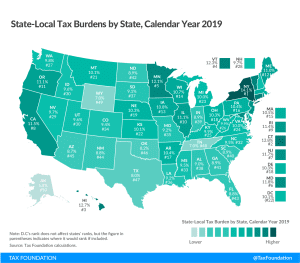
New Yorkers faced the highest burden, with 14.1 percent of income in the state going to state and local taxes. Connecticut (12.8 percent) and Hawaii (12.7 percent) followed.
19 min read
The American Rescue Plan Act’s restriction on states’ Fiscal Recovery Funds being used to directly or indirectly offset a net tax cut is vague and raises difficult questions of interpretation and application. A broad interpretation of this prohibition may be unconstitutional.
19 min read
Senate amendments to the American Rescue Plan Act prohibit using any of the $350 billion in State and Local Fiscal Recovery Funds to cut taxes, but many are concerned that states which accept the funds could be prohibited from implementing tax cuts between now and 2024—an astonishing level of federal interference in states’ fiscal affairs.
8 min read
Here’s each state’s estimated revenue gains or losses in 2020, alongside the state and local aid that would be allocated to each under the American Rescue Plan Act.
8 min read
Mississippi has an opportunity to become the 10th state without an individual income tax and to do so with sales tax rates which, while certainly high, are in line with regional competitors. For such a momentous undertaking, however, policymakers should be equipped with reliable revenue projections and a detailed accounting of how much revenue is projected to come from each offsetting change. A change worth doing is worth doing right.
15 min read
Under the budget introduced by Gov. Tom Wolf, Pennsylvania’s flat personal income tax rate would increase by 46 percent, partially offset by an outsized increase in the poverty credit, which would see a family of four eligible for partial relief due to poverty until they reached $100,000 in taxable income—four times the poverty line.
6 min read
Approximately $78 billion might be owed in federal and state income taxes on the unemployment compensation payments made since the pandemic began.
3 min read
The Tax Foundation’s “State Tax Policy Boot Camp,” is ideal for anyone interested in gaining a better understanding of state taxation.
2 min read
In addition to its economic impact on Maryland businesses and the likelihood of serious legal challenges, Maryland’s proposed digital advertising tax is incredibly vague on vital definitions, creating uncertainty about where revenue is sourced and when it is subject to the tax.
17 min read
By failing to keep pace with modern consumption patterns, sales taxes have become less neutral, less equitable, and less economically efficient over time.
16 min read
Improving trust fund solvency and staving off costly business tax increases is a win-win proposition for federal and state governments alike.
4 min read
Whether you see the GameStop saga as a Robin Hood-style victory for the little guys or as a case of disruptive investor hysteria, it provides an interesting case study in just how badly the mark-to-market treatment of capital gains income could go awry.
6 min read
What happens if you create a tax and its base is, for all intents and purposes, four people? If some Washington lawmakers had their way, we might find out.
5 min read
The $900 billion coronavirus relief package provides nearly $82 billion for the Education Stabilization Fund, $14 billion for mass transit, and $10 billion for state highways,
3 min read