
As Inflation Rises, So Will Tax Bills in Many States
Inflation is often called a hidden tax, but in many states it yields a far more literal tax increase as tax brackets fail to adjust for changes in consumer purchasing power.
5 min readJared Walczak is a Senior Fellow at the Tax Foundation, where he spent five years as Vice President of State Projects, and president of Walczak Policy Consulting.
Jared has written or co-written tax reform guides for more than a dozen states and has served as the principal author of the Tax Foundation’s State Tax Competitiveness Index and Location Matters. He is also a regular on the conference circuit and has testified before legislatures in 35 states. His efforts have been instrumental in securing tax reform in many states, including sweeping reforms in Iowa and Louisiana, along with substantive reforms in Georgia, Idaho, Kentucky, Missouri, North Carolina, Oklahoma, Utah, West Virginia, and Wyoming, among others.
Jared also serves as a member of the faculty of the Institute for Professionals in Taxation, sits on the state tax advisory board of the Institute for State Policy Leaders, and contributes to Tax Notes State magazine. He is the author of the “SALT Road” Substack, a free newsletter on state and local tax policy.
Inflation is often called a hidden tax, but in many states it yields a far more literal tax increase as tax brackets fail to adjust for changes in consumer purchasing power.
5 min read
Kentucky and Tennessee won an important legal victory Friday when a federal court ruled that the American Rescue Plan Act (ARPA)’s restrictions on state fiscal autonomy were unconstitutional and enjoined (blocked) the enforcement of those provisions against both states.
7 min read
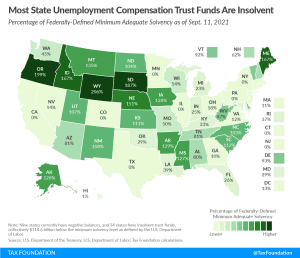
Given the restrictions on the use of federal relief funding, and the significantly higher tax burdens on employment that will result if trust funds are not replenished, applying federal aid to these trust funds should be an urgent priority.
11 min read
Whether spurred by a belief that government is improperly favoring religious institutions, an antipathy to wealthy celebrity pastors, or a hope that taxing houses of worship could bring down personal tax bills, the taxation of religious bodies is hotly debated online, but barely on the radar of actual elected officials. But is that true? How much, if any, tax revenue is forgone, and what do the policies look like?
7 min read
Earlier this year, Maryland legislators overrode Governor Larry Hogan’s (R) veto of HB732, approving a digital advertising tax, the first of its kind in the country. But legislators punted several crucial questions to the state comptroller, who last week submitted proposed regulations for the digital advertising tax to the state Joint Committee on Administrative, Executive, and Legislative Review.
9 min read
Neither Anchorage, Alaska, nor Portland, Oregon, impose any state or local sales taxes. Honolulu, Hawaii, has a low rate of 4.5 percent and several other major cities, including Milwaukee and Madison, Wisconsin, keep overall rates modest.
13 min read
Even as lawmakers in eleven states have cut income taxes this year, the D.C. Council has responded to surpluses and growth by voting to include substantial income tax increases in the budget.
7 min read
As states close their books for fiscal year 2021, many have much more revenue on hand than they anticipated last year. Eleven states have responded by reducing income tax rates and making related structural reforms as they strive to solidify a competitive advantage in an increasingly competitive national landscape.
29 min read
Tax reform has paid off for the Tar Heel State. North Carolina features one of the nation’s most competitive tax environments for businesses across the industry spectrum, and the state currently boasts the nation’s third-best effective tax rates for newly established firms and fifth-best rates for mature firms, according to a new analysis conducted by the Tax Foundation and KPMG LLP.
7 min read
The Tax Foundation recently submitted regulatory comment on the U.S. Treasury’s state tax cuts limitation rule, highlighting three areas of concern and suggesting revisions to the rule.
Montana adopted structural reforms to both individual and corporate income taxes during the recently adjourned legislative session, enacting three bills reducing individual tax rates, simplifying the state’s individual tax system, repealing 16 tax credits, and changing the apportionment factor for corporate income tax.
5 min read
Today, the U.S. Treasury issued an interim final rule on the $350 billion in State and Local Fiscal Recovery Funds provided under the American Rescue Plan Act (ARPA). The proposed rule resolves several important questions but continues to involve the federal government in state finances at an extraordinary level.
7 min read
Digital advertising, social media, and data tax proposals have been introduced in nine states following enactment of Maryland’s digital advertising tax, which has since been postponed a year due to administrative and legal challenges.
14 min read
Location Matters is an account of tax complexity and the ways that tax structure affect competitiveness. For policymakers, it represents an opportunity to explore the seemingly more arcane tax provisions that can have a significant impact on business tax burdens, and to discover how their tax code—often completely by accident—picks winners and losers.
4 min read
A landmark comparison of corporate tax costs in all 50 states, Location Matters provides a comprehensive calculation of real-world tax burdens, going beyond headline rates to demonstrate how tax codes impact businesses and offering policymakers a road map to improvement.
8 min read
State and local tax policy have always mattered, but the rise of remote work is bringing tax burdens and economic competitiveness to the forefront. It is a development that states cannot afford to ignore.
5 min read
Remote work is here to stay. Convenience rules can’t change that. What they can change is the decisions people make. Under this rule, those decisions may not be to Arkansas’s advantage.
Newly implemented county and regional taxes yield state and local top marginal tax rates in excess of 26 percent for many Portland small businesses, and if all of President Biden’s tax proposals were adopted, those owners could face all-in marginal rates of more than 80 percent, far and away the highest in the country going back decades.
5 min read
Raising rates on those with the most flexibility to leave—or never to return—risks turning those fears into a self-fulfilling prophesy.
3 min read