Corporate Income Tax Rates in Europe, 2026
Some European countries have raised their statutory corporate rates over the past year, including Estonia, Lithuania, and Slovakia.
4 min read

Cristina Enache writes on the economics of tax policy and is the author of the Spanish Regional Tax Competitiveness Index. She was formerly the Director of Research at Civismo, an economic research organization based in Spain. She also served as head of research at Institución Futuro, a regional think tank based in Navarra in northern Spain. She is also currently Secretary-General at the World Taxpayers Associations and General Manager of the Spanish Taxpayers Union, which she joined in 2016.
Cristina has a degree in economics from the Academy of Economic Studies in Bucharest and a master’s degree in Economics and Finance from the University of Navarra.

Some European countries have raised their statutory corporate rates over the past year, including Estonia, Lithuania, and Slovakia.
4 min read
Scandinavian countries are well known for their broad social safety nets and their public funding of services such as universal health care, higher education, parental leave, and child and elderly care. High levels of government spending naturally require high levels of taxation. So, how do these countries raise their tax revenues?
7 min read
As European countries have undertaken a series of tax reforms designed for budgetary stability, policymakers should focus on consumption taxes by making them more neutral and efficient.
15 min read
The worldwide average statutory corporate tax rate has consistently decreased since 1980 but has leveled off in recent years. In the US, the 2017 Tax Cuts and Jobs Act brought the country’s statutory corporate income tax rate from the fourth highest in the world closer to the middle of the distribution.
20 min read
The recently proposed UK budget contains several tax measures that put a greater burden on the working class and ultimately fails to tackle the deeper structural problems of the UK’s tax code.
6 min read
Switzerland’s proposed 50 percent billionaire estate tax promises negligible revenue, risks economic harm, and strips cantons of their autonomy and tax competition.
5 min read
In most European OECD countries, corporate income is taxed twice, once at the entity level and once at the shareholder level.
4 min read
Spain’s central government could learn some valuable lessons from its regional governments and other European countries about sound tax policy.
7 min read
France is proposing to double the tax rate of its digital services tax (DST) to 6 percent, making the DST even more discriminatory.
5 min read
The 2025 Spanish Regional Tax Competitiveness Index allows policymakers and taxpayers to evaluate and measure how their regions’ tax systems compare.
7 min read
Since digital services taxes deliver limited revenue, shift the burden to European consumers, and risk provoking trade disputes, it’s time for policymakers to rethink their approach.

Canada has the power to shape its own competitiveness by making itself an attractive destination for investment this 2025 budget season.

The ongoing economic uncertainty from Russia’s war in Ukraine, economic recovery, supply chain disruptions, and rising interest rates have highlighted the importance of business investment.
30 min read
Different taxes have different economic effects, so policymakers should always consider how tax revenue is raised and not just how much is raised.
4 min read
Developed countries raise tax revenue through individual income taxes, corporate income taxes, social insurance taxes, taxes on goods and services, and property taxes—the combination of which determines how distortionary or neutral a tax system is.
4 min read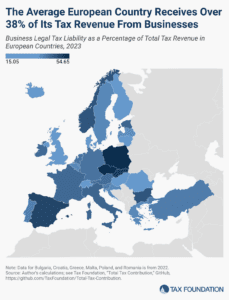
Without businesses as their taxpayers and tax collectors, governments would not have the resources to provide even the most basic services.
5 min read
On average, businesses in the OECD are liable for collecting, paying, and remitting more than 85 percent of the total tax collection.
15 min read
Policymakers should aim for neutral tax policies that support stable revenues like VATs and avoid inviting trade conflicts with discriminatory and economically harmful policies like DSTs.
6 min read
In a recent survey regarding companies’ barriers to conducting business in the EU single market, VAT ranked first. Policymakers should invest in reforming VAT systems to close both compliance and policy gaps in ways that improve the overall efficiency of their tax systems.
7 min read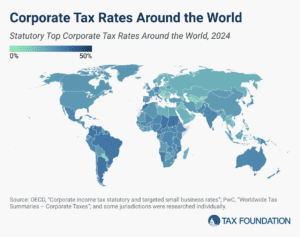
The worldwide average statutory corporate tax rate has consistently decreased since 1980 but has leveled off in recent years. In the US, the 2017 Tax Cuts and Jobs Act brought the country’s statutory corporate income tax rate from the fourth highest in the world closer to the middle of the distribution.
18 min read