

All Related Articles

Amazon Passes France’s Digital Services Tax on to Vendors
France’s new 3 percent digital tax may be targeted at Amazon and other large digital firms, but Amazon’s French vendors will bear the burden of the tax.
3 min read
The Good and Bad about Tax Havens
3 min read

How Controlled Foreign Corporation Rules Look Around the World: United Kingdom
The UK rules are designed to arrive at the most accurate definition of foreign income that should be taxed in the home country. These rules apply one of the most detailed approaches to solving the issue of taxing the right type and amount of foreign income. The method can be considered more effective, but the compliance implications and derived costs may be higher compared to those that are derived from the application of other methods.
7 min read
The Impacts of Tightening up on Transfer Pricing
As with other anti-base erosion policies, transfer pricing regulations reveal the challenges of designing rules that address problems associated with various strategies businesses use to minimize their tax burdens. While countries may want to target specific abuses, the way the rules are designed can have real economic impacts on cross-border investment.
6 min read
Five Things to Know about the Pending Tax Treaties in the Senate
The tax treaties pending before the Senate present an opportunity to make the U.S. a more attractive place for companies from our treaty partner countries to invest and hire.
7 min read
How Controlled Foreign Corporation Rules Look Around the World: Netherlands
The Dutch tax system is characterized by its simplicity and the attractiveness to investors. With the incorporation of CFC rules, the Dutch government protected its tax base from erosion and profit shifting. The Netherlands is facing a whole series of adjustments that would create a more complex system adapted to the international standards recommended by the OECD and adopted by the European Union Council. When revising the rules authorities must be mindful about not making the system more complex and to avoid increasing the compliance burden in the country.
5 min read
How Controlled Foreign Corporation Rules Look Around the World: Japan
Japan is a country with a complex multilayer system to calculate the corporate income tax. As a consequence, the CFC income determination has evolved as a complex set of rules to complement the corporate income tax. It would be a great idea for the Japanese authorities to address a simplification of the rules to facilitate the entry of new capital investments into their economy.
7 min read
The Economics Behind Thin-Cap Rules
6 min read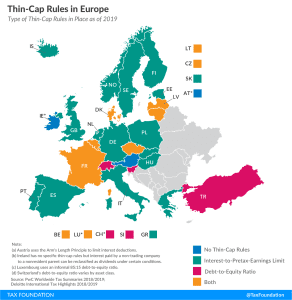
Thin-Cap Rules in Europe
2 min read

How Controlled Foreign Corporation Rules Look Around the World: United States of America
The United States was the first country to enact CFC rules, and it is probably the country with the most complex set of rules that will be presented in this blog series. The rules determine control using a combined ownership test: one for the corporation and the other at the shareholder level. The assessable income under the rules is generally passive income but the amount of foreign income subject to U.S. tax has expanded with the adoption of GILTI.
10 min read
Summary and Analysis of the OECD’s Work Program for BEPS 2.0
From a broad standpoint, agreement at the OECD will require countries to give up some measure of their own tax sovereignty on policies they have designed to minimize the distortionary effects of the corporate income tax. Over the years tax competition has led to some countries adopting policies that are attractive to businesses because they have a more neutral rather than distortionary approach to taxing corporate income. This project could directly undermine that progress by introducing new levels of complexity and distortion that would ultimately have a negative impact on global trade and growth.
34 min read
CFC Rules Around the World
Our paper undertakes a review of controlled foreign corporation (CFC) rules around the world as a contribution to the global discussion over the possible expansion of existing anti-base erosion CFC regimes or the potential adoption of a minimum tax.
3 min read
Ripple Effects from Controlled Foreign Corporation Rules
Governments should recognize these trade-offs as they implement controlled foreign corporation (CFC) rules or change their tax policies in ways that increase taxes on foreign subsidiaries.
7 min read
Putting the Pieces Together on BEPS
Taxes matter for decisions to be made by businesses, individuals, and families, and it is important for policymakers to understand that rules can be designed to be neutral rather than distortionary.
6 min read
Anti-Base Erosion Provisions and Territorial Tax Systems in OECD Countries
The U.S. decision to adopt a territorial tax system is certainly an improvement over having a worldwide system. However, in moving to a territorial system some of the new features created with the TCJA increased the complexity of the system.
38 min read

Tax Foundation Response to OECD Public Consultation Document: Addressing the Tax Challenges of the Digitalization of the Economy
Though the challenges to international tax policy are many, the OECD has a chance to work toward a system that creates fewer distortions and negative economic effects than the current one. However, given the policies on the table, it will certainly take quite an effort to avoid further complexity of international tax rules that creates challenges to global trade and economic prosperity.